Artificial intelligence tools have transcended their niche origins to become indispensable components of daily professional workflows across virtually every sector. From writers leveraging sophisticated language models for research and content generation to developers utilizing AI for code synthesis and debugging, and marketers employing intelligent systems for campaign optimization and visual asset creation, AI’s pervasiveness is undeniable. Businesses, too, are increasingly adopting AI to streamline operations, automate repetitive tasks, and unlock new efficiencies. However, this rapid proliferation of AI solutions has inadvertently created a new challenge: the fragmentation of the AI tool landscape. Users frequently find themselves managing a multitude of subscriptions—one platform for OpenAI models, another dedicated to Anthropic’s Claude, a third specializing in image generation, and yet others for bespoke AI agents or analytics. This fragmented ecosystem often leads to increased costs, workflow inefficiencies, and a steep learning curve as users navigate disparate interfaces and capabilities.
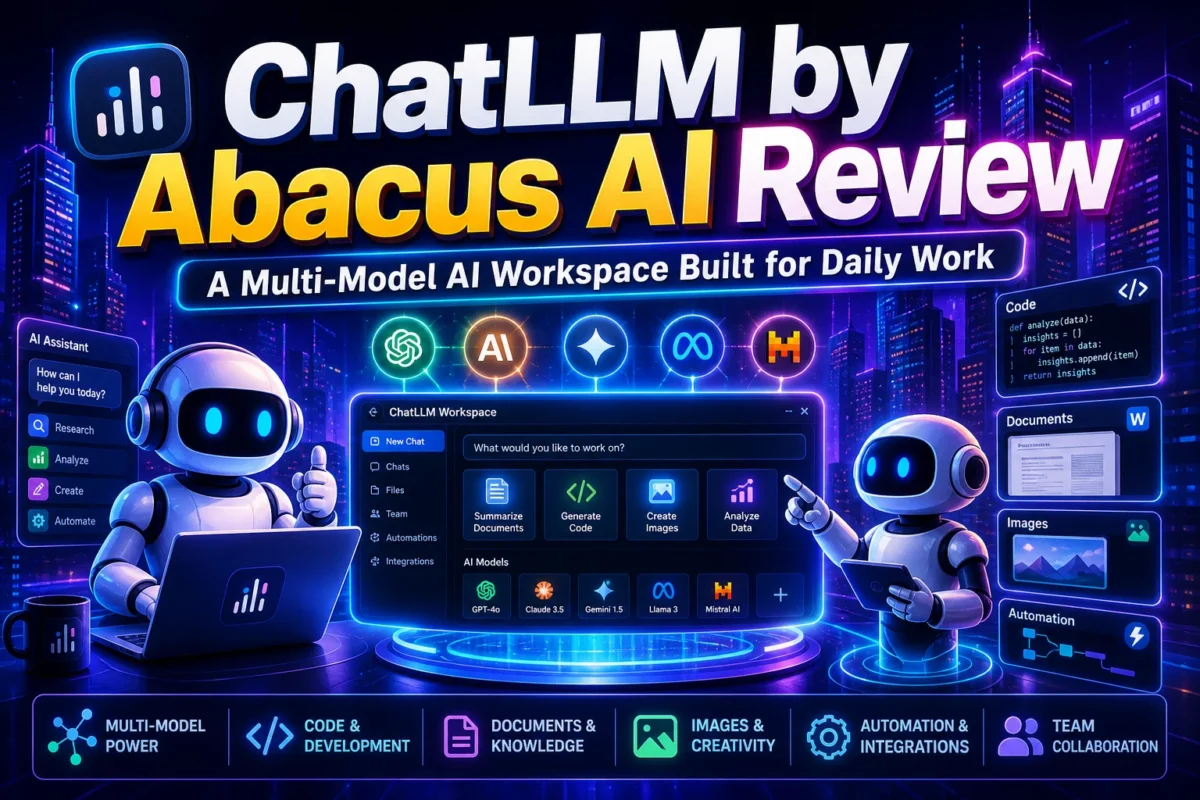
This is the precise problem ChatLLM by Abacus AI seeks to address, taking a fundamentally different approach to AI accessibility and utility. Instead of offering access to a singular AI model, ChatLLM consolidates a vast array of the world’s leading AI models under a unified subscription. The platform integrates a comprehensive suite of tools, including advanced chat assistants, autonomous AI agents, robust coding environments, sophisticated image and video generation capabilities, in-depth document and data analysis, workflow automation, and collaborative features, all within a single, cohesive workspace. This review delves into ChatLLM’s extensive offerings, its operational mechanics, key strengths, potential limitations, pricing structure, and its strategic positioning as a compelling AI solution for 2026 and beyond.
What is ChatLLM? Abacus AI’s Vision for a Consolidated AI Future
ChatLLM is an innovative AI workspace developed by Abacus AI, a company with a strong pedigree in enterprise-grade AI solutions and machine learning platforms. At its core, ChatLLM provides unparalleled access to a diverse portfolio of large language models (LLMs) and other AI capabilities from a single, intuitive interface. The platform eliminates the need for users to choose between competing LLMs such as OpenAI’s ChatGPT, Anthropic’s Claude, Google’s Gemini, xAI’s Grok, or open-source contenders like DeepSeek and Qwen; instead, all are accessible within a unified environment.
Beyond merely aggregating LLMs, ChatLLM significantly expands its utility by incorporating a wide range of advanced AI functionalities. These include the deployment of sophisticated AI agents capable of executing complex multi-step tasks, tools for in-depth document and data analysis, integrated coding environments, cutting-edge image and video generation features, robust workflow automation tools, and comprehensive team collaboration capabilities. In essence, ChatLLM is engineered to serve as the definitive single destination for the vast majority of AI-related work, aiming to reduce operational overhead, enhance productivity, and democratize access to advanced AI technologies for a broad user base.
The Evolution of AI and the Need for Consolidation: A Market Context
The journey of AI from academic curiosity to mainstream utility has been marked by distinct phases. Early AI tools often focused on narrow applications, followed by the explosion of large language models in the early 2020s, which demonstrated unprecedented general-purpose capabilities. This led to a Cambrian explosion of specialized AI services, each excelling in a particular domain—be it text generation, code completion, image synthesis, or data interpretation. While this specialization brought powerful tools to market, it also introduced significant friction for users and organizations.
Industry analysts project that the average professional using AI tools will subscribe to at least three to five different platforms by 2025, leading to what market observers term "AI subscription fatigue." This phenomenon is characterized by:
- Increased Costs: Managing multiple monthly or annual subscriptions quickly escalates operational expenses.
- Workflow Disruption: Constantly switching between applications breaks concentration and adds cognitive load.
- Data Silos: Information generated or processed in one AI tool often doesn’t seamlessly integrate with another, creating data inconsistencies.
- Learning Curves: Each platform comes with its own interface, command structure, and nuances, requiring users to invest time in mastering multiple systems.
Abacus AI, with its background in building scalable AI infrastructure for enterprises, recognized this growing pain point. The development of ChatLLM can be seen as a strategic response to this market fragmentation, offering a consolidated ecosystem that not only brings leading models together but also layers on advanced features crucial for real-world productivity. This positions ChatLLM not just as a tool, but as a platform designed to future-proof AI adoption for individuals and organizations alike, especially as the AI landscape continues to evolve rapidly.
Navigating ChatLLM: A Beginner’s Guide to the Multi-Model Workspace
For new users, ChatLLM maintains a familiar user experience akin to standard AI chatbots, minimizing the learning curve while unlocking advanced capabilities. The core interaction begins with a single dashboard, from which users can initiate conversations, upload files, or select specific AI tools. For instance, a user might:
- Start a new chat: Simply type a prompt, and ChatLLM, powered by its intelligent RouteLLM system (discussed further below), automatically selects the most appropriate model for the task, or allows manual selection.
- Upload a document: Drag and drop a PDF or spreadsheet, then prompt the AI to summarize, analyze, or extract specific information.
- Generate an image: Input a textual description, and the platform utilizes its integrated image generation models to produce visuals.
- Write and execute code: Access the integrated Code Playground to generate, test, and refine programming scripts.
The critical distinction is that all these diverse functionalities are executed within the same environment, eliminating the need for separate logins or data transfers between applications. This seamless workflow is underpinned by Abacus AI’s robust infrastructure, designed to handle multi-modal inputs and outputs efficiently. The underlying mental model for beginners is straightforward: think of ChatLLM as a universal remote control for the vast, diverse world of AI, where every function is accessible without changing channels or devices.
The Power of Diversity: Which AI Models are Accessible via ChatLLM?
One of ChatLLM’s most compelling attributes is its commitment to model diversity and currency. The platform’s model library is dynamically updated, ensuring that newly released and cutting-edge models are integrated shortly after their public launch. This agility allows users to always leverage the best available AI for any given task, without being locked into a single vendor’s ecosystem.
Currently, ChatLLM provides access to an impressive array of leading AI models, including but not limited to:
OpenAI Models
- GPT-4 Turbo: Known for its advanced reasoning and extensive context window.
- GPT-4o: OpenAI’s latest flagship model, offering enhanced multimodal capabilities and speed.
- GPT-3.5 Turbo: A cost-effective and highly capable model for general text tasks.
Anthropic Models
- Claude 3 Opus: Anthropic’s most intelligent model, excelling in complex reasoning and long-context understanding.
- Claude 3 Sonnet: A balance of intelligence and speed, suitable for a wide range of enterprise tasks.
- Claude 3 Haiku: Optimized for speed and cost-efficiency, ideal for quick interactions.
Google Models
- Gemini 1.5 Pro: Google’s powerful multimodal model with a massive context window.
- Gemini 1.0 Ultra: Google’s highest-performing model for highly complex tasks.
xAI Models
- Grok: xAI’s conversational AI, often characterized by its unique personality and real-time knowledge access.
Additional Models
- DeepSeek-V2: A highly performant open-source model, particularly strong in coding and reasoning.
- Qwen 2: Developed by Alibaba Cloud, known for its strong multilingual capabilities.
- Llama 3 (Meta): Meta’s latest open-source offering, gaining traction for its versatility.
- Mixtral 8x22B (Mistral AI): A powerful sparse mixture-of-experts model, offering high performance at competitive efficiency.
- Stable Diffusion 3.0 (Stability AI): A leading model for advanced image generation.
This extensive selection is not merely a list; it represents a strategic advantage. Different AI systems, much like different specialized tools, excel at different tasks. For instance, some models might be superior for creative writing, while others are optimized for code generation, scientific reasoning, or factual recall. ChatLLM’s aggregated access empowers users to dynamically choose or have the system intelligently select the optimal model, ensuring superior results and efficiency. This approach also mitigates the risk of "vendor lock-in" and allows users to benefit from competitive innovation across the entire AI industry.
A Deep Dive into ChatLLM’s Comprehensive Feature Set
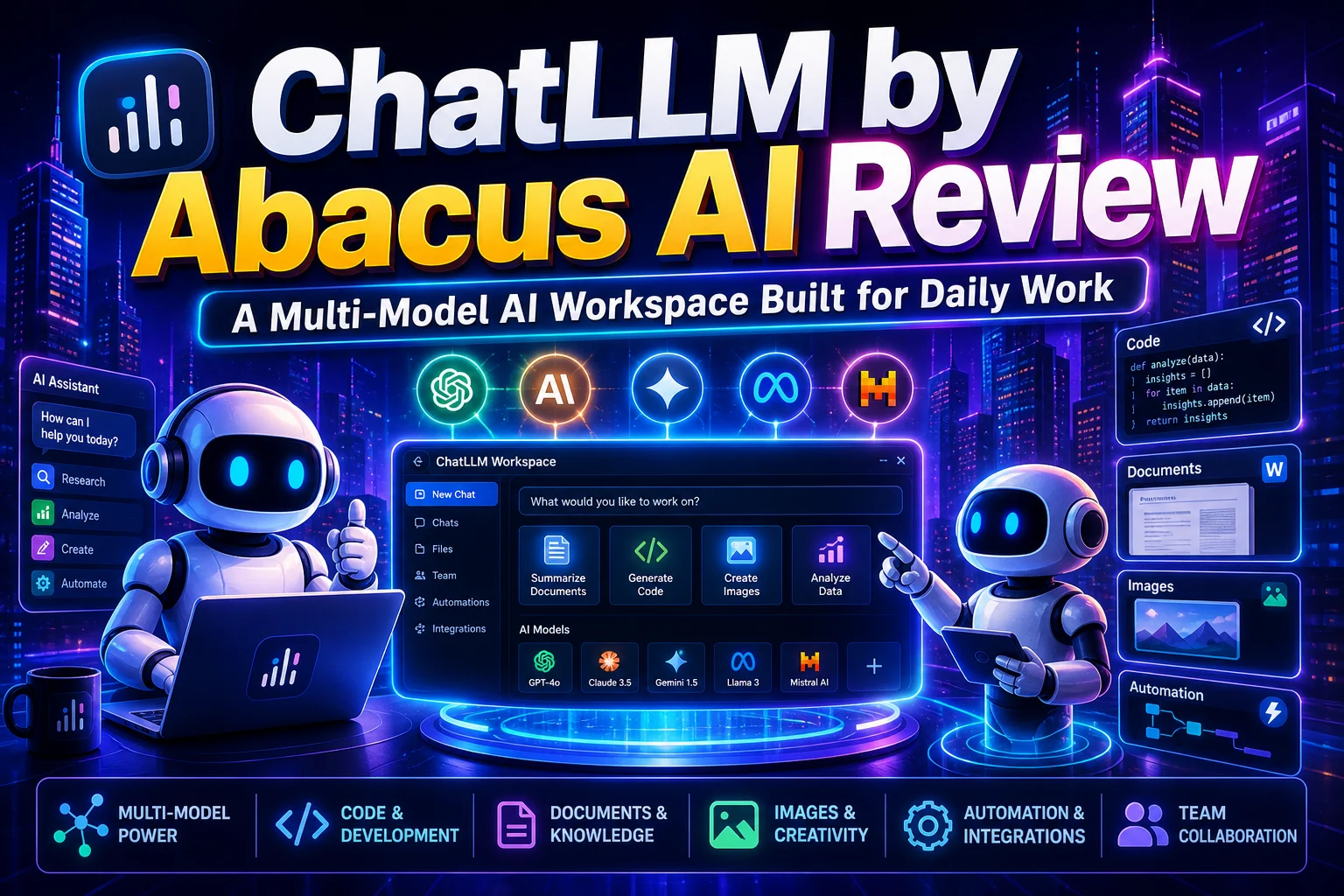
ChatLLM transcends the definition of a mere chatbot by integrating a vast array of AI capabilities into a singular, cohesive platform, making it a true all-in-one workspace.
1. Multi-Model AI Chat
The core of ChatLLM’s offering, this feature allows seamless interaction with dozens of leading AI models without the overhead of managing individual subscriptions. Users can initiate natural language conversations, request content generation, summarization, translation, and more, with the flexibility to switch models mid-conversation or rely on intelligent model routing.
2. Document Analysis
ChatLLM empowers users to upload and interact with a wide variety of document types, including PDFs, Microsoft Word documents (.docx), Excel spreadsheets (.xlsx), Google Docs, and various text files. The AI can perform sophisticated operations such as summarizing lengthy reports, extracting key insights, explaining complex concepts, answering specific questions about the content, and even identifying trends or anomalies within the text. This is invaluable for researchers, legal professionals, and business analysts.
3. Data Analysis
Beyond text, users can upload structured data files like CSVs and JSONs. The system can then analyze this data, identify patterns and trends, perform statistical computations, and even generate insightful charts and visualizations to present findings clearly. This capability transforms raw data into actionable intelligence without requiring specialized data science software.
4. Image Generation
Integrating state-of-the-art image generation models such as Stable Diffusion 3.0, DALL-E 3, Midjourney (via integration), and Imagen, ChatLLM allows users to create stunning visuals from textual prompts. This feature is crucial for marketers developing campaign visuals, designers brainstorming product concepts, content creators producing social media graphics, and illustrators seeking inspiration.
5. Video Generation
Expanding its multimodal capabilities, ChatLLM offers video creation through Abacus Studio, utilizing advanced models like Sora (if available via API), Pika Labs, and RunwayML. This groundbreaking feature enables users to generate short video clips from text descriptions or image inputs, pushing the boundaries of AI-driven content creation beyond static media.
6. Web Search Integration
To ensure the AI’s responses are current and factually accurate, the platform integrates real-time web search capabilities. This is particularly useful for research tasks, fact-checking, staying updated on recent events, and gathering contemporary information that might not be present in a model’s training data cutoff.
7. Text Humanization and Style Adaptation
Users can rewrite content in a multitude of styles and tones, including professional, casual, academic, persuasive, or creative. This "text humanization" feature is invaluable for adapting content for different audiences, ensuring brand consistency, and refining communication to achieve specific objectives.
8. Custom Instructions
ChatLLM allows users to define persistent custom instructions. These could include personal preferences, specific company style guides, brand voice requirements, or project-specific parameters that the AI should adhere to across all interactions. This significantly enhances personalization and reduces the need for repetitive prompting.
9. Code Playground
For developers and technical users, the integrated Code Playground is a game-changer. It allows users to generate, test, and execute code snippets directly within the platform. This is highly beneficial for debugging existing code, rapid prototyping of new functionalities, and learning new programming languages through interactive experimentation.
10. AI Engineer
This advanced feature assists users in building more complex AI solutions, such as custom applications, specialized AI agents, or automated workflows, often without requiring extensive coding knowledge. It acts as a guide and facilitator for creating bespoke AI tools.
11. AI Agents
Users can create autonomous AI agents capable of performing recurring tasks and orchestrating multi-step workflows. These agents can, for example, monitor market trends, generate weekly reports, manage email communications, or automate customer support responses, significantly boosting operational efficiency.
12. Enterprise Integrations
ChatLLM supports seamless connections with popular enterprise tools and platforms, including Microsoft 365, Google Workspace, Salesforce, Slack, and various CRM/ERP systems. This allows the AI to interact directly with business data and workflows, enabling deeper automation and intelligent insights within existing organizational ecosystems.
13. Mobile Applications
Recognizing the demand for on-the-go productivity, ChatLLM offers dedicated mobile applications for both Android and iPhone, complete with voice input capabilities. This ensures that users can access the full power of the platform anytime, anywhere, extending the workspace beyond the desktop.
The Distinct Advantages of Choosing ChatLLM
After a thorough examination, several compelling benefits of ChatLLM stand out, making it a formidable contender in the AI landscape:
- Cost Efficiency: By consolidating access to multiple premium AI models and tools under a single subscription, ChatLLM offers substantial cost savings compared to subscribing to each service individually. This is particularly attractive for freelancers and small businesses.
- Enhanced Productivity: The unified workspace eliminates the friction of switching between applications, leading to smoother workflows, reduced context-switching costs, and ultimately, higher productivity.
- Unparalleled Model Diversity: Access to a broad spectrum of leading LLMs and other AI models ensures users can always select the best tool for the specific task at hand, optimizing output quality and efficiency.
- Future-Proofing: As the AI landscape rapidly evolves, ChatLLM’s commitment to regularly integrating new models ensures users remain at the cutting edge of AI technology without needing to constantly re-evaluate and subscribe to new platforms.
- Advanced Capabilities: Beyond chat, the integration of document/data analysis, image/video generation, code execution, and AI agents elevates ChatLLM beyond a simple conversational AI tool, addressing a wider array of professional needs.
- Seamless Collaboration: Features designed for team collaboration allow for shared workspaces, projects, and AI interactions, fostering better teamwork and knowledge sharing within organizations.
- Intelligent Model Routing (RouteLLM): The automated model selection feature significantly reduces cognitive load for users, especially beginners, ensuring optimal model utilization without manual intervention.
Understanding Usage Limits: Credits, Rate Limits, and Fair Usage Policies
A common concern with AI subscriptions revolves around usage limits and potential restrictions. Abacus AI states that ChatLLM offers more generous usage limits compared to many standalone AI platforms. Users can typically send thousands of text-based messages using popular models like GPT-4, Claude 3 Sonnet, and Gemini 1.5 Pro without encountering hard limits during typical usage patterns.
However, ChatLLM does employ a credit-based system for more resource-intensive tasks, reflecting the underlying computational costs. Credits are consumed based on several factors:
- Model Complexity: More advanced and larger models (e.g., Claude 3 Opus, GPT-4o) consume more credits per interaction.
- Input/Output Length: Longer prompts and more extensive AI-generated responses utilize more resources.
- Multimodal Operations: Tasks like image generation, video creation, and detailed document/data analysis are credit-intensive.
- AI Agent Operations: Autonomous agents performing complex, multi-step workflows will consume credits based on the number and complexity of actions taken.
Standard text conversations are designed to be highly efficient, consuming minimal credits. Conversely, users frequently engaging in video generation, large-scale data analysis, or extensive agent-based automation will observe credits being utilized more rapidly. A key feature for continuity is ChatLLM’s ability to automatically switch requests to another available, less credit-intensive model if a user approaches their limit, thereby minimizing interruptions. For the vast majority of freelancers, developers, marketers, and business users, the platform’s limits are engineered to be non-restrictive during everyday professional use, aligning with a "fair usage" policy designed to prevent abuse while accommodating high productivity.
RouteLLM: The Intelligent Core of ChatLLM’s Model Selection
One of ChatLLM’s most ingenious capabilities is RouteLLM, an advanced routing system that intelligently determines the most suitable AI model for any given request. Instead of burdening users with the decision of manually selecting from dozens of available models, RouteLLM automates this process, significantly streamlining workflows and enhancing efficiency.
For example:
- If a user submits a complex programming query or asks for code debugging, RouteLLM might automatically direct the request to coding-specialized models like DeepSeek-V2 or GPT-4, known for their proficiency in software development.
- When a user uploads a large legal document for summarization and analysis, RouteLLM could prioritize models with extensive context windows and strong reasoning capabilities, such as Claude 3 Opus or Gemini 1.5 Pro.
- For creative content generation, like drafting marketing copy or brainstorming story ideas, the system might route the request to models optimized for creativity and linguistic nuance.
This intelligent routing system not only reduces trial and error for experienced users but also removes a significant layer of complexity for beginners, making advanced AI capabilities immediately accessible and effective. RouteLLM continuously learns and adapts, optimizing model selection based on user feedback and task outcomes, ensuring that the platform always leverages the optimal AI resource.
ChatLLM for Developers: A Comprehensive AI Coding Environment
Coding is an area where ChatLLM truly shines, offering a robust and comprehensive environment for developers of all skill levels. Several factors contribute to its strength in this domain:
Access to Specialized Coding Models
Developers gain access to models specifically fine-tuned for software development tasks, including GPT-4, DeepSeek-V2, and Gemini 1.5 Pro. These models are adept at generating code in various languages, identifying and fixing bugs, refactoring code, and explaining complex programming concepts.
Integrated Code Playground
The presence of a direct Code Playground within the platform is a significant advantage. It allows developers to test generated code snippets, experiment with different solutions, and instantly see the output, fostering a highly interactive and efficient development cycle. This reduces the need to switch to external IDEs for quick tests.
AI Desktop Integration (Abacus AI Desktop)
The included Abacus AI Desktop environment further augments coding capabilities by providing a dedicated AI-powered desktop assistant for developers. This can include features like real-time code suggestions, project management integration, and more.
AI Agents for Automation
Developers can leverage ChatLLM’s AI agent feature to automate repetitive development workflows. This could involve setting up agents to monitor code repositories, generate boilerplate code, perform automated testing, or even assist with deployment processes, freeing up developers to focus on more complex problem-solving.
For hobbyists learning to code, students working on projects, or professional developers seeking to accelerate their workflows, ChatLLM offers a remarkably comprehensive and integrated AI coding environment.
ChatLLM vs. ChatGPT: A Comparative Analysis
The question of whether ChatLLM is "better" than ChatGPT is nuanced and depends heavily on individual or organizational needs. Both platforms are powerful, but they serve slightly different strategic purposes.
ChatGPT May Be Better For:
- Users solely focused on OpenAI’s ecosystem: If a user’s workflow is exclusively built around OpenAI models and they have no need for other AI capabilities or integrations, ChatGPT offers a direct, streamlined experience.
- Casual, conversational AI use: For simple Q&A, basic content generation, or general exploration of AI capabilities without the need for advanced features, ChatGPT remains a strong, user-friendly option.
- Deep dives into specific OpenAI model capabilities: Users who want to push the absolute limits of OpenAI’s latest models in a dedicated environment might find ChatGPT’s interface slightly more focused.
ChatLLM May Be Better For:
- Users requiring model diversity and flexibility: Professionals who need to leverage the unique strengths of various LLMs (e.g., Claude for long context, DeepSeek for code, DALL-E for images) will find ChatLLM’s aggregated access invaluable.
- Multimodal and advanced AI workflows: For tasks involving document analysis, data analytics, image/video generation, code execution, or autonomous AI agents, ChatLLM offers a far broader and deeper feature set.
- Team collaboration and enterprise integration: ChatLLM’s robust collaboration features and extensive enterprise integrations make it a more suitable choice for teams and businesses looking to embed AI into their existing operational infrastructure.
- Cost-conscious users with diverse AI needs: Consolidating multiple AI tools into one subscription can offer significant cost savings over separate subscriptions to ChatGPT and other specialized platforms.
The fundamental differentiator lies in flexibility and breadth. ChatGPT focuses primarily on delivering OpenAI’s ecosystem, while ChatLLM is designed as a universal AI workspace, providing simultaneous access to a multitude of AI ecosystems and a wider array of AI capabilities.
Expanding the Ecosystem: Bonus Access to Abacus AI Agent and Abacus AI Desktop
A significant value-add of the ChatLLM subscription is the included access to other powerful products within the broader Abacus AI ecosystem. These additional tools further extend the platform’s utility, particularly for advanced users and developers.
Abacus AI Agent
This general-purpose AI agent is designed to be more than just a chatbot; it functions as a task executor. It can assist with a wide range of complex activities, including:
- Automated Research: Gathering information from multiple sources and synthesizing findings.
- Project Management: Assisting with task assignment, deadline tracking, and progress reporting.
- Data Orchestration: Managing and transforming data across different systems.
- Workflow Automation: Executing sequences of actions across various applications.
- Code Generation and Deployment: From ideation to testing and deployment assistance.
- Customer Support Automation: Handling routine inquiries and escalating complex cases.
- Personal Assistant Functions: Managing schedules, drafting communications, and organizing information.
The Abacus AI Agent is particularly valuable for users looking to automate recurring, multi-step processes, acting as an intelligent assistant that proactively works towards defined goals.
Abacus AI Desktop
Abacus AI Desktop operates as an AI-powered desktop assistant, integrating seamlessly with a user’s local computing environment. Its features include:
- Local File Interaction: Analyzing and interacting with files stored directly on the user’s computer.
- Operating System Automation: Performing tasks within the operating system, such as opening applications, managing files, or controlling settings.
- Contextual Assistance: Providing AI support based on the user’s current desktop activities, such as offering suggestions while coding or drafting documents.
- Enhanced Security: Keeping sensitive data local where required, offering a more secure alternative for certain tasks.
- Customizable Workflows: Allowing users to define specific AI-driven workflows that interact with desktop applications.
For users heavily involved in AI-assisted software development, data analysis, or requiring deep integration with their local files and operating system, Abacus AI Desktop offers a highly valuable extension to the ChatLLM experience.
Who Stands to Benefit Most from ChatLLM? Identifying the Target Audience
ChatLLM is intentionally designed with a broad appeal, catering to a diverse range of professionals and organizations seeking to maximize their AI potential.
Freelancers
Ideal for content creators, graphic designers, writers, and consultants who juggle multiple projects and require versatile AI assistance for research, content generation, image creation, and client communication. The consolidated platform helps manage costs and workflows efficiently.
Developers
With access to specialized coding models, an integrated Code Playground, and AI agents for workflow automation, ChatLLM provides a robust environment for software engineers, data scientists, and AI/ML practitioners to accelerate development cycles, debug code, and experiment with new technologies.
Marketing Teams
For marketing professionals, ChatLLM offers a powerhouse for content creation, campaign planning, market research, social media graphics generation, and even video ad creation. Its automation features can streamline routine marketing tasks, allowing teams to focus on strategy and creativity.
Agencies
Agencies managing multiple clients across various industries can leverage ChatLLM’s collaboration features and extensive AI integrations to standardize AI-driven processes, maintain brand consistency, and efficiently deliver diverse client projects, from content to code.
Small and Medium-sized Businesses (SMBs)
SMBs often operate with limited resources. ChatLLM’s combination of AI chat, automation, and enterprise integrations can significantly reduce operational workload, automate customer service, streamline administrative tasks, and provide competitive intelligence without the need for extensive in-house AI expertise.
Researchers and Academics
The platform’s advanced document and data analysis capabilities, coupled with access to multiple reasoning models, make it an invaluable tool for academic researchers, analysts, and students. It facilitates literature reviews, data interpretation, and the generation of structured reports.
ChatLLM Subscription: Is $10 Per Month a Worthwhile Investment in 2026?
As of 2026, ChatLLM is priced at:
- $10 per month (billed monthly)
- $99 per year (equivalent to $8.25 per month, billed annually)
Evaluating whether this cost is "worth it" depends significantly on a user’s existing AI tool landscape and usage patterns.
For users currently paying for multiple AI subscriptions: If an individual or team is already subscribing to ChatGPT Plus ($20/month), a Claude Pro plan ($20/month), a Midjourney subscription ($10-$30/month), and perhaps a separate coding assistant or data analysis tool, consolidating these into a single ChatLLM subscription could lead to substantial cost savings and simplified billing. In this scenario, $10/month is not just competitive but a highly attractive proposition for the sheer breadth of tools included.
For casual users: If someone only occasionally uses a single AI model for basic tasks and has minimal need for advanced features, a dedicated, free, or low-cost subscription to that specific model (or its free tier) might suffice. In this case, ChatLLM’s extensive features might be overkill.
For professionals with diverse needs: For individuals or teams who regularly switch between models, perform research, generate images and videos, write complex content, develop code, and automate workflows, the pricing appears exceptionally competitive relative to the comprehensive suite of tools and advanced capabilities included. The value proposition here extends beyond mere cost saving to significant gains in productivity and workflow efficiency.
Considering the market trend towards AI consolidation and the increasing demand for versatile AI tools, ChatLLM’s pricing positions it as a highly accessible yet powerful all-in-one solution for the modern professional.
Conclusion: ChatLLM’s Strategic Position in the Evolving AI Landscape
ChatLLM by Abacus AI represents a significant evolutionary step beyond the traditional standalone AI chatbot. It masterfully combines access to a multitude of leading AI models with a comprehensive suite of advanced functionalities, including document and data analysis, sophisticated image and video generation, integrated coding environments, powerful automation through AI agents, extensive enterprise integrations, and seamless collaboration features.
Its paramount strength lies in its ability to offer unparalleled convenience and efficiency. In an era where professionals are increasingly burdened by "AI subscription fatigue" and fragmented workflows, ChatLLM provides a singular, intuitive workspace where users can access the cutting edge of AI technology without the overhead of juggling multiple platforms. This strategic consolidation not only simplifies the user experience but also delivers substantial cost efficiencies and productivity gains.
While ChatLLM may not be necessary for every casual user who only requires a single AI model for sporadic tasks, its value proposition is undeniable for professionals, developers, researchers, marketing teams, agencies, and small businesses. These segments, which regularly engage with diverse AI tasks and demand integrated, efficient solutions, will find ChatLLM’s flexibility and breadth of tools to be transformative.
In summary, ChatLLM by Abacus AI positions itself not merely as another entrant in the crowded AI market but as an all-in-one AI workspace designed to define the next generation of AI productivity tools. Its unique approach to model aggregation, feature integration, and user experience makes it a compelling and strategically important platform, poised to reshape how individuals and organizations interact with artificial intelligence in 2026 and beyond.