As autonomous artificial intelligence agents and large language models (LLMs) become increasingly integrated into enterprise workflows, developers are confronting a hidden operational bottleneck: token bloat. AI agents, designed to perform complex multi-step tasks, frequently consume massive quantities of processing tokens simply by ingesting search results, raw data logs, and extensive file retrievals. Every time an agent executes a routine query—such as looking up local businesses or gathering product specifications—it processes dozens of full-length documents, tracking URLs, nested metadata objects, and redundant comment blocks. A significant portion of this data is ultimately ignored by the underlying model, yet organizations continue to pay for every single ingested token. This inefficiency is further exacerbated by recursive agentic loops, where an AI repeatedly reruns search queries and ingests identical bloated payloads, driving up operational expenditures and rapidly exhausting valuable context windows.
Addressing this silent drain on computing resources requires a fundamental reexamination of how data is formatted before it enters an AI model. Traditionally, developers have relied on JavaScript Object Notation (JSON) as the universal standard for API data exchange. While JSON remains indispensable for traditional software development due to its strict typing and parsing reliability, it is inherently inefficient for LLMs. JSON payloads are burdened by structural syntax, redundant keys, and extensive metadata designed for programmatic execution and user interface rendering rather than cognitive reasoning. To mitigate these inefficiencies, API providers are beginning to adopt lightweight alternatives. Notably, SerpApi has introduced native Markdown output capabilities across its entire suite of search engines, offering a structural transformation that significantly trims payload sizes without sacrificing the core informational integrity required by AI systems.
The Economic and Operational Burden of Token Bloat in Autonomous Agents
The financial implications of token consumption in modern AI deployments cannot be overstated. Modern foundation models charge users based on the volume of tokens processed during both input (prompting) and output generation. When an agentic workflow is scaled to thousands or millions of daily queries, the cumulative cost of processing unnecessary metadata becomes a substantial line item in enterprise technology budgets. Furthermore, token bloat directly impacts model performance. Every unnecessary token occupying an LLM’s context window reduces the available space for critical instructions, historical conversation context, and retrieved knowledge documents. This crowding effect can lead to degraded reasoning capabilities, higher latency, and increased rates of hallucination as the model struggles to filter signal from noise.
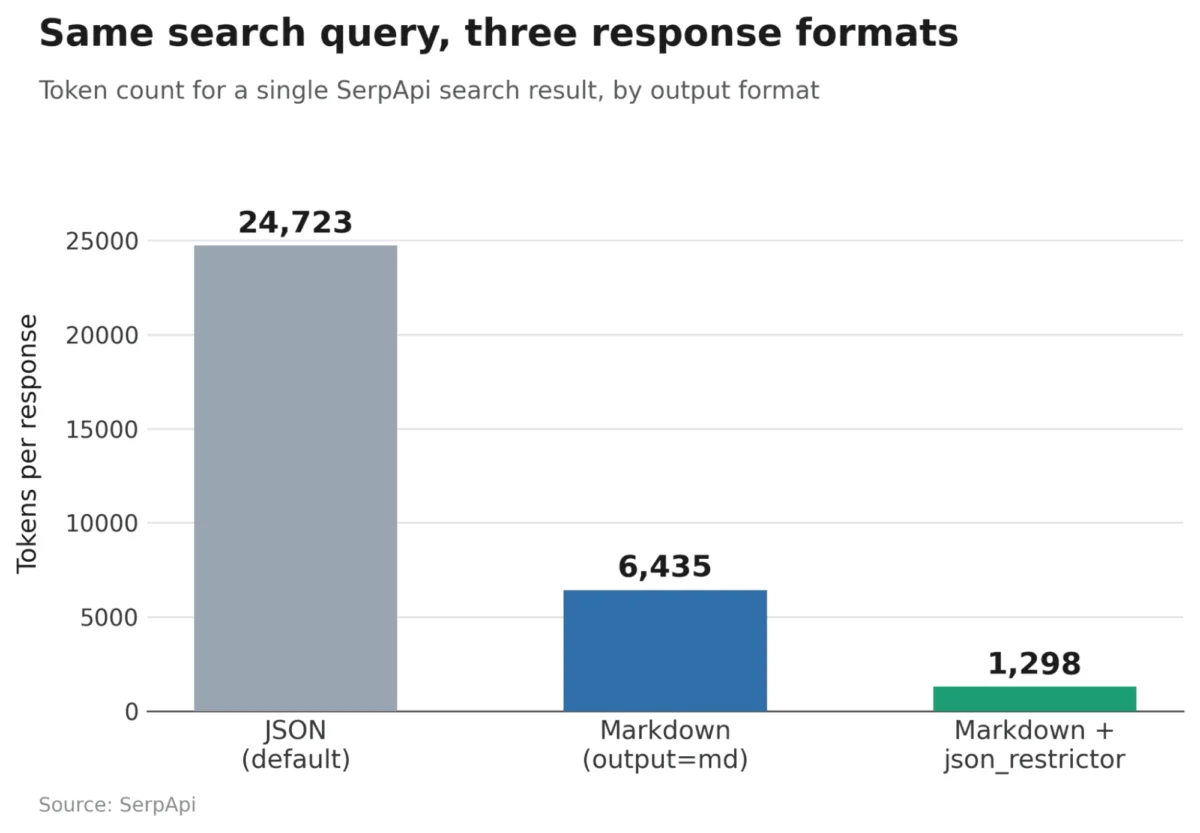
In a typical search engine query returned via traditional JSON, a request for a common term like "coffee" yields a sprawling response laden with tracking parameters, nested UI elements, and redundant object keys. According to benchmark testing conducted by SerpApi, a standard JSON response for this query consumed approximately 24,723 tokens. When the exact same query was executed using the newly introduced Markdown output format, token consumption dropped precipitously to 6,435 tokens. This represents an immediate 74 percent reduction in payload size. Furthermore, when developers applied advanced server-side filtering and restriction parameters, the token count for a more targeted view dropped to just 1,298 tokens—representing an aggregate reduction of nearly 95 percent compared to the original JSON payload. Such dramatic shrinkage allows organizations to stretch their API budgets, accelerate response times, and preserve precious context window capacity for deeper cognitive analysis.
Decoding the Transformation: JSON Versus Markdown in LLM Workflows
The mechanics behind this token reduction lie in the elimination of non-semantic data. Traditional JSON responses are engineered for deterministic software applications. They explicitly define data types, nested hierarchies, and programmatic identifiers that allow code compilers and web browsers to render interfaces or execute conditional logic. For instance, a shopping search result returned in JSON format will systematically delineate numeric prices, currency symbols, discount structures, merchant identification codes, and floats for product ratings across multiple nested arrays. While essential for a pricing engine or a relational database, these structural markers are entirely superfluous for an LLM tasked merely with summarizing the top three affordable products in a given region.
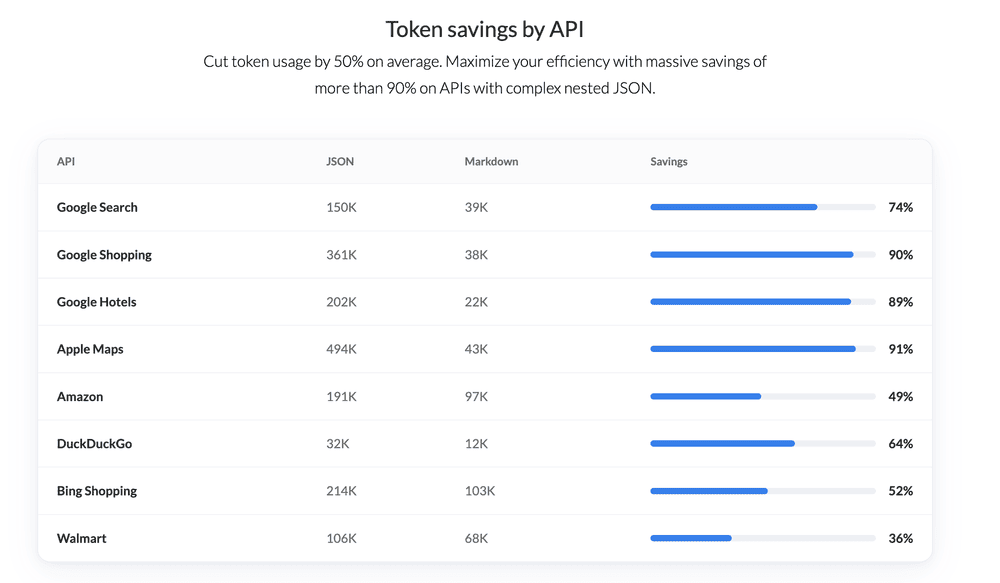
SerpApi’s Markdown integration bridges this gap by stripping away structural syntax that inflates token counts while preserving human-readable and model-comprehensible signals. By converting hierarchical JSON objects into structured Markdown tables, bulleted lists, and native inline links, the data format aligns more closely with the natural language training data upon which modern LLMs are built. YAML frontmatter is utilized to capture essential metadata efficiently, while internal tracking URLs, duplicate fields, and UI rendering cues are systematically purged at the server level.
Despite these clear advantages, industry architects emphasize that Markdown is not a universal replacement for JSON. In application architectures where downstream pipelines depend on strict data types—such as precise numeric float calculations, programmatic sorting by coordinates, or automated inventory synchronization—JSON remains the superior format. The strategic choice depends entirely on the consumer of the data. When code is reading the response, structured typed formats are mandatory; when a neural network is reasoning over the content, human-readable text formats yield superior efficiency.
Implementation Strategies and Developer Integration
Deploying token-efficient data retrieval mechanisms does not require a complete overhaul of existing software architectures. Service providers have designed these optimization features to integrate seamlessly into existing pipelines. Developers utilizing SerpApi can request Markdown formatting across more than 100 distinct search engine endpoints using a simple query parameter, route extension, or custom request header.
To achieve even greater payload reduction, developers can pair Markdown formatting with server-side filtering tools such as SerpApi’s json_restrictor or command-line interface field selectors. By specifying exact keys prior to network transmission, organizations can prevent extraneous data from ever crossing the wire, drastically minimizing bandwidth usage alongside token consumption. Because these formatting options are natively supported within existing API tiers at no additional cost, engineering teams can benchmark and deploy these efficiencies with minimal friction. Industry analysts recommend that development teams audit their existing agentic workflows by executing baseline queries, measuring token consumption before and after enabling Markdown parameters, and calculating the resultant delta to quantify operational savings.
Broader Implications for the Generative AI Ecosystem
The shift toward lightweight data serialization formats like Markdown highlights a maturing software engineering discipline around generative artificial intelligence. As the industry moves past the initial phase of experimental proof-of-concepts and into large-scale production deployments, optimization, cost containment, and resource efficiency have emerged as primary engineering priorities. The realization that data shape has a direct, quantifiable financial cost is driving a broader reassessment of data pipelines across the AI ecosystem.
As autonomous agents assume more complex responsibilities—ranging from automated software engineering and corporate research to customer service orchestration—the volume of inter-system communication will continue to scale exponentially. Mitigating payload bloat at the data source represents a foundational step toward sustainable AI scaling. By rethinking how information is packaged for consumption by neural networks, developers can build faster, cheaper, and more reliable intelligent systems capable of operating efficiently within real-world economic and technical constraints.