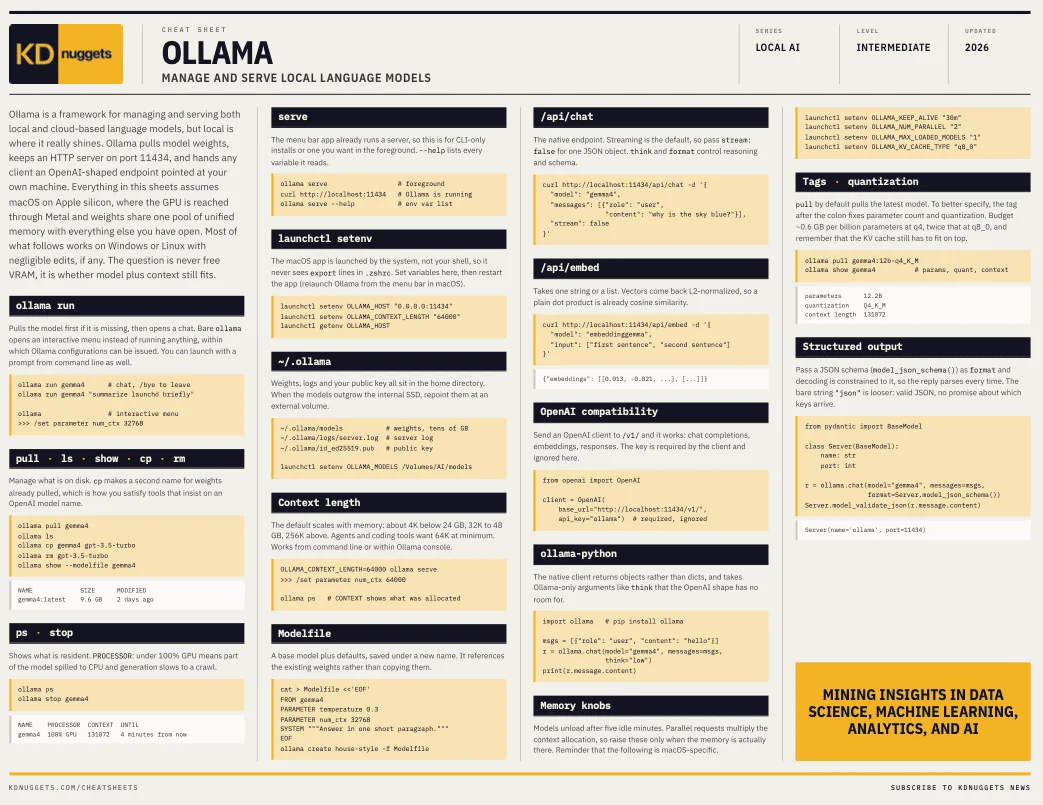
Running sophisticated artificial intelligence models directly on local consumer and enterprise hardware has evolved from an academic exercise into a standard operational paradigm for developers, data scientists, and organizations prioritizing data privacy and reduced inference latency. Among the tooling facilitating this hardware decentralization, Ollama has emerged as a prominent utility. By abstracting the complex process of weight management, memory allocation, and API serving, Ollama allows users to download, configure, and execute large language models (LLMs) with minimal friction. To assist practitioners in navigating the operational nuances of local deployment, technical resource publisher KDnuggets has released a comprehensive new reference guide titled the Ollama for Managing Local Language Models Cheat Sheet.
The democratization of local AI infrastructure represents a significant shift in the broader software development and data science landscapes. Historically, running state-of-the-art neural networks required specialized, costly cloud clusters or enterprise-grade server infrastructure equipped with multiple high-end graphics processing units. However, breakthroughs in model quantization—such as 4-bit and 8-bit precision representations—alongside optimizations in inference engines, have drastically lowered hardware barriers. Modern consumer laptops and desktop workstations featuring unified memory architectures or dedicated desktop GPUs are now fully capable of running models possessing billions of parameters locally.
Despite these hardware advancements, bridging the gap between simply launching a model and effectively managing it in a production or development environment introduces distinct technical hurdles. While initialization often boils down to a single terminal command, subsequent performance bottlenecks, memory management issues, and environment configuration quirks can severely impede development velocity. The newly released KDnuggets cheat sheet aims to address these friction points by providing a structured, quick-reference framework for both novice and experienced practitioners utilizing Ollama.
Understanding Memory Allocation and Performance Diagnostics
One of the primary challenges in local language model deployment is managing hardware resource constraints, specifically video random-access memory (VRAM) and system RAM. When an LLM is invoked, the entire model and its associated context window—the working memory the model uses to track conversation history and document inputs—must fit within the available high-speed memory of the system or GPU. If the combined footprint exceeds capacity, the system must resort to offloading portions of the model computation to the central processing unit or swapping data to system memory, leading to a precipitous decline in token generation speeds.
Ollama provides a built-in diagnostic tool to monitor these resource metrics via the command line interface. Executing the ollama ps command generates a real-time status report detailing which models are currently resident in memory. Alongside identifiers and sizing information, the output includes a critical PROCESSOR column. In an optimal deployment scenario, this metric should display 100% GPU utilization. Any figure falling below this threshold indicates that a portion of the model has spilled over to the CPU, signaling a potential degradation in processing efficiency.
Furthermore, ollama ps reveals the actively allocated context window length. Developers frequently encounter discrepancies where the allocated context differs from the expected or requested token limit due to default system constraints. By monitoring these parameters directly through Ollama’s diagnostic interfaces, engineers can quickly identify and remediate sizing bottlenecks before they impact application performance.
Navigating Environment Variables and Desktop Application Quirks
Operational friction often arises when transitioning from standard command-line interfaces to desktop application environments, particularly on macOS and other modern operating systems. A frequent stumbling block for developers configuring Ollama involves environment variable management.
When Ollama is installed as a desktop application, it is typically launched as a background daemon by the operating system rather than interactively spawned from a user’s terminal shell. Consequently, the application process never reads configuration exports defined in shell profile scripts, such as .zshrc or .bash_profile. Settings that appear correct when queried in a terminal window—such as custom model storage directories or modified default context lengths—may have zero effect on the background service.
On macOS, resolving this configuration challenge requires interacting directly with the system daemon manager, launchd. Variables must be explicitly declared using system-level commands such as launchctl setenv to ensure the background application inherits the necessary configurations. This architectural distinction is widely recognized as one of the most common hurdles for newcomers adopting Ollama for local development, frequently resulting in troubleshooting delays regarding model paths and persistent configuration states.
Structured Outputs and API Compatibility Layers
As local language models increasingly serve as backends for automated software agents and enterprise applications, the demand for reliable, structurally compliant outputs has grown exponentially. Standard language model decoding is probabilistic, which can occasionally result in prose that deviates from strict programmatic requirements, breaking downstream parsers that expect valid JSON or specific schema definitions.
Ollama addresses this requirement by supporting structured output constraints. By passing a valid JSON schema directly to the format parameter during an API call, developers can strictly constrain the model’s decoding process. This forces the generated response to conform precisely to the requested schema on every invocation, rather than achieving probabilistic compliance most of the time. Conversely, passing the bare string "json" invokes a looser constraint, ensuring the output is syntactically valid JSON without enforcing a rigid key-value structure.
Beyond structured decoding, Ollama bridges local execution with standard development workflows by maintaining broad API compatibility. The utility exposes native endpoints such as /api/chat and /api/embed, alongside a /v1/ compatibility layer designed to mirror the OpenAI API specification. This architectural choice allows developers to seamlessly redirect existing applications built for cloud-hosted AI providers to localhost:11434 with minimal code modifications, enabling rapid prototyping and local testing without incurring API usage costs.
Customization via Modelfiles and Resource Governance
For organizations and developers seeking to tailor base models to specific use cases, Ollama utilizes a configuration construct known as a Modelfile. Analogous to Dockerfiles in containerized software development, Modelfiles allow users to package base model weights alongside custom system prompts, temperature settings, stop sequences, and parameter defaults into a unified, version-controlled artifact.
In addition to customization, production-grade local deployments require careful governance of system resources. Ollama provides a suite of environment variables that dictate operational parameters, including how long idle models remain loaded in memory before being automatically evicted, and how many concurrent model instances can execute simultaneously. These settings are critical for developers balancing rapid response times against finite hardware resource pools.
Broader Industry Implications and the Shift Toward Local AI
The proliferation of tools like Ollama reflects a broader macroeconomic and strategic shift within the technology sector. Driven by escalating concerns over data privacy, regulatory compliance—such as the European Union’s Artificial Intelligence Act—and the unpredictable costs associated with cloud-hosted API consumption, enterprises are increasingly evaluating hybrid or fully localized AI architectures.
By enabling organizations to run powerful open-weights models developed by entities like Meta, Mistral, and Google on internal hardware infrastructure, local deployment models eliminate the necessity of transmitting sensitive proprietary data, intellectual property, or personally identifiable information to external third-party servers. This capability is particularly vital in highly regulated sectors such as healthcare, finance, legal services, and defense.
However, widespread adoption of local inference also underscores the growing importance of developer education and tooling. As models scale and hardware diversity increases, resources that simplify operational complexity—such as comprehensive cheat sheets, standardized management CLIs, and clear configuration guidelines—play an essential role in bridging the gap between raw computational capability and production-ready software engineering.
The release of the Ollama cheat sheet by KDnuggets serves as a timely reference for the technical community, consolidating essential commands, configuration pathways, and optimization strategies into an accessible format. As local artificial intelligence continues to mature, mastery of these foundational infrastructure components will remain a core competency for modern software architects and data professionals aiming to build resilient, private, and cost-effective AI solutions.