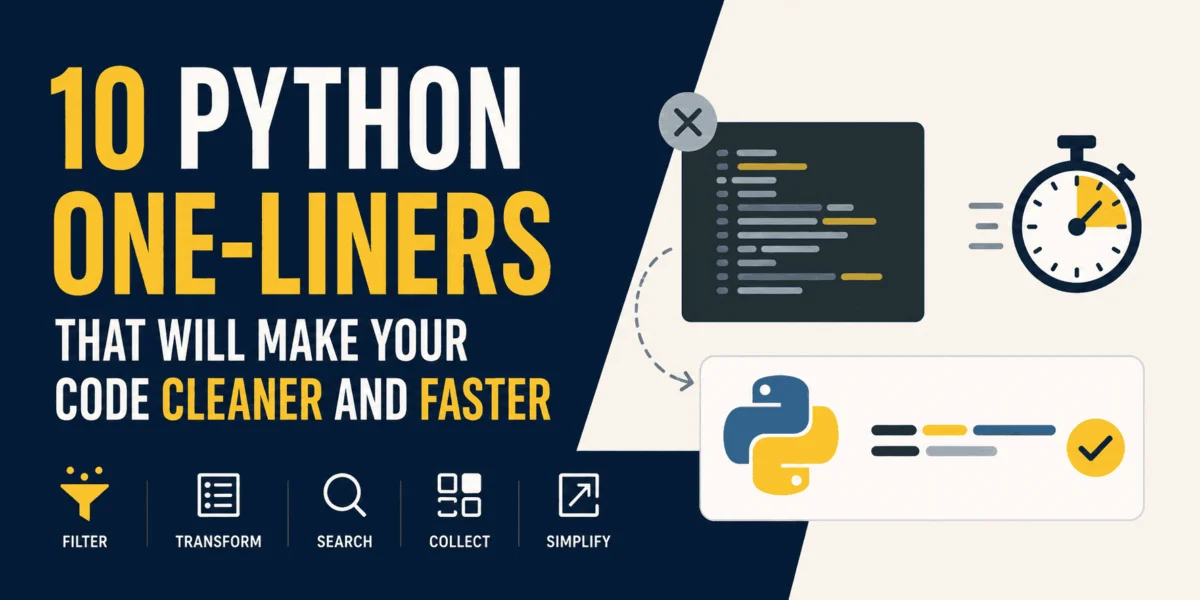
In the contemporary software development landscape, optimizing code readability alongside execution efficiency remains a core objective for engineers across industries. Python, widely recognized for its clear syntax and readability, often tempts developers to write verbose multi-line loops and conditional statements where concise, native constructs could suffice. A newly compiled technical overview highlights ten practical, version-aware Python one-liners designed to replace traditional, lengthy code blocks. These expressions aim to enhance both computational performance and maintainability, aligning with modern software engineering standards that prioritize efficiency and cleaner codebases.
Background and Technical Evolution of Python Syntax
Over the past several years, Python’s core development team, alongside the Python Software Foundation (PSF), has systematically introduced features aimed at reducing boilerplate code. Major releases—ranging from Python 3.8 through Python 3.12—have integrated syntax improvements such as assignment expressions (the walrus operator), robust dictionary merging operators, and native memoization tools. These updates reflect a broader industry shift toward minimizing cognitive load for developers while maximizing execution speeds in data-heavy environments.
Historically, routine data manipulation tasks—such as flattening nested lists, removing duplicates while maintaining sequence integrity, or batching records for application programming interface (API) requests—required cumbersome algorithmic boilerplate. By leveraging standard libraries like itertools, functools, and collections, developers can now execute these operations in a single, highly optimized line of code implemented at the C level within the interpreter.
Core Efficiency Techniques: The Ten Python One-Liners
The compiled collection categorizes ten distinct operations where single-line expressions outperform traditional multi-line loops:
-
Removing Duplicates While Preserving Order:
Replacing manual loops withunique = list(dict.fromkeys(items))builds a dictionary from items as keys, discarding duplicates while guaranteeing the preservation of the original insertion order, a feature standard since Python 3.7. -
Flattening a List of Lists:
Utilizingflat = list(itertools.chain.from_iterable(nested))offers a faster, lazy-evaluation alternative to quadratic-time summation tricks or nested loops. -
Merging Dictionaries:
Introduced in Python 3.9, the merge operator (merged = defaults | overrides) provides a clean, native method to combine dictionaries, with right-hand values taking precedence during key conflicts. -
Short-Circuiting Collection Checks:
Expressions likehas_negative = any(x < 0 for x in values)evaluate collections efficiently by halting iteration upon encountering the first matching condition. -
Eliminating Redundant Computation via Assignment Expressions:
Python 3.8’s walrus operator allows developers to compute, filter, and retain values simultaneously, as demonstrated inresults = [y for x in data if (y := transform(x)) is not None], preventing expensive functions from being called twice. -
Instant Function Memoization:
Applying the@functools.cachedecorator (standard in Python 3.9+) converts recursive or computationally expensive functions into near-instantaneous lookup operations by storing return values for unique arguments. -
Matrix Transposition:
The expressiontransposed = list(zip(*matrix))dynamically swaps rows and columns without requiring index arithmetic or external libraries like NumPy. -
Identifying Maximum Dictionary Keys:
Usingbest = max(scores, key=scores.get)replaces manual tracking loops to locate the key associated with the highest value in a dictionary. -
Retrieving High-Frequency Items:
The built-inCounter(words).most_common(3)from thecollectionsmodule optimizes frequency analysis, returning ordered pairs of items and their occurrence counts. -
Iterative Batching:
Python 3.12 introduceditertools.batched(records, 100), eliminating error-prone manual slicing logic previously required to group iterables into fixed-size chunks for batch processing.
Industry Implications and Developer Impact
Software engineering analysts note that adopting idiomatic, concise syntax directly influences code maintainability and software lifecycle costs. Cleaner codebases typically experience reduced technical debt, lower defect rates during code reviews, and faster onboarding times for incoming engineering talent. Furthermore, because several of these one-liners rely on optimized C-level implementations within the Python standard library, execution speeds frequently surpass equivalent Python-level implementations written as standard
Data scientists and backend engineers, in particular, stand to benefit from these optimizations. In domains handling high-throughput data pipelines—such as machine learning preprocessing, natural language processing, and cloud-based API integrations—reducing computational overhead at the syntax level translates to measurable resource savings.
Future Outlook for Python Optimization
As Python maintains its position as a dominant language in artificial intelligence, data science, and web development, the demand for expressive, high-performance syntax continues to grow. Community discussions within python-dev forums indicate an ongoing commitment to balancing readability with execution speed in future language specifications. For professional software developers, mastering these native one-liners represents a crucial step toward writing more maintainable, efficient, and professional-grade code.