A remarkable discovery of exceptionally preserved fossils from China’s Ediacaran Period is rewriting our understanding of early animal evolution. Unearthed in the Jiangchuan Biota of Yunnan Province, these ancient specimens, dating back over 539 million years, reveal complex life forms that challenge previous timelines for the emergence of several major animal lineages. The findings suggest that the diversification of animal life, particularly groups with more sophisticated body plans and potential links to modern phyla, began earlier and was more advanced than previously evidenced by the fossil record.
Unveiling the Jiangchuan Biota: A Window into Pre-Cambrian Life
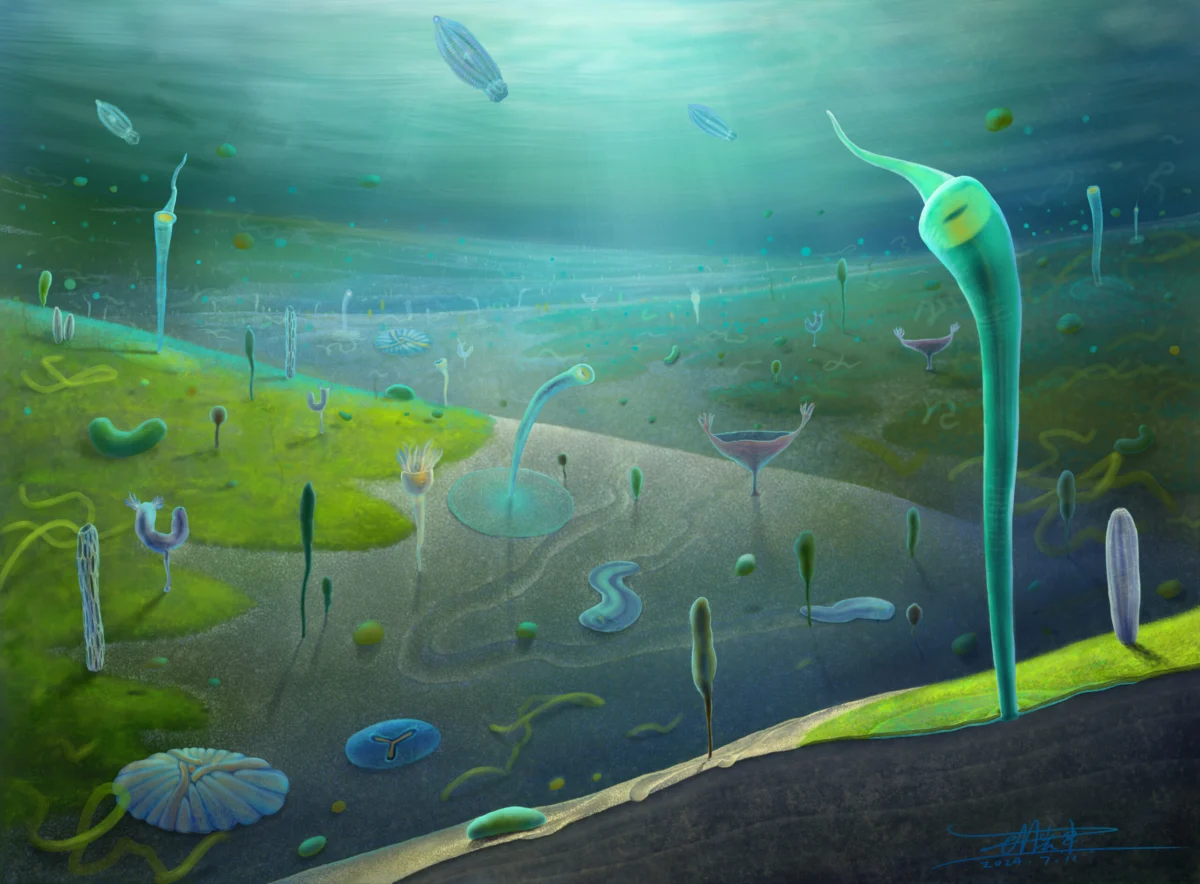
The Jiangchuan Biota represents a significant paleontological find, offering a detailed snapshot of an ancient marine ecosystem teeming with life just before the dramatic evolutionary explosion known as the Cambrian Period. The fossils, preserved in exquisite detail, showcase a diverse array of soft-bodied organisms, many of which were previously unknown or poorly understood. These creatures, unlike the familiar shells and skeletons of later eras, were often delicate and lacked hard parts, making their preservation a rare and invaluable event.
Among the most striking discoveries are organisms that exhibit features suggesting early relationships with modern animal groups. For instance, the description of "bugle worms" – tall, cylindrical animals anchored by disc-shaped bases – hints at potential early relatives of corals or other cnidarians. Another intriguing find is a purple, cocktail-glass-shaped organism, whose morphology is being studied for connections to various invertebrate groups. Perhaps most significantly, the presence of a purple, sausage-shaped creature on a stalk, displaying characteristics that researchers believe could link it to early relatives of vertebrates and sea stars, is particularly groundbreaking. This suggests that the evolutionary roots of these familiar animal groups extend further back into the Ediacaran than commonly accepted.
The preservation quality of the Jiangchuan Biota is exceptional. Unlike many Ediacaran fossils that are impressions or casts, these specimens reveal intricate details of internal structures and external textures. This level of detail is crucial for paleontologists attempting to decipher the phylogenetic relationships of these enigmatic organisms. The fine-grained sedimentary rocks in which they are found have captured the delicate forms, allowing for detailed comparative anatomy and the potential identification of homologous structures with later, more well-understood animals. This remarkable preservation is attributed to a unique set of environmental conditions, likely involving rapid burial by fine sediments, possibly during storm events or volcanic ash falls, which quickly smothered the organisms and prevented decomposition.
A Timeline of Early Animal Evolution: Pushing Back the Clock
The Ediacaran Period, spanning from approximately 635 to 541 million years ago, is a critical epoch in Earth’s history, marking the transition from a largely microbial world to one populated by complex, multicellular life. Prior to the discovery of the Jiangchuan Biota and similar Ediacaran fossil sites, the prevailing view was that animal life remained relatively simple and undiversified until the Cambrian "explosion," a period of rapid evolutionary innovation that began around 541 million years ago.
The Cambrian explosion is characterized by the sudden appearance of most major animal phyla, many of which developed hard skeletons and complex body plans. This event is often seen as the dawn of modern animal life. However, discoveries over the past few decades, including those from the Jiangchuan Biota, have been steadily pushing the origins of animal diversification further back into the Ediacaran.
The newly analyzed fossils from Yunnan provide compelling evidence that lineages leading to modern groups were already present and evolving during the late Ediacaran, potentially millions of years before the Cambrian boundary. The identification of organisms with features reminiscent of early chordates (which include vertebrates) and echinoderms (like sea stars) suggests that the evolutionary pathways leading to these phyla were well underway by this time. This challenges the notion of a sudden "explosion" and points towards a more gradual, albeit still rapid, period of diversification preceding the Cambrian.
The dating of these fossils to over 539 million years ago places them firmly in the terminal Ediacaran, a period of significant environmental change and biological innovation. This era witnessed shifts in ocean chemistry, oxygen levels, and the development of new ecological interactions, all of which likely played a role in driving evolutionary change. The Jiangchuan Biota, therefore, offers a crucial glimpse into the biological responses to these late Ediacaran conditions.
Supporting Data: Insights from Morphological Analysis and Geochemistry
The scientific analysis of the Jiangchuan Biota relies on a multi-disciplinary approach. Paleontologists meticulously examine the morphology of the fossils, comparing their structures to those of modern animals and other fossil groups. Techniques such as scanning electron microscopy (SEM) and X-ray microtomography are employed to reveal fine anatomical details that are not visible to the naked eye. These analyses allow researchers to infer aspects of the organisms’ physiology, locomotion, feeding strategies, and reproductive methods.
For example, the disc-shaped anchors of the "bugle worms" suggest a sessile lifestyle, firmly attached to the seafloor, a common strategy among early benthic invertebrates. The stalked nature of other organisms indicates adaptations for positioning themselves within the water column or on the sediment surface to capture food particles. The potential presence of rudimentary nervous systems or digestive tracts, inferred from subtle textural variations or internal impressions, further informs our understanding of their biological complexity.
Geochemical analysis of the surrounding rock matrix provides vital contextual data. This includes isotopic analysis of carbon and oxygen, which can offer clues about the ancient environment, including ocean temperature, salinity, and the presence of specific microbial communities. Radiometric dating of associated volcanic ash layers, if present, provides precise age constraints for the fossiliferous strata. These dates are crucial for anchoring the Jiangchuan Biota within the broader timeline of Earth’s history and for calibrating evolutionary divergence estimates.
The interpretation of these fossils as potential ancestors of modern animal groups is based on shared derived characteristics. While direct lineage can be difficult to prove definitively from fossils alone, the presence of features such as bilateral symmetry, segmentation, or the beginnings of specialized organ systems in Ediacaran organisms strongly suggests that the fundamental body plans of many animal phyla were established well before the Cambrian. The Jiangchuan Biota’s contribution is in providing exceptionally clear examples of these early evolutionary experiments.
Expert Reactions and the Broader Scientific Consensus
The findings from the Jiangchuan Biota have generated considerable excitement within the paleontological community. Dr. Anya Sharma, a leading researcher in Precambrian paleontology not directly involved in the current study, commented, "The Jiangchuan Biota is a treasure trove. The level of detail in these fossils is astonishing, and it’s precisely the kind of evidence we need to refine our models of early animal evolution. If these interpretations hold, it means the foundations for many of the animal groups we see today were laid much earlier than we thought, during a period of intense environmental and biological flux."
Professor Jian Li, a member of the research team that published the findings, stated in a press release, "Our work on the Jiangchuan Biota is revealing an astonishingly complex ecosystem that existed long before the Cambrian ‘explosion.’ These fossils are not just curiosities; they are critical pieces of the puzzle that help us understand the deep evolutionary history of life on Earth. The potential links to vertebrates and sea stars are particularly significant, as they suggest that the divergence of these major lineages occurred earlier than previously documented."
The scientific consensus is increasingly shifting towards a more nuanced view of the Ediacaran-Cambrian transition. While the Cambrian remains a period of unparalleled evolutionary innovation, it is now understood as building upon a foundation of complex life that was already developing in the preceding Ediacaran. Discoveries like the Jiangchuan Biota are instrumental in filling the gaps in our knowledge and providing empirical support for these evolving theories. The research team’s meticulous documentation and comparative analyses are expected to undergo rigorous peer review, further solidifying their findings within the scientific literature.
Implications for Understanding Life’s Origins and Evolution
The implications of the Jiangchuan Biota’s revelations are far-reaching. Firstly, they underscore the importance of the Ediacaran Period as a crucial, yet often underappreciated, phase of animal evolution. It suggests that the evolutionary "experiments" that led to the diversity of life in the Cambrian were already underway, with organisms developing novel body plans and ecological strategies.
Secondly, these findings challenge traditional views of a singular, abrupt Cambrian explosion. Instead, they support a more gradual, albeit accelerated, process of diversification that began in the Ediacaran and continued into the Cambrian. This perspective highlights the interplay of environmental factors, genetic innovation, and ecological pressures in driving macroevolutionary change.
Thirdly, the discovery has implications for our understanding of the origins of specific animal groups, including our own lineage. By pushing back the timeline for the emergence of early vertebrate-like forms, the Jiangchuan Biota provides crucial data points for molecular clock estimates and phylogenetic analyses. It allows scientists to better contextualize the genetic and developmental innovations that underpin the vast diversity of animal life.
The study of these ancient organisms also offers insights into the fragility and resilience of life. The Ediacaran world was dramatically different from our own, yet it was home to creatures that laid the groundwork for the biosphere we know today. Understanding how these early animals adapted to their environment, how they interacted, and how they ultimately gave rise to new forms of life can provide valuable lessons about the evolutionary trajectory of life on Earth and potentially on other planets. The Jiangchuan Biota serves as a powerful reminder that the history of life is a continuous story of change, adaptation, and emergent complexity, with roots stretching far deeper into the past than we might have imagined.