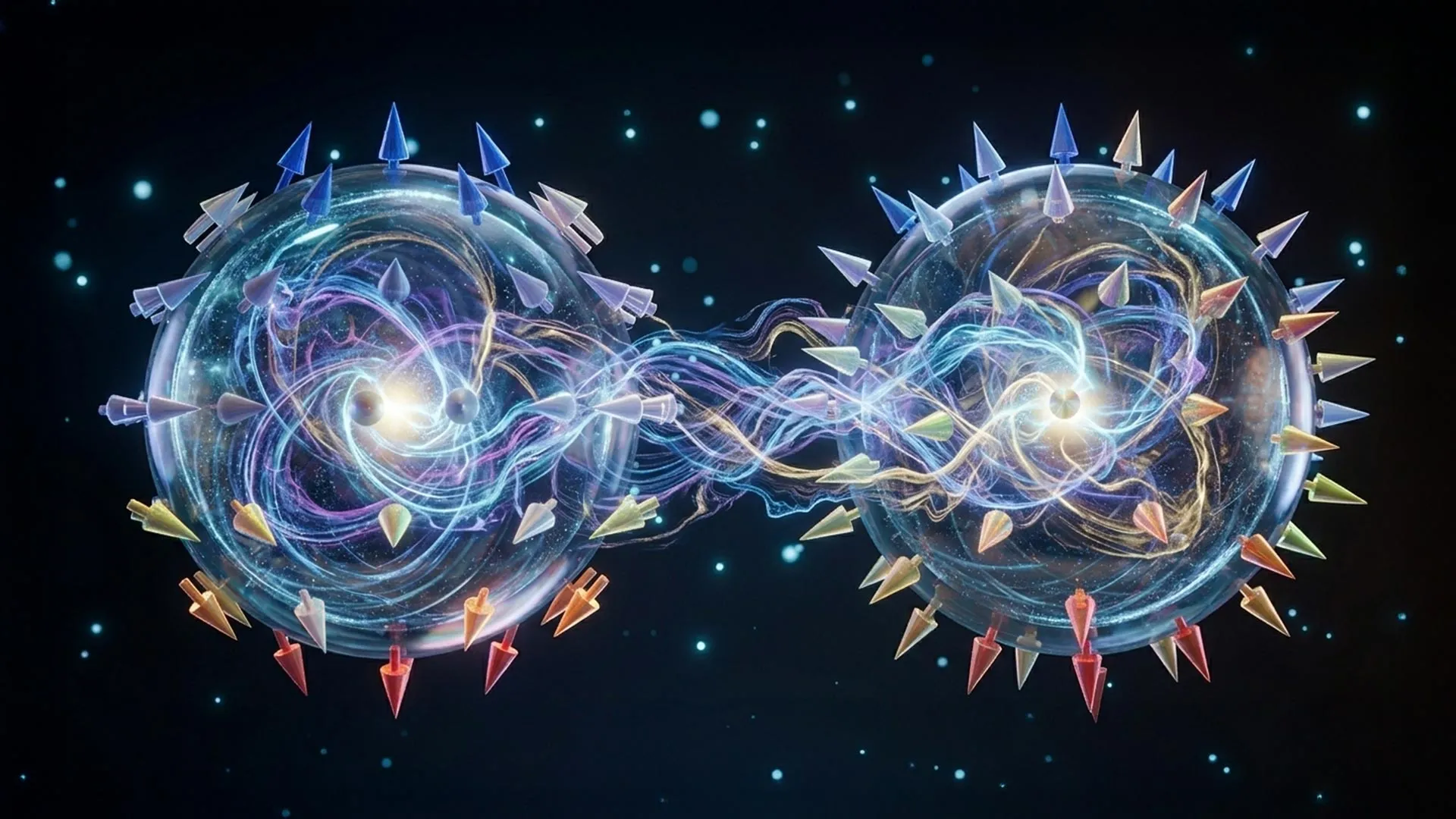
A collaborative research effort between the University of the Witwatersrand (Wits) in South Africa and Huzhou University in China has revealed an unprecedented layer of complexity within the spatial structures of entangled photons. The study, recently published in the prestigious journal Nature Communications, details the discovery of high-dimensional topological patterns hiding within one of the most common processes in quantum optics: spontaneous parametric downconversion (SPDC). By mapping these structures, the team identified a record-breaking 48 dimensions of topological diversity and more than 17,000 distinct topological signatures. This breakthrough effectively provides a vast, new "alphabet" for quantum encoding, offering a potential solution to the long-standing challenge of information fragility in quantum systems.
The Evolution of Quantum Entanglement and the Discovery of Hidden Topologies
Quantum entanglement, a phenomenon Albert Einstein famously described as "spooky action at a distance," has moved from a theoretical paradox to the backbone of modern quantum technologies. In contemporary laboratories, entanglement is typically generated using SPDC, a process where a high-energy laser photon is passed through a nonlinear crystal, splitting into two lower-energy "daughter" photons. These photons are inherently linked, sharing physical properties regardless of the distance between them.
For decades, researchers have focused on the spatial properties of these photons, particularly their Orbital Angular Momentum (OAM). OAM refers to the way a light beam twists as it travels, creating a "vortex" or "donut" shape. While OAM has been a staple of quantum communication for its ability to carry high-dimensional data, it was long considered sensitive to environmental interference, or "noise."
The team led by Professor Andrew Forbes at Wits and Professor Robert de Mello Koch at Huzhou University has fundamentally shifted this perspective. They discovered that the entanglement in space is not just a collection of fragile states but is governed by intrinsic topology. In mathematics and physics, topology is the study of properties that remain unchanged even when a system is stretched or deformed—much like how a donut and a coffee mug are considered topologically equivalent because they both possess a single hole. By identifying these "invincible" topological structures within entangled light, the researchers have found a way to potentially shield quantum information from the decoherence that typically plagues quantum experiments.
Breaking the Paradigm: Topology from a Single Property
Before this discovery, the scientific consensus held that creating topological structures in light required the manipulation of at least two distinct properties, such as the coupling of OAM with polarization (the direction in which light waves vibrate). This requirement added layers of complexity to experimental setups, often necessitating specialized "quantum engineering" and highly sensitive equipment.
The Wits-Huzhou study has dismantled this assumption. The researchers demonstrated that the OAM of entangled photons alone is sufficient to manifest complex topologies. Because OAM can theoretically take on an infinite range of integer values, the resulting topological space is not limited to simple two-dimensional models.
"We report a major advance in this work: we only need one property of light (OAM) to make a topology," stated Professor Andrew Forbes, a leading figure in the Wits School of Physics. "The consequence is that since OAM is high-dimensional, so too is the topology. This allowed us to report the highest topologies ever observed in a quantum system."
The team successfully reached 48 dimensions, a significant leap from previous experiments that struggled to maintain stability in even low-dimensional topological states. By accessing these higher dimensions, the researchers were able to observe over 17,000 unique topological signatures—mathematical invariants that act as stable identifiers for specific quantum states.
Theoretical Framework and Experimental Validation
The discovery was not the result of a chance observation but the culmination of rigorous theoretical prediction followed by precise experimental verification. Professor Robert de Mello Koch noted that identifying these structures required looking beyond traditional optical physics into the realm of abstract mathematics.
"In high dimensions, it is not so obvious where to look for the topology," de Mello Koch explained. "We used abstract notions from quantum field theory to predict where to look and what to look for."
Quantum field theory (QFT), which combines classical field theory, special relativity, and quantum mechanics, provided the roadmap. By applying QFT concepts to the spatial entanglement of photons, the team could predict the existence of "topological charges" that would remain constant even if the light beam was subjected to certain types of interference.
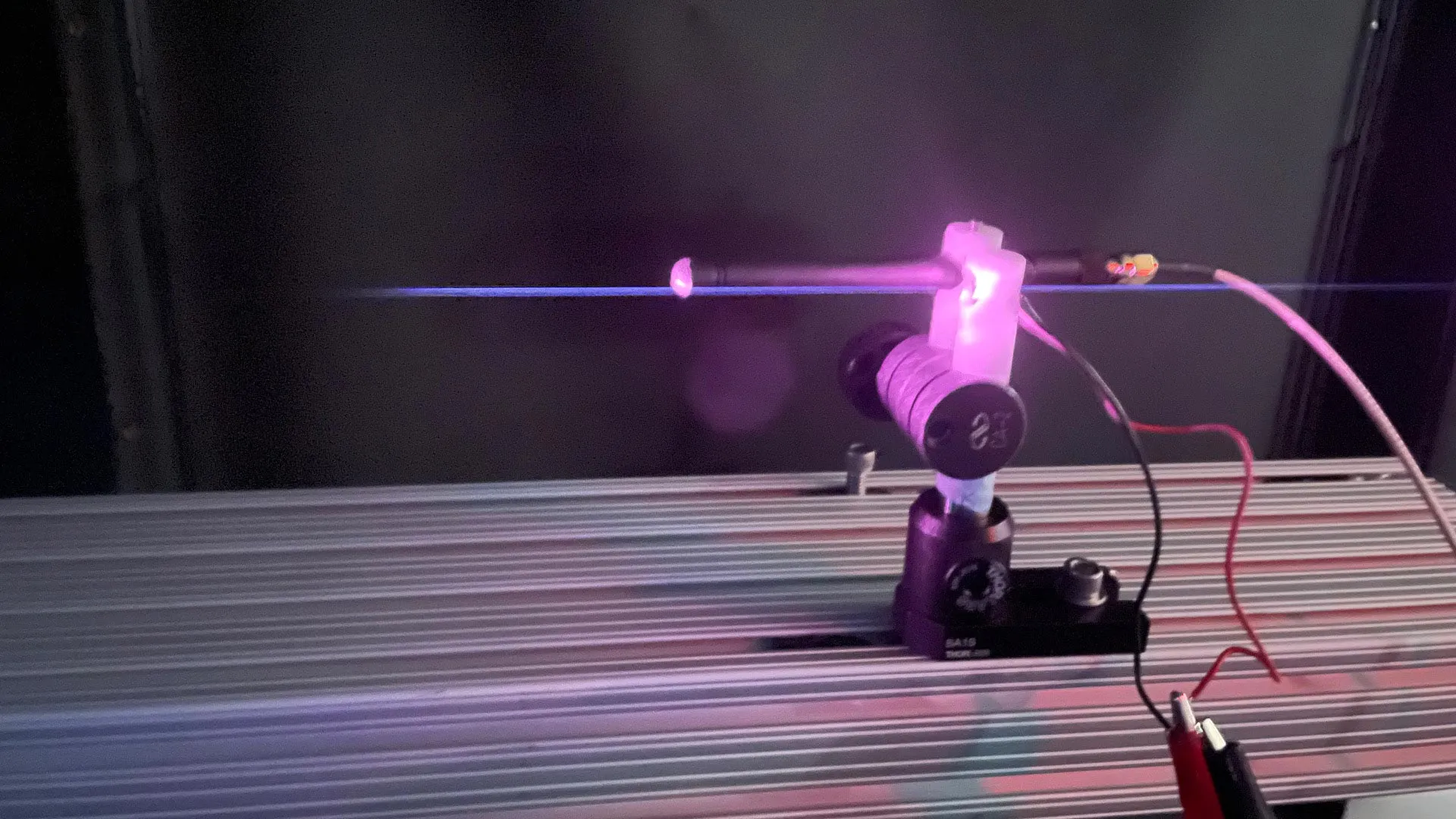
In the laboratory, Pedro Ornelas and the team at Wits used a standard SPDC setup. They pumped a nonlinear crystal with a laser to create entangled pairs and then used spatial light modulators to measure the OAM of the resulting photons. By analyzing the correlations between the two photons, they found the predicted topological patterns. Ornelas emphasized that the discovery was "hiding in plain sight," as the resources needed to find these topologies are already present in most quantum optics labs worldwide. "You get the topology for free, from the entanglement in space," he noted. "It was always there; it just had to be found."
Data and Significance: The 17,000-Signature Alphabet
The sheer volume of data produced by this experiment underscores its potential impact. In a standard binary quantum system (qubits), information is stored in two states: 0 and 1. In high-dimensional quantum systems (qudits), the amount of information that can be carried per photon increases exponentially.
The 17,000 topological signatures discovered by the team represent a massive expansion of this capacity. These signatures are "topologically protected," meaning they are remarkably resistant to the "noise" or environmental fluctuations that usually cause quantum information to degrade. In a practical sense, this provides a massive "alphabet" for quantum communication. Instead of sending a simple 0 or 1, scientists could potentially use thousands of unique, stable topological "letters" to encode complex data, significantly increasing the bandwidth and security of quantum networks.
The 48-dimensional space identified in the study also sets a new benchmark for the complexity of controlled quantum states. Maintaining coherence in 48 dimensions is a feat that suggests topological light could be the key to scaling quantum computers and communication systems beyond their current limitations.
Historical Context: From the EPR Paradox to Modern Optics
To understand the weight of this discovery, it is necessary to look at the timeline of quantum entanglement research.
- 1935: Einstein, Podolsky, and Rosen (EPR) publish their paper questioning the completeness of quantum mechanics, introducing the concept of entanglement.
- 1964: John Bell formulates Bell’s Theorem, providing a way to experimentally test the reality of entanglement.
- 1980s-1990s: The first successful experiments with SPDC are conducted, proving that entangled photons could be generated and measured in a lab setting.
- 2000s: Researchers begin exploring the Orbital Angular Momentum of light, realizing its potential for high-dimensional encoding.
- 2010s: The field of "Topological Photonics" emerges, seeking to apply the principles of topology (originally found in solid-state physics) to light.
- 2024: The Wits and Huzhou team discovers that high-dimensional topology is an inherent, "free" feature of spatial entanglement, requiring only one property of light.
This progression shows a clear trajectory from theoretical debate to the discovery of robust, naturally occurring structures that can be utilized for engineering.
Implications for the Future of Quantum Technology
The implications of this discovery extend far beyond the laboratory. As the world moves toward a "Quantum Internet," the primary hurdle remains the fragility of quantum states. Photons traveling through fiber-optic cables or the atmosphere are subject to temperature changes, physical vibrations, and other disturbances that destroy entanglement.
By viewing entanglement through the lens of topology, researchers can develop systems where information is stored not in the easily disturbed "shape" of the light, but in its "topology." Because the topology of a system cannot be changed by small, local perturbations, the information remains intact.
1. Robust Quantum Communication
Future quantum networks could use these 17,000+ signatures to create ultra-secure, high-bandwidth communication channels. The topological protection would allow for longer transmission distances with lower error rates, reducing the need for complex quantum repeaters.
2. Advanced Quantum Computing
In quantum computing, error correction is the most significant bottleneck. Using high-dimensional topological states could provide a "hardware-level" solution to error correction, where the qubits themselves are inherently resistant to certain types of decoherence.
3. Accessible Quantum Research
Because this effect does not require specialized "quantum engineering" equipment, it democratizes access to high-dimensional quantum research. Laboratories that already possess standard SPDC setups can now begin exploring topological quantum information without massive capital investment.
Conclusion and Scientific Consensus
The work of Forbes, de Mello Koch, and their colleagues has been met with significant interest from the global physics community. While OAM entanglement has been studied for nearly three decades, the realization that it contains a rich, high-dimensional topological structure changes the fundamental understanding of how light and entanglement interact.
By proving that complex topology can emerge from a single property of light, the team has simplified the path toward practical quantum applications while simultaneously increasing the complexity of what can be achieved. This "alphabet" of 17,000 signatures is more than just a mathematical curiosity; it is a roadmap for the next generation of stable, high-capacity quantum technologies. As researchers continue to map this newly discovered realm, the transition from experimental quantum optics to real-world quantum infrastructure appears closer than ever before.