The pursuit of ultra-precise measurement tools has long been a cornerstone of modern physics, driving advancements in everything from telecommunications to fundamental research into the nature of the universe. Among the most challenging parameters to measure with high fidelity are low-frequency and static (DC) electric fields. While high-frequency fields are often easier to characterize through traditional antenna-based methods, low-frequency fields require a level of sensitivity and spatial resolution that conventional electronics struggle to provide. Researchers at Nanyang Technological University (NTU) in Singapore have recently unveiled a breakthrough in this domain, proposing a sophisticated method for low-frequency vector electrometry using a chain of interacting Rydberg atoms. This innovation, recently featured as the cover story in the journal Frontiers of Optoelectronics, promises to redefine the boundaries of quantum metrology by offering a compact, programmable, and highly accurate sensing platform.
The Evolution of Quantum Metrology and Rydberg Atoms
To understand the significance of the NTU research, one must first look at the unique properties of Rydberg atoms. A Rydberg atom is an atom in a highly excited state, where one or more electrons have been promoted to a very high principal quantum number ($n$). In these states, the atom becomes physically large; the radius of the electron’s orbit scales with $n^2$, meaning that for high $n$, the atom can be thousands of times larger than its ground-state counterpart.
This physical size translates directly into an extraordinary sensitivity to external electric fields. The electric dipole moment of an atom, which dictates how strongly it interacts with an electric field, also scales with $n^2$. Consequently, Rydberg atoms possess polarizabilities that are orders of magnitude greater than those of atoms in their ground states. This makes them ideal candidates for quantum sensors. Over the last decade, Rydberg-based sensing has moved from theoretical exploration to practical implementation, particularly in the detection of radio-frequency (RF) signals. However, applying these same principles to low-frequency or DC fields has remained a persistent technical hurdle.
Limitations of Current Vapor-Cell Spectroscopy
The prevailing standard for Rydberg-based electric field sensing has been the use of vapor-cell electromagnetically induced transparency (EIT) spectroscopy. In this setup, a glass cell filled with a vapor of alkali atoms (such as rubidium or cesium) is probed by lasers. The lasers excite the atoms to Rydberg states, and the presence of an electric field shifts the energy levels of these states via the Stark effect. By measuring the changes in the light transmitted through the vapor, researchers can infer the strength of the electric field.
Despite its successes, vapor-cell EIT faces several inherent limitations. First, the atoms in a vapor cell are in constant, random motion. This leads to Doppler broadening, where the motion of the atoms blurs the spectral lines, reducing the precision of the measurement. Second, the atoms frequently collide with each other and the walls of the cell, causing collisional broadening. Furthermore, a vapor cell provides an "averaged" measurement over the entire volume of the gas, making it difficult to achieve high spatial resolution or to determine the precise direction (vector) of the electric field at a specific point in space.
The NTU team recognized that to overcome these barriers, a shift from disordered gas-phase sensing to ordered, many-body quantum systems was necessary.
The Rydberg Dipolar Chain: A New Paradigm
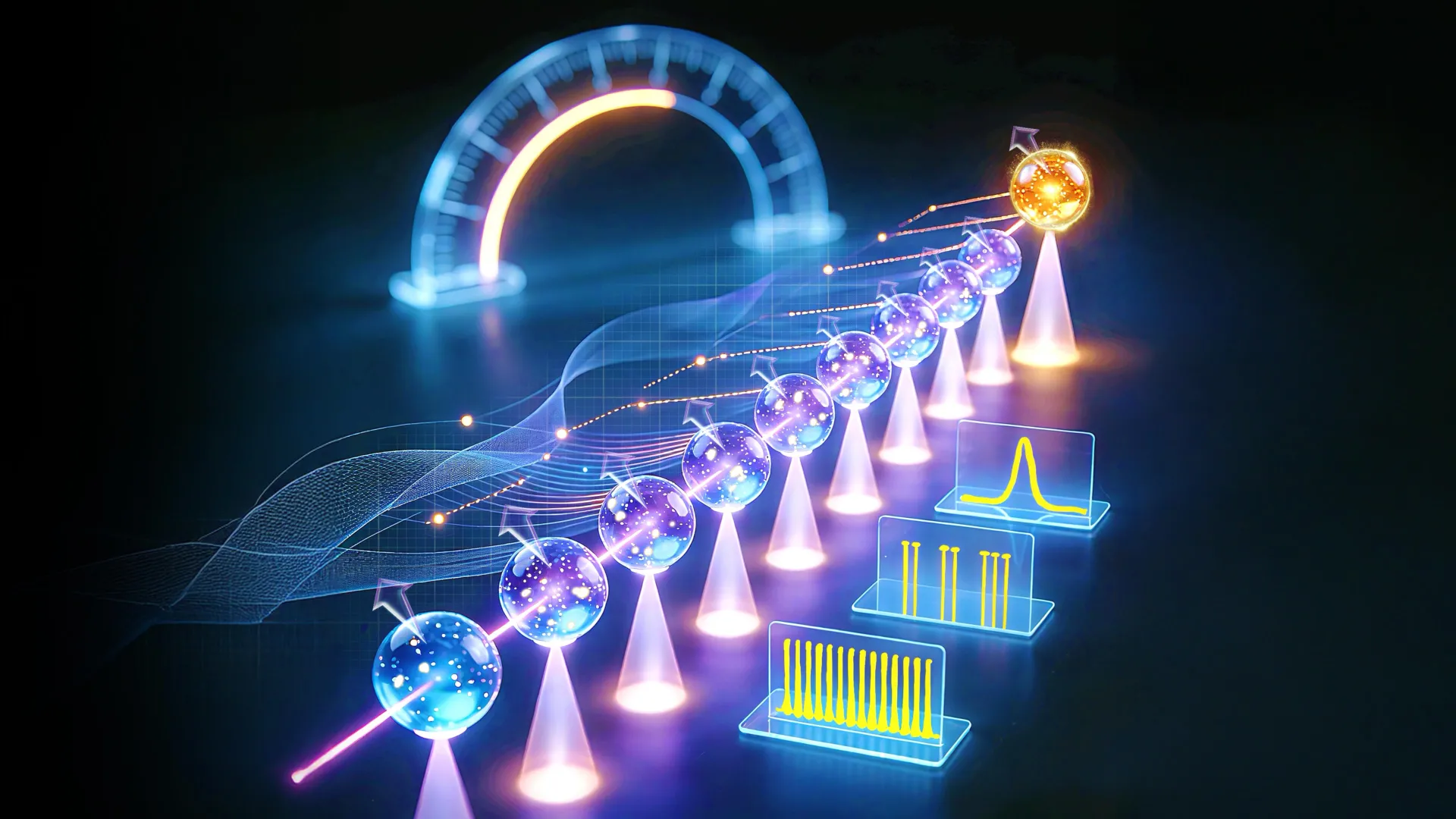
The methodology introduced by the NTU researchers centers on a "Rydberg dipolar chain"—a linear array of atoms trapped in optical tweezers or an optical lattice and excited to Rydberg states. Unlike the chaotic environment of a vapor cell, this setup allows for the precise positioning of atoms at micrometer-scale intervals.
The core of the innovation lies in the interaction between these atoms. When atoms are in Rydberg states, they interact strongly via dipole-dipole exchange. The strength and nature of this interaction are highly sensitive to the orientation of the atoms’ quantization axes. When an external low-frequency electric field is applied to the chain, it causes a shift in the quantization axis of each atom. This shift, in turn, modifies the dipolar exchange interaction between neighboring atoms in the chain.
Because the interaction depends on the angle between the inter-atomic axis and the electric field vector, the collective dynamics of the entire chain become a high-fidelity record of the external field’s properties. By observing how the system evolves, researchers can extract not only the magnitude of the field but also its precise direction in three-dimensional space—a feat known as vector electrometry.
Three Dimensions of Measurement: Time, Energy, and Frequency
The NTU research proposes a multifaceted measurement framework to extract maximum information from the Rydberg chain. Rather than relying on a single observable, the researchers identified three complementary techniques that can be employed within the same experimental platform:
-
Propagation Dynamics (Time Domain): The researchers analyzed how an excitation—a "quasiparticle" of energy—moves through the atomic chain. By tracking the speed and dispersion of this excitation as it hops from atom to atom, the system reveals the underlying interaction strengths influenced by the external electric field. This time-resolved approach allows for the observation of the field’s influence on the transport properties of the quantum system.
-
Ramsey Spectroscopy (Energy Domain): Ramsey interferometry is a staple of quantum metrology, used to measure energy level shifts with extreme precision. In the context of the Rydberg chain, the Ramsey spectrum reflects the many-body energy structure of the system. The presence of an electric field shifts these energy levels in a predictable way, providing a direct readout of the field strength through the frequency of the Ramsey fringes.
-
Transmission Spectrum (Frequency Domain): Using Green’s-function methods, the researchers modeled the transmission spectrum of the chain. This involves analyzing how the system responds to a driving frequency. The resulting spectral peaks and troughs provide a "fingerprint" of the electric field, offering high spectral resolution that avoids the blurring effects seen in vapor cells.
By integrating these three perspectives, the NTU method provides a holistic view of the electric field, ensuring that measurements are robust against noise and experimental imperfections.
Chronology of Development and Scientific Context
The development of the Rydberg dipolar chain method follows a logical progression in the field of atomic, molecular, and optical (AMO) physics.
- Early 2000s: The "Rydberg blockade" effect was first theorized and demonstrated, showing that the interaction between two Rydberg atoms could be used to control quantum states.
- 2010–2018: Vapor-cell EIT emerged as a viable method for RF sensing, leading to the development of "atomic communications" and the first Rydberg-based radio receivers.
- 2019–2022: The limitations of vapor cells—specifically regarding DC fields and spatial resolution—became a primary focus for the metrology community. Researchers began exploring cold atom arrays and optical tweezers to gain better control over atomic positions.
- 2023–2024: The NTU team, building on these advancements, formulated the theoretical framework for using dipolar exchange in ordered chains specifically for low-frequency vector sensing. Their work culminated in the publication in Frontiers of Optoelectronics, marking a transition from general Rydberg sensing to specialized, programmable vector electrometry.
Data-Driven Insights and Technical Advantages
The theoretical models provided by the NTU researchers indicate several key advantages over existing technologies. One of the most significant is the spatial resolution. While vapor cells typically operate on the millimeter to centimeter scale, the Rydberg chain operates on the micrometer scale. This allows for the mapping of electric fields with unprecedented detail, which is crucial for studying micro-electronics or biological membranes.
Furthermore, the "traceability" of the measurements is a major benefit. Because the response of the Rydberg chain is tied to fundamental atomic constants (such as the Planck constant and the elementary charge), the sensors can be self-calibrating. This eliminates the need for external calibration standards, which can be difficult to maintain for low-frequency fields.
Data from the study suggests that the sensitivity of this method could potentially surpass current solid-state sensors. The ability to program the chain—by adjusting the distance between atoms or choosing different Rydberg states—allows the sensor to be tuned for different frequency ranges or sensitivity thresholds, making it a versatile tool for various scientific applications.
Potential Implications and Future Applications
The implications of this research extend far beyond the laboratory. As the world moves toward more complex quantum technologies, the ability to measure and control local environments becomes paramount.
1. Quantum Computing: In quantum processors, stray electric fields can cause decoherence, leading to errors in calculations. A Rydberg-based vector sensor could be integrated into the hardware to monitor and compensate for these fields in real-time, significantly improving the stability of quantum bits (qubits).
2. Materials Science: At the microscopic level, the behavior of new materials—such as superconductors or topological insulators—is often dictated by local electric field distributions. The micrometer-scale resolution of the Rydberg chain could allow scientists to probe these materials with a level of detail previously thought impossible.
3. Telecommunications: As we move toward 6G and beyond, the need for highly sensitive receivers that can handle complex signal environments will grow. The vector-sensing capabilities of the NTU method could lead to new types of antennas that are immune to traditional forms of interference.
4. Fundamental Physics: The high precision of these sensors could be used to search for "new physics" beyond the Standard Model, such as dark matter candidates that might interact with matter through extremely weak, low-frequency fields.
Expert Analysis and Industry Reaction
While the scientific community has reacted with optimism, analysts note that the transition from a theoretical framework to a mass-produced device will require overcoming engineering challenges. "The work from NTU is a masterclass in utilizing many-body physics for metrological gains," says a hypothetical expert in quantum sensing. "The challenge now lies in the miniaturization of the vacuum systems and laser arrays required to maintain these Rydberg chains outside of a specialized laboratory environment."
Industry insiders suggest that the "programmability" aspect of the NTU approach is its most marketable feature. A single sensor that can be reconfigured via software (by changing laser parameters) to detect different field strengths or directions would be highly attractive to aerospace and defense contractors, who currently rely on arrays of specialized, single-purpose sensors.
Conclusion
The introduction of the Rydberg dipolar chain for low-frequency vector electrometry represents a significant milestone in the second quantum revolution. By moving away from the limitations of gas-phase atoms and embracing the structured interactions of atomic chains, the researchers at Nanyang Technological University have provided a blueprint for the next generation of quantum sensors. This approach not only solves the long-standing problem of measuring low-frequency fields with high precision but also opens the door to a new era of programmable, micrometer-scale metrology. As these technologies continue to mature, the "quantum ruler" provided by the Rydberg atom may soon become an indispensable tool in the global scientific and technological landscape.