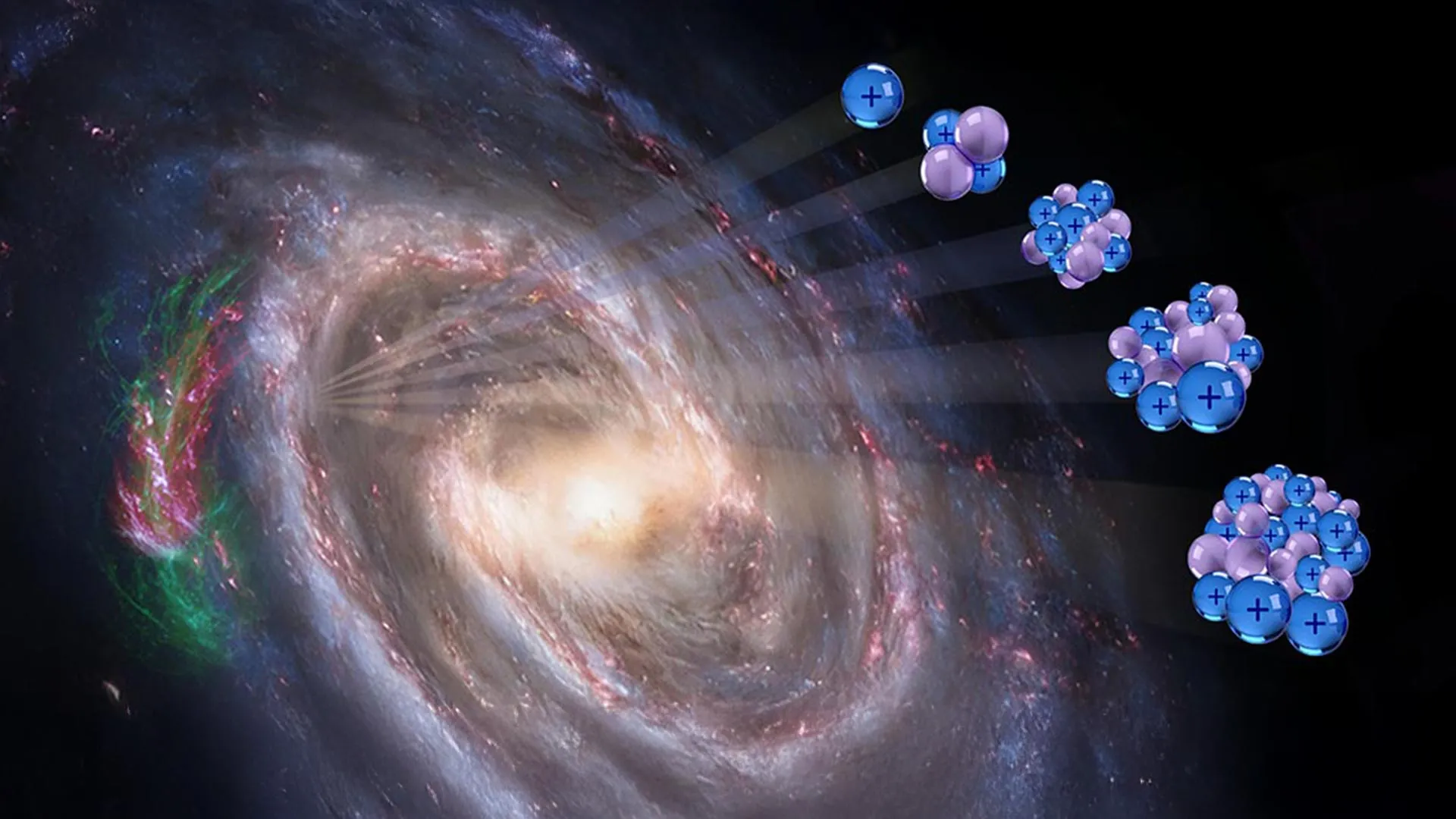
The Dark Matter Particle Explorer (DAMPE) satellite has provided a definitive breakthrough in high-energy astrophysics by identifying a universal "spectral softening" across various species of cosmic ray nuclei, a discovery that offers a new perspective on how these particles are accelerated and propagated through the Milky Way. Published in the journal Nature, the study reveals that the energy spectra of primary cosmic rays—ranging from the lightest hydrogen protons to heavy iron nuclei—all exhibit a consistent downward break at a specific magnetic rigidity of approximately 15 teravolts (TV). This finding suggests that the mechanisms governing the journey of cosmic rays across the universe are dictated by their magnetic rigidity rather than their energy per nucleon, effectively ruling out several competing theoretical models with a statistical confidence level of 99.999%.
The Century-Old Mystery of Cosmic Radiation
For over 110 years, since Victor Hess first discovered "height radiation" via a balloon flight in 1912, scientists have grappled with the origins and behavior of cosmic rays. These subatomic particles travel at nearly the speed of light and possess kinetic energies that dwarf anything achievable in human-made particle accelerators, such as the Large Hadron Collider (LHC) at CERN. While the lowest-energy cosmic rays originate from the Sun, the high-energy "galactic" cosmic rays are believed to be forged in the universe’s most cataclysmic environments: the shockwaves of supernova explosions, the intense magnetic environments of pulsars, and the relativistic jets emanating from supermassive black holes.
Despite over a century of observation, the precise "engines" that accelerate these particles and the "plumbing" of the interstellar medium that guides them to Earth have remained subjects of intense debate. The primary challenge lies in the fact that cosmic rays are electrically charged. As they traverse the galaxy, their paths are bent and scrambled by interstellar magnetic fields, making it impossible to point a telescope back to their source in the same way astronomers do with light or neutrinos. Consequently, scientists must rely on the "energy spectrum"—the distribution of how many particles arrive at specific energy levels—to decode the history of these cosmic travelers.
The DAMPE Mission and the Geneva Contribution
Launched in December 2015 from the Jiuquan Satellite Launch Center in the Gobi Desert, the DAMPE satellite—nicknamed "Wukong" after the Monkey King of Chinese mythology—was placed into a sun-synchronous orbit at an altitude of approximately 500 kilometers. The mission is a major international collaboration led by the Chinese Academy of Sciences (CAS), with critical contributions from the University of Geneva (UNIGE) in Switzerland and the National Institute for Nuclear Physics (INFN) in Italy.
The University of Geneva’s Department of Nuclear and Particle Physics (DPNC) played a pivotal role in the mission’s technical and analytical success. The Geneva team led the development of the Silicon-Tungsten Tracker (STK), the "eyes" of the telescope. The STK consists of multiple layers of silicon strip detectors interleaved with tungsten plates, allowing for the precise reconstruction of particle trajectories and the identification of their electrical charges. By determining the charge, scientists can distinguish between different types of nuclei, such as hydrogen (one proton), helium (two protons), or iron (26 protons).
Furthermore, the UNIGE researchers applied cutting-edge artificial intelligence and machine learning algorithms to the vast datasets produced by DAMPE. These AI methods were essential for separating the "signal" of rare high-energy nuclei from the "noise" of more common lower-energy particles and background gamma rays. "Cosmic rays are primarily composed of protons, but also of helium, carbon, oxygen, and iron nuclei," explains Andrii Tykhonov, associate professor at the DPNC and a lead co-author of the study. "These particles are categorized according to their energy: low, intermediate, and high. The precision of DAMPE has allowed us to see features that were previously hidden in the data of older experiments."
Discovering the 15 TV Threshold: A Universal Pattern
The core of the discovery lies in the observation of "spectral softening." In astrophysics, a spectrum is often described by a "power law," where the number of particles decreases predictably as their energy increases. However, the DAMPE data revealed that for every species of nucleus measured—protons, helium, carbon, oxygen, and iron—the decline in particle numbers becomes significantly steeper once a certain threshold is crossed.
Crucially, this "break" in the spectrum occurs at a consistent magnetic rigidity of roughly 15 TV. Rigidity is a measure of a particle’s momentum divided by its electric charge, representing how resistant the particle is to being deflected by a magnetic field. Because the softening occurs at the same rigidity for all nuclei, rather than at the same energy per nucleon, the findings provide a powerful constraint on theoretical physics.
"The fact that this feature appears across different types of particles at the same rigidity strongly supports the idea that the acceleration and propagation of cosmic rays are governed by magnetic processes," says the research team. If the softening had occurred at the same energy per nucleon, it would have suggested a different set of physical laws or sources. The DAMPE data essentially disqualifies those alternative models with a 5-sigma level of confidence, the gold standard for discovery in physics.
Chronology of the DAMPE Research Breakthrough
The journey to this discovery has been a multi-year endeavor involving the collection and analysis of billions of particle events.
- December 2015: DAMPE is launched and begins its three-year primary mission, which was later extended due to the excellent health of the instruments.
- 2017–2019: DAMPE publishes its first major results in Nature, revealing a break in the electronic cosmic ray spectrum at 0.9 TeV, hinting at potential dark matter signatures or nearby astrophysical sources like pulsars.
- 2019–2021: The collaboration focuses on individual nuclei. They confirm a spectral break in the proton spectrum at around 14 TeV and a similar break in the helium spectrum at 34 GeV per nucleon (which corresponds to the same rigidity range).
- 2022–2024: Researchers expand their analysis to heavier nuclei, including carbon, oxygen, and iron. By synthesizing the data from these diverse elements, the team identifies the "universal" nature of the 15 TV softening.
- Late 2024: The comprehensive findings are published in Nature, marking a milestone in the mission’s legacy.
Technical Analysis and Implications for Galactic Models
The identification of the 15 TV softening has profound implications for our understanding of the "Galactic Accelerator." One leading theory is that this break represents the maximum energy limit of the most common cosmic ray sources in our local neighborhood of the galaxy. Just as a car engine has a "redline" limit for its RPMs, supernova remnants may have a physical limit to how much they can accelerate particles based on the strength of their magnetic fields.
Alternatively, the softening could be a result of "leakage." As cosmic rays reach higher rigidities, the Milky Way’s magnetic field becomes less effective at trapping them. At 15 TV, these particles may begin to escape the galactic disk more easily, leading to the observed drop in the number of particles reaching Earth-based detectors.
The DAMPE results also provide a vital bridge to understanding the "knee" of the cosmic ray spectrum. For decades, scientists have known that at even higher energies—around 1,000,000 TV (or 1 PeV)—the cosmic ray flux drops even more sharply. The 15 TV feature discovered by DAMPE may be a "pre-knee" structure, providing a missing link in the transition from local solar-influenced particles to the most energetic particles in the galaxy.
Global Scientific Impact and Future Outlook
The success of DAMPE has reinvigorated the field of space-based particle detection. For years, the Alpha Magnetic Spectrometer (AMS-02) on the International Space Station was the primary tool for these measurements. However, DAMPE’s ability to measure higher energies with greater precision has allowed it to surpass previous limits.
The broader scientific community has reacted with enthusiasm to the Nature publication. Independent astrophysicists note that these results will require a significant revision of the "Standard Model" of cosmic ray propagation. By providing tighter limits on existing models, DAMPE is helping theorists narrow down the possible locations and types of sources responsible for the radiation that constantly bathes our planet.
Looking ahead, the DAMPE collaboration continues to monitor the cosmos. The telescope remains in excellent condition, and its mission extension allows for the collection of even more "rare events" at the highest energy ranges. Meanwhile, plans are already underway for next-generation detectors. The High Energy cosmic Radiation Detection (HERD) facility, planned for the future Chinese Space Station, aims to extend these measurements to the PeV range, directly probing the "knee" and potentially identifying the specific supernova remnants responsible for the galaxy’s most energetic particles.
The discovery at 15 TV stands as a testament to the power of international scientific cooperation and the role of advanced technology—from Swiss-made silicon trackers to sophisticated AI—in unraveling the oldest mysteries of the universe. As DAMPE continues its silent vigil above the Earth, each particle it detects brings humanity one step closer to understanding the violent, high-energy heart of our galaxy.