The pursuit of the fundamental building blocks of the universe has long been a game of scale, where larger detectors and more complex instrumentation were the only paths to discovery. However, a collaborative team of physicists and engineers from ETH Zurich and EPFL (École Polytechnique Fédérale de Lausanne) has introduced a paradigm shift in how scientists observe subatomic interactions. By integrating advanced light field photography with single-photon sensitive electronics and artificial intelligence, the researchers have developed a detector known as PLATON (PLenoptic Analysis for TOmographic Neutrino detection). This innovation promises to bypass the massive financial and technological bottlenecks currently hindering the next generation of particle physics experiments, while simultaneously offering a revolutionary tool for medical diagnostics.
The Bottleneck of Conventional Particle Detection
To understand the significance of the PLATON project, one must first consider the immense challenges involved in modern particle physics. Experiments targeting weakly interacting particles—such as neutrinos or dark matter candidates—require massive volumes of sensitive material. Because these particles rarely interact with ordinary matter, detectors must be large enough to increase the probability of a "hit." When a particle does interact within a detector, it typically produces a flash of light through a process called scintillation.
Traditionally, to determine the exact three-dimensional path of a particle, the detector material is segmented into millions of individual units. For instance, the T2K (Tokai to Kamioka) neutrino-oscillation experiment in Japan utilizes a detector containing approximately two tons of sensitive material divided into two million individual cubes, each connected by 60,000 optical fibers. Similarly, experiments at CERN’s Large Hadron Collider (LHCb) and the Paul Scherrer Institute (Mu3e) rely on millions of thin scintillating fibers to achieve sub-millimeter resolution.
While effective, this "segmentation" approach is reaching its practical limits. As detectors scale toward the kiloton range, the labor required to assemble millions of fibers and the electronic complexity of reading out millions of channels create a "technological bottleneck." The costs associated with manufacturing and power consumption for such systems are becoming prohibitive for the global scientific community.
The PLATON Concept: From Segmentation to Computational Imaging
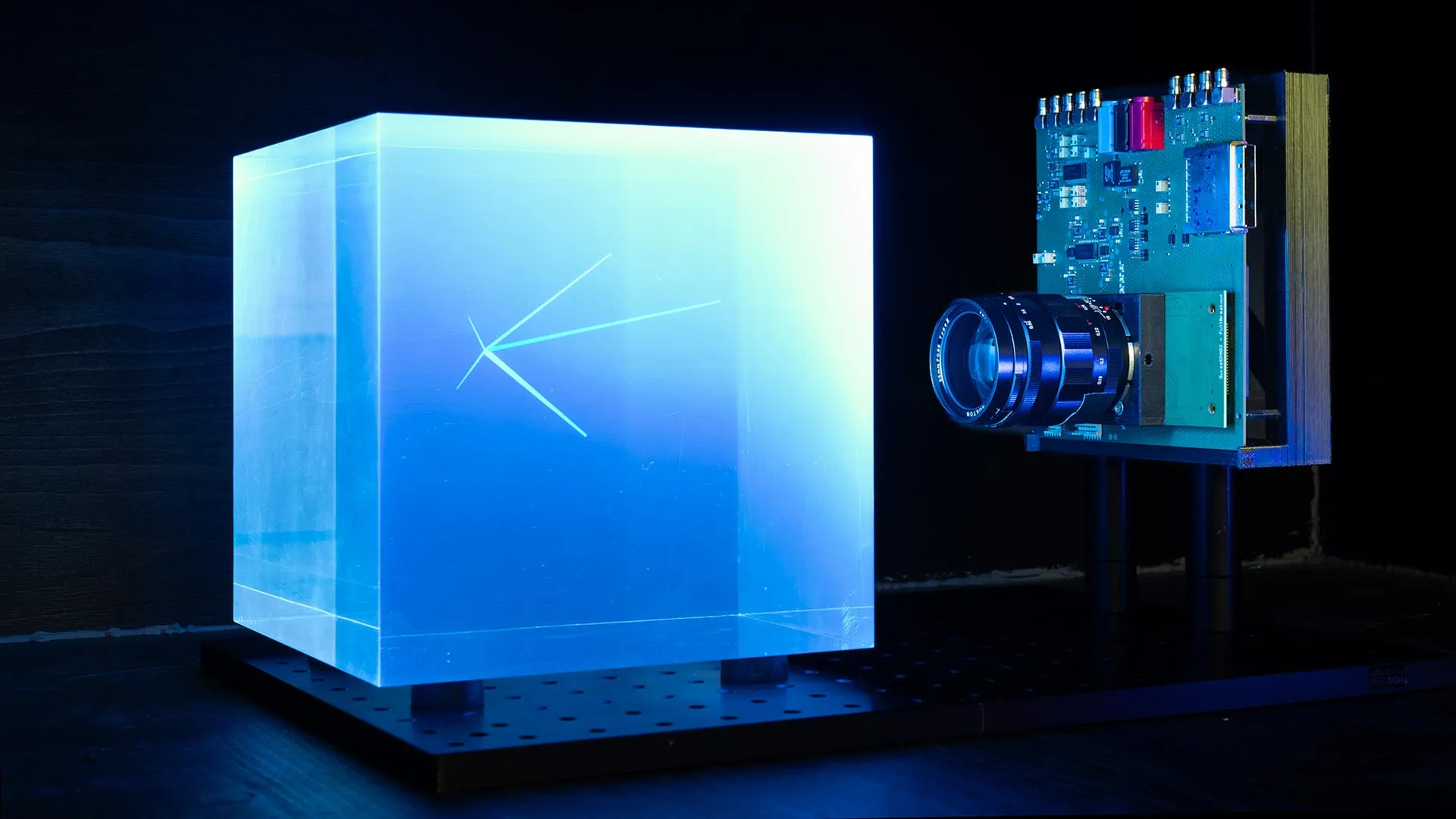
The PLATON project, led by Professor Davide Sgalaberna and PhD student Till Dieminger at ETH Zurich, in collaboration with Professor Edoardo Charbon’s Advanced Quantum Architecture Lab at EPFL, proposes a radical alternative: a monolithic, unsegmented block of scintillator. Instead of physically dividing the material to locate a light source, the team uses a specialized camera system to "see" inside the solid block and reconstruct the 3D origin of every photon.
This approach draws its primary inspiration from plenoptic or "light field" photography. A standard camera records only the intensity and color of light hitting a pixel, losing information about the direction from which that light arrived. In contrast, a light field camera captures the full 4D light field. By placing a micro-lens array (MLA) between the main lens and the imaging sensor, the system functions like thousands of tiny cameras looking at the same scene from slightly different perspectives. This directional data allows researchers to mathematically reconstruct the depth and volume of light sources within the scintillator block.
Technical Foundations: SwissSPAD2 and Micro-Lens Arrays
The hardware heart of the PLATON prototype is the SwissSPAD2, a sophisticated sensor developed by the EPFL team. This sensor utilizes Single-Photon Avalanche Diode (SPAD) technology, which is sensitive enough to detect a single photon of light. In the realm of particle physics, where a single electron or proton interaction might only produce a handful of detectable photons, this sensitivity is non-negotiable.
The prototype integration was completed by Raytrix GmbH, which mounted a custom micro-lens array directly onto the SwissSPAD2 sensor. This created a plenoptic imaging system capable of "gated" detection. Gating allows the sensor to activate only during specific nanosecond windows, effectively filtering out "dark counts" (random electronic noise) and background radiation. This ensures that the data processed by the system consists almost entirely of genuine scintillation events.
Experimental Validation and Performance Data
The researchers subjected the PLATON prototype to rigorous laboratory testing, the results of which were recently published in Nature Communications. One of the most striking findings was the system’s ability to maintain spatial resolution even at extremely low light levels. In tests involving as few as five detected photons, the system could still reconstruct the position of a light source with high accuracy.
To simulate real-world conditions, the team used a Strontium-90 source to produce electrons within a block of plastic scintillator. The prototype successfully tracked these electrons, and the experimental data closely aligned with the team’s sophisticated Monte Carlo simulations.
Key data points from the study include:
- Spatial Resolution: Simulations of a (10x10x10) cm³ unsegmented detector achieved sub-millimeter spatial resolution.
- Sensitivity: Reliable detection and reconstruction were achieved with levels ranging from several hundred down to 5 photons.
- Purity and Efficiency: The system demonstrated a high capability for identifying neutrino interactions that produce low-momentum protons, a critical requirement for studying neutrino-nucleus interactions.
The Role of Transformer-Based Artificial Intelligence
A significant portion of PLATON’s success is attributed to its "software-defined" nature. To process the complex 4D light field data, the team implemented a neural network based on the Transformer architecture—the same underlying technology used in Large Language Models (LLMs) like GPT-4.
In this context, the Transformer does not process words; instead, it analyzes the spatial and temporal correlations between individual photons. By treating the arrival of photons as a sequence of events in a 3D space, the AI can "deconvolve" the light field to pinpoint exactly where the particle traveled. This AI-driven reconstruction allows the system to achieve the resolution of a segmented detector without any of the physical partitions.
Chronology of Development and Future Scaling
The development of PLATON has followed a structured timeline supported by the Swiss National Science Foundation (SNSF):
- Phase 1 (Conceptualization): Integration of light field theory into high-energy physics models.
- Phase 2 (Hardware Integration): Development of the SwissSPAD2 and its marriage with the Raytrix MLA.
- Phase 3 (Prototype Testing): Laboratory experiments with Strontium-90 and low-photon emitters.
- Phase 4 (Scaling – Ongoing): The team is currently designing an upgraded SPAD array with sub-nanosecond timing for each individual photon, rather than fixed time windows.
The ultimate goal is to scale the technology to a one-cubic-meter detector. Preliminary simulations for a detector of this size suggest a spatial resolution of a few millimeters is already achievable, rivaling state-of-the-art plastic scintillator detectors like those used at CERN, but at a fraction of the mechanical complexity.
Beyond Physics: Implications for Positron Emission Tomography (PET)
While the primary driver for PLATON is fundamental physics, the team was quick to recognize its potential in the medical field. Positron Emission Tomography (PET) scans rely on detecting gamma rays produced by radioactive tracers in a patient’s body. These gamma rays hit scintillator crystals, producing light that is then detected to form an image.
Current PET scanners are limited by the size and arrangement of their scintillator crystals. The PLATON technology—specifically the ability to reconstruct 3D light origins in a monolithic block—could lead to PET scanners with significantly higher resolution and better sensitivity. This would allow for the detection of smaller tumors and a reduction in the dose of radioactive tracers required for patients.
In a move that highlights the commercial and clinical potential of this research, Dieminger, Alonso-Monsalve, and Sgalaberna have filed three patents related to the use of PLATON in PET imaging. These patents cover both the hardware scanner design and the neural network processing techniques.
Analysis: A New Era of "Transparent" Detectors
The implications of the PLATON project extend far beyond the laboratory. By moving the complexity of particle detection from hardware (millions of fibers) to software (AI and light field reconstruction), the researchers have opened the door to a more sustainable and scalable form of "Big Science."
If successful at the cubic-meter scale, PLATON-style detectors could become the standard for future neutrino observatories and dark matter searches, where the cost of traditional segmentation would be astronomical. Furthermore, the cross-pollination between particle physics and medical imaging reinforces a long-standing tradition of fundamental research yielding practical societal benefits. Just as the World Wide Web was born at CERN to facilitate data sharing, the next generation of cancer diagnostics may well be rooted in the quest to understand the most elusive particles in the universe.
As the team at ETH Zurich and EPFL continues to refine their SPAD sensors and neural networks, the scientific community awaits the first full-scale deployment of a "transparent" detector—a device that sees the invisible not by chopping it into pieces, but by capturing the very essence of light itself.