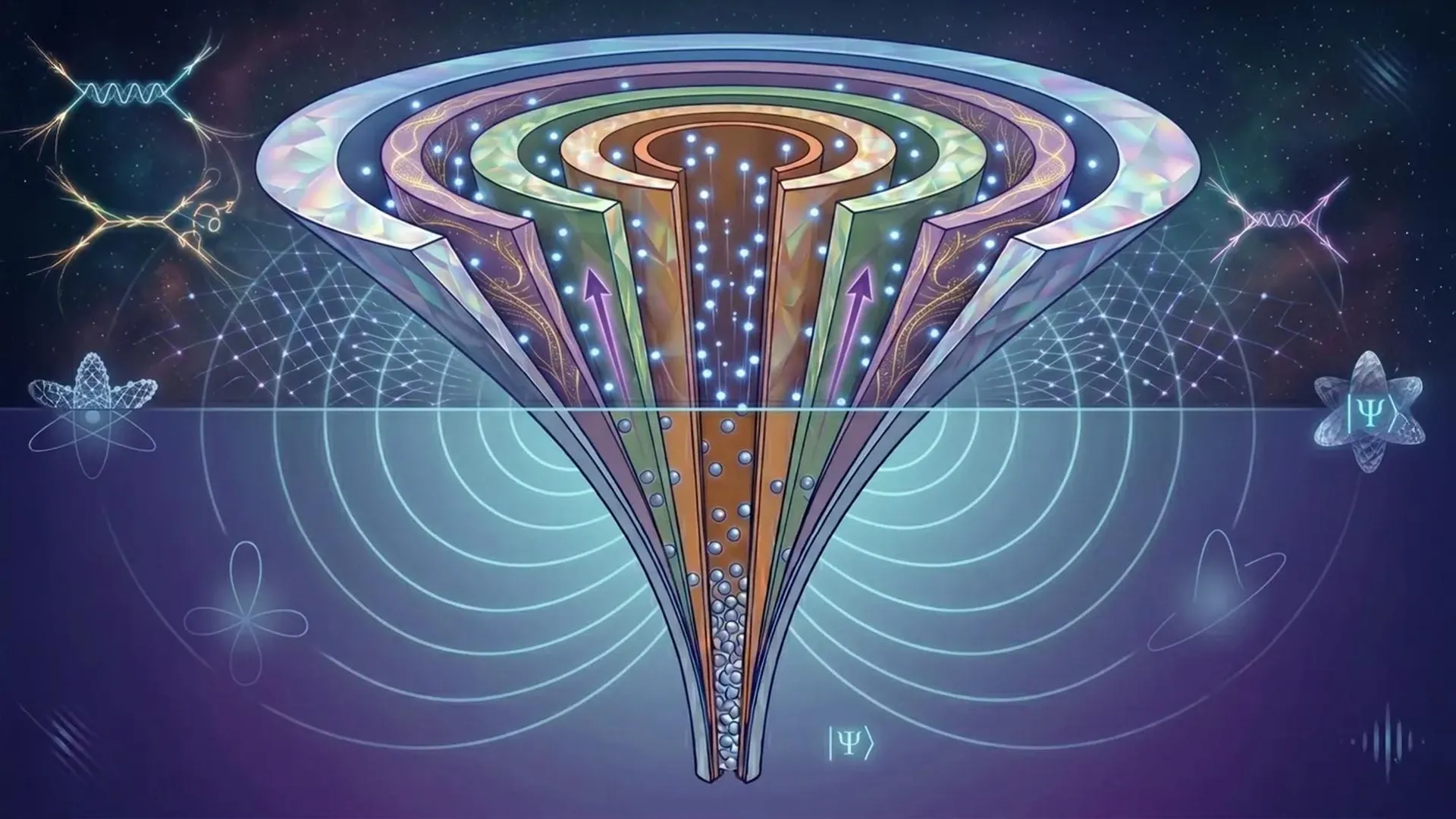
In a landmark advancement for the field of many-body physics, an international collaboration of researchers has successfully demonstrated the theoretical and practical framework for creating "fractional Fermi seas," a previously elusive class of quantum states. The study, published in the prestigious journal Physical Review Letters, marks a significant departure from established equilibrium physics, revealing how quantum particles can be manipulated into highly organized, non-equilibrium configurations that defy traditional classification. Conducted by the Nägerl group at the University of Innsbruck, in partnership with theoretical physicist Alvise Bastianello from the Centre National de la Recherche Scientifique (CNRS) and Université Paris-Dauphine, the research provides a new lens through which scientists can view the behavior of matter at the atomic scale.
The discovery centers on the behavior of ultracold atoms confined to one-dimensional (1D) environments. In these restricted dimensions, quantum effects become dominant, and the standard rules of three-dimensional physics often cease to apply. By subjecting cesium atoms to repetitive cycles of interaction strength—moving them rapidly between states of intense repulsion and intense attraction—the team observed the emergence of a new critical phase of matter. This state, characterized by what the researchers term a "fractional Fermi sea," exhibits a hidden order and internal correlation structure that surpasses the predictions of the Tomonaga-Luttinger liquid theory, which has served as the bedrock of 1D quantum physics for over half a century.
The Foundation of One-Dimensional Quantum Systems
To appreciate the significance of the fractional Fermi sea, it is necessary to understand the traditional models it challenges. In standard quantum mechanics, fermions—a category of particles that includes electrons, protons, and neutrons—obey the Pauli Exclusion Principle, which dictates that no two fermions can occupy the same quantum state simultaneously. At temperatures near absolute zero, these particles stack into the lowest available energy levels, filling them up to a specific limit known as the Fermi energy. This "stack" is referred to as the Fermi sea.
In three-dimensional space, fermions can generally be treated as individual entities with minor corrections for their interactions. However, in one dimension, the particles are forced to interact collectively. If one particle moves, it must push its neighbors, creating a ripple effect throughout the entire system. Since the 1950s and 60s, these systems have been described by the Tomonaga-Luttinger liquid theory. This theory posits that 1D systems do not behave like a gas of individual particles but rather like a collective fluid. While robust, this theory primarily describes systems at or near equilibrium—the state where a system has settled into its lowest energy configuration or a stable thermal state.
The work by the Nägerl and Bastianello groups pushes the boundaries of this paradigm by exploring "far-from-equilibrium" conditions. By driving the system through extreme shifts in interaction, the researchers have moved beyond the "liquid" description and into a territory where the particles reorganize into a "fractional" configuration.
Chronology of the Discovery and Experimental Evolution
The journey toward the discovery of fractional Fermi seas is rooted in decades of refinement in the field of quantum simulation. The following timeline outlines the progression from theoretical foundations to the recent breakthrough:
- 1950s–1963: Shin’ichirō Tomonaga and Joaquin Mazdak Luttinger develop the mathematical foundations for 1D quantum fluids, later refined by Duncan Haldane in the 1980s.
- Early 2000s: The advent of optical lattice technology allows physicists to trap atoms using intersecting laser beams, effectively creating "artificial crystals" of light where atoms can be confined to 1D tubes.
- 2004–2010: Researchers begin successfully simulating the Tonks-Girardeau gas, a state where bosons (particles that usually cluster together) begin to act like fermions due to strong 1D repulsion.
- 2020–2022: The Nägerl group at Innsbruck focuses on the dynamic control of cesium atoms, utilizing Feshbach resonances—a tool that uses magnetic fields to tune the interaction strength between atoms with extreme precision.
- 2023: Theoretical collaboration with Alvise Bastianello leads to the hypothesis that periodic driving of these interactions could yield a stable, highly excited state rather than simply heating the system into chaos.
- 2024: The publication of the theoretical framework in Physical Review Letters confirms the existence of the fractional Fermi sea and its departure from Luttinger liquid norms.
The Mechanism of Interaction Cycling
The core of the experiment involves a process that might intuitively seem destructive. Usually, when a quantum system is "shaken" or driven by external forces, it absorbs energy and heats up, eventually reaching a state of maximum entropy or disorder. However, the researchers discovered that by "cycling" the interactions—smoothly yet rapidly shifting the atoms from a state of strong repulsion to strong attraction—the system avoids thermalization.
Instead of becoming a hot, disordered gas, the atoms undergo a sophisticated reorganization. "Instead of simply heating the system, the interaction cycle reorganizes the atoms into a new many-body state," explains Yi Zeng, the study’s lead author. This state is "highly excited," meaning it possesses significantly more energy than the ground state, yet it remains remarkably stable and structured.
The "fractional" nature of this state refers to the occupancy of the momentum states. In a traditional Fermi sea, the occupancy is binary: states are either full or empty. In the fractional Fermi sea, the particles appear to obey a reduced occupancy rule, effectively "thinning out" the sea in a way that suggests the emergence of new types of quasiparticles. Hanns-Christoph Nägerl, the group leader, has tentatively suggested the term "super-Fermions" to describe these entities, noting that they possess properties that do not align with any known fundamental particle.
Supporting Data: Hidden Order and Friedel Oscillations
The researchers utilized advanced mathematical correlations to identify the "hidden order" within this excited state. One of the primary pieces of evidence for this new phase is the presence of Friedel oscillations. In condensed matter physics, Friedel oscillations are ripples in the density of charges (or particles) around an impurity or a boundary.
In the fractional Fermi sea, these oscillations were found to be pronounced and persistent across all levels of repulsive interactions. Furthermore, the decay behavior of these correlations—how the influence of one particle fades over distance—matched neither the standard Fermi gas nor the Tomonaga-Luttinger liquid.
Data from the study indicates that:
- The system maintains "criticality," meaning it sits at a point where its properties are universal and not dependent on the microscopic details of the atoms.
- The momentum distribution shows a distinctive "step" that is smaller than that of a standard fermion, signifying the fractional occupancy.
- The state survives multiple cycles of interaction tuning, suggesting a robust topological or dynamical protection that prevents it from collapsing into heat.
Perspectives from the Scientific Community
The discovery has prompted significant interest from both theoretical and experimental physicists. While the current paper provides the theoretical scaffolding, a companion paper detailing the experimental realization is currently undergoing peer review.
Alvise Bastianello, the lead theorist, emphasizes the philosophical shift this research represents. "Fermions stack neatly into available energy states… but what happens if one forces interacting atoms to continuously cycle through extreme conditions?" He suggests that this work opens the door to "non-equilibrium engineering," where researchers don’t just study what nature provides but actively drive matter into states that cannot exist under normal conditions.
Hans-Christoph Nägerl views the discovery as a testament to the power of cold-atom simulators. "We are not yet sure how we should name these new quasiparticles," he stated, highlighting the "super-Fermion" concept. He believes the work shows that quantum simulators are moving beyond their initial role of "calculators" for existing theories and are now becoming "explorers" of entirely new physical territories.
Broader Implications and Future Directions
The implications of discovering a new critical phase of matter extend far beyond the laboratory. Understanding how to stabilize highly excited quantum states is a crucial hurdle in the development of quantum technologies, including quantum computing and high-precision sensors.
1. Quantum Simulation and Computing:
Most quantum computers rely on maintaining delicate states of equilibrium. The ability to create stable, organized states far from equilibrium suggests that there may be new ways to store and process quantum information that are more resilient to external noise.
2. Materials Science:
The "hidden order" found in the fractional Fermi sea could provide clues to the behavior of exotic materials like high-temperature superconductors. In many of these materials, electrons are confined to 1D or 2D layers, and their interactions are complex. The fractional Fermi sea provides a "clean" environment to study these interactions without the interference of crystal lattice defects found in natural minerals.
3. Fundamental Physics:
The emergence of "super-Fermions" challenges our understanding of particle statistics. If these quasiparticles can be further isolated and characterized, they may lead to a revision of the standard models used to describe collective electron behavior in metals and semiconductors.
As the scientific community awaits the publication of the experimental companion paper, the Innsbruck group is already looking toward the next phase of research. Future experiments will likely involve probing the transport properties of fractional Fermi seas—testing how they conduct "heat" or "charge" (in the form of atomic flow). This will determine if the "super-Fermions" can move through a vacuum or a lattice with less resistance than ordinary particles, potentially paving the way for "super-conductive" atomic devices.
In conclusion, the creation of fractional Fermi seas represents a pivotal moment in quantum research. By demonstrating that order can be found deep within highly excited, non-equilibrium states, the Nägerl and Bastianello groups have expanded the map of the quantum world. This discovery not only provides a new tool for cold-atom simulation but also reinforces the idea that the most profound secrets of matter may be hidden not in its resting state, but in its most energetic and dynamic transformations.