The integration of artificial intelligence into the pharmaceutical industry has reached a critical inflection point, as a new collaborative analysis from the Tufts Center for the Study of Drug Development (CSDD) and clinical trial platform provider Medable quantifies the financial impact of agentic AI in clinical research. The study reveals that deploying Medable’s Clinical Monitoring Agent can yield a staggering 82x return on investment (ROI) for phase 3 oncology trials, with an estimated $21 million in added financial value. For phase 2 trials, the projected return is 64x, equating to approximately $7.5 million in added net present value (eNPV).
This analysis provides a rare, hard-data look at the "agentic" shift currently transforming clinical operations. While the biopharmaceutical industry has long experimented with predictive analytics and machine learning, the transition to "agentic" workflows—systems capable of performing tasks, recommending actions, and interacting with enterprise software independently—marks a significant departure from traditional passive data processing.
The Financial Imperative: Quantifying AI Value
For decades, the pharmaceutical sector has struggled with the "innovation productivity gap." As clinical trials grow in complexity, the volume of data generated per protocol has skyrocketed. Data from the Tufts CSDD indicates that a typical phase 3 protocol in 2024 involved an average of 5.9 million data points, a massive increase from the roughly 929,000 data points collected in 2012. This explosion of data has placed an unprecedented burden on Clinical Research Associates (CRAs) and site monitors, who are tasked with synthesizing disparate streams of information to ensure patient safety and data integrity.
The Tufts-Medable study serves to translate these operational headaches into balance-sheet metrics. Ken Getz, executive director of the Tufts CSDD, emphasized that the lack of clear financial modeling has previously hampered the adoption of AI tools. By applying an eNPV model to oncology trials, the research team successfully demonstrated that AI is not merely a "nice-to-have" efficiency tool but a driver of significant capital preservation. For large-scale sponsors managing portfolios of 50 or more indications, the projected incremental value reaches as high as $565 million, suggesting that the compounding effects of AI-driven efficiencies could fundamentally alter the risk-adjusted return profiles of entire R&D pipelines.
Chronology of the AI Shift in Clinical Trials
The current climate is the result of a multi-year maturation process in digital health technology:
- 2020–2022: The Pandemic Catalyst. The COVID-19 pandemic forced a rapid, industry-wide adoption of decentralized clinical trial (DCT) technologies, setting the stage for digital-first data collection.
- 2023: The Rise of Generative AI. Following the broad release of large language models, the pharmaceutical industry shifted its focus from simple data automation to generative and agentic workflows.
- 2025: Evidence of Impact. A landmark Tufts CSDD analysis of 36 industry-reported AI/ML use cases confirmed an 18% reduction in cycle times, particularly in patient monitoring and enrollment assessments.
- Late 2026: The Quantified ROI Era. The current Tufts-Medable collaboration represents the next phase: moving beyond anecdotal success stories to rigorous, investment-grade financial modeling of AI performance.
Architecture of the Clinical Monitoring Agent
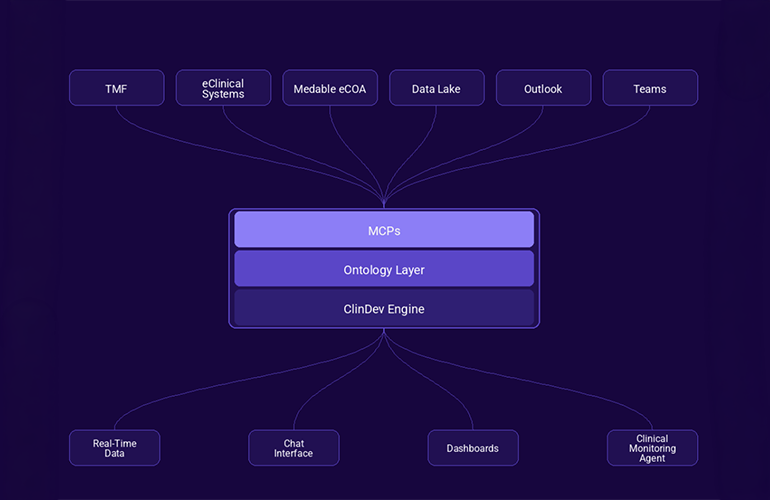
Medable’s approach to agentic AI relies on a modular architecture designed to bridge the gap between siloed clinical systems. The platform utilizes prebuilt agents that connect directly to essential enterprise infrastructure, including Electronic Data Capture (EDC) systems like Medidata Rave and Oracle InForm, as well as Clinical Trial Management Systems (CTMS) and Trial Master File (TMF) repositories.
Dr. Pamela Tenaerts, Chief Medical Officer at Medable, explains that these agents are not "plug-and-play" in the traditional sense. Because every sponsor’s infrastructure is unique, Medable typically requires roughly 20% customization to ensure the agent aligns with specific protocols and internal data standards. Once configured, the agent functions as a high-speed analyst, scanning thousands of data points to identify anomalies—such as inconsistent adverse-event reporting or enrollment trends that deviate from the expected trajectory.

The agent’s primary utility is its ability to "contextualize" data. For instance, if a site reports a concomitant medication but fails to log a corresponding adverse event, the agent identifies the discrepancy, drafts an EDC query, and alerts the monitoring team. This capability allows human monitors to move away from mundane, repetitive data checking toward the higher-level, strategic oversight of trial success.
Addressing the 95% Failure Rate
The persistent high failure rate of oncology drug candidates remains the primary challenge in clinical development. Despite decades of scientific advancement, small-molecule cancer drugs continue to face a roughly 95% failure rate through the phase 1 to phase 3 pipeline. The Tufts-Medable analysis posits that agentic AI could help mitigate some of the "human-error" and "oversight" factors that contribute to these failures.
By detecting signals earlier—such as subtle shifts in patient lab values or premature trends in adverse events—agents provide sponsors with the "time to intervene." This represents a vital capability in the context of phase 3 trials, where the success rate for oncology drugs has hovered at roughly 43% over the last two decades. While agents cannot change the biology of a drug, they can improve the quality of the evidence, potentially preventing the unnecessary termination of trials due to preventable protocol deviations or poor site performance.
Industry Perspectives: The Human-in-the-Loop Constraint
Despite the optimistic projections for ROI, industry experts maintain a cautious, pragmatic outlook regarding the "autonomy" of these agents. Venu Mallarapu, Chief Transformation and AI Officer at eClinical Solutions, notes that while the industry is moving toward more sophisticated agents, the current reality remains "human-in-the-loop."

"There is nobody that is running fully autonomous agents that not only process the data but also make decisions without human involvement," Mallarapu observed. This sentiment is echoed by Medable’s leadership, who describe their current deployments as "recommend-and-review" systems. The agent surfaces an issue, proposes a course of action, and provides the necessary data for a human to make the final decision.
The primary concern among stakeholders is not the loss of control, but the risk of creating new bottlenecks. If an agent increases the velocity of monitoring and query generation, the pressure shifts to the sites and the human staff responsible for responding to those queries. As Dr. Tenaerts notes, "You push the balloon and it goes somewhere else. You need to figure out the whole system."
Strategic Implications and Future Outlook
The implications of the Tufts-Medable study are profound for the pharmaceutical investment landscape. As organizations face rising costs and increasing regulatory scrutiny, the adoption of agentic AI is likely to shift from an experimental pilot phase to a core operational requirement.
- Portfolio Management: For large pharma, the ability to scale trials across dozens of indications without a linear increase in headcount is a game-changer. The model suggests that the financial value of these agents scales proportionally with the size of the pipeline.
- Regulatory Hurdles: As these tools become more central to trial oversight, regulatory bodies such as the FDA and EMA will likely evolve their guidelines for "AI-monitored" trials, focusing on the transparency and explainability of the agents’ logic.
- The Talent Gap: The future of clinical research will require a new type of CRA—one who is skilled not just in GCP (Good Clinical Practice) and protocol compliance, but in "agent orchestration"—the ability to manage, interpret, and validate the output of AI systems.
As the industry moves toward 2027 and beyond, the focus will likely shift from "can we use AI" to "how do we standardize AI across global trials." The Tufts-Medable analysis provides the foundational data necessary to justify this transition, suggesting that the long-promised efficiency gains of the digital age are finally being realized through the strategic deployment of autonomous and semi-autonomous agents. By transforming how data is processed, monitored, and acted upon, the industry may finally be able to address the inefficiencies that have long hindered the speed and success of life-saving medical innovation.