

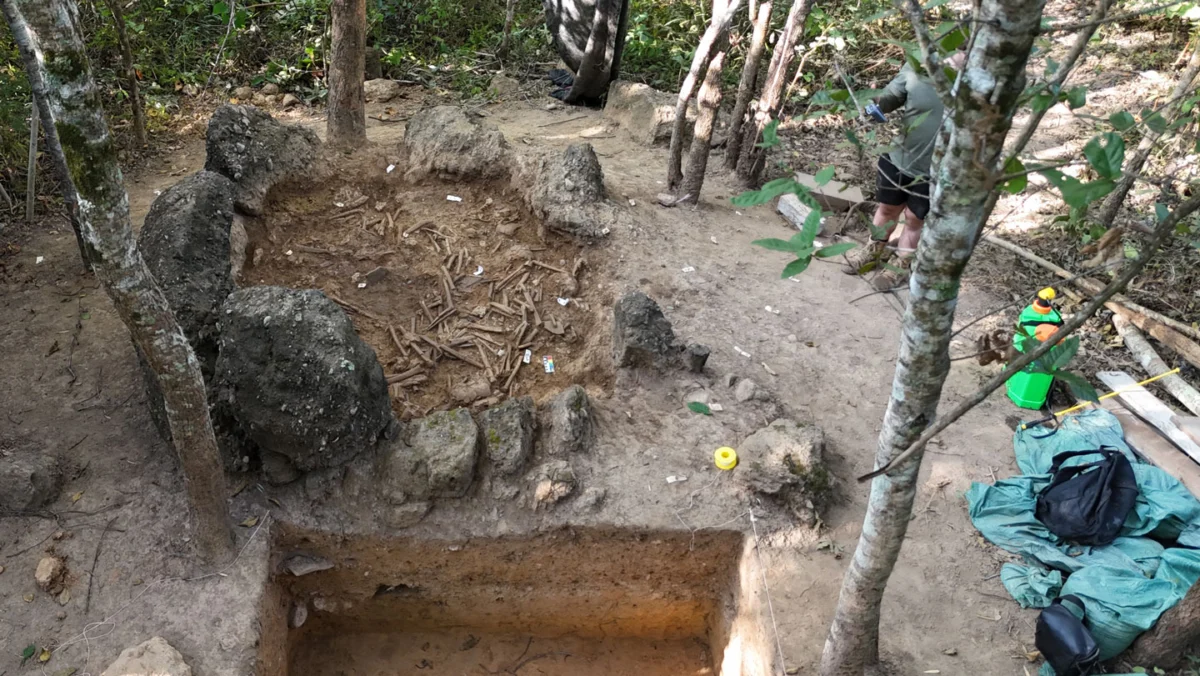
Archaeologists have unearthed a monumental stone jar in northeastern Laos, containing the skeletal remains of at least 37 individuals. Preliminary dating suggests the oldest remains could be over 1,000 years old, pointing to a significant and prolonged use of this unique burial site. The massive stone vessel, measuring over two meters in diameter, is believed to have served as a multigenerational burial site, providing crucial insights into the funerary practices and spiritual beliefs of ancient communities in Southeast Asia, particularly concerning ancestor worship.
Unearthing a Millennia-Old Secret
The discovery, made in a remote wooded area of northern Laos, has sent ripples of excitement through the archaeological community. The sheer scale of the stone jar and the number of individuals interred within it suggest a communal and enduring approach to death and remembrance. This finding adds a significant piece to the complex puzzle of prehistoric and early historical human settlements and belief systems in a region that has historically been less extensively studied than others in Asia.
The stone jar itself is a marvel of ancient engineering. Crafted from massive stones, its precise construction implies a sophisticated understanding of quarrying, transportation, and assembly techniques. The presence of such a large, singular burial vessel challenges some existing assumptions about burial practices, which often favor individual graves or smaller communal ossuaries.
A Glimpse into the Past: Chronology and Context
The estimated age of the remains, spanning from the 9th to the 13th centuries, places this burial site firmly within a pivotal period of Southeast Asian history. This era witnessed the rise and fall of various kingdoms, the spread of religious influences, and significant cultural exchanges across the region. The use of the stone jar over several centuries suggests a consistent cultural tradition and a deep-seated respect for lineage and ancestors.
Prior to this discovery, archaeological evidence for elaborate communal burial sites in this specific region of Laos was less pronounced. While large stone jars, often referred to as the "Plains of Jars," are famously found in Xieng Khouang Province, this particular find in the northeast offers a distinct context and potentially different cultural affiliations. The Plains of Jars, a UNESCO World Heritage site, features thousands of enigmatic stone jars scattered across rolling hills, with their exact purpose and the civilization that created them still debated among scholars. The current discovery, though sharing the "stone jar" nomenclature, appears to be a more contained and specific funerary context, potentially offering a more direct window into the rituals surrounding death.
The timeframe of the 9th to 13th centuries is particularly interesting. This period saw the influence of Hinduism and later Buddhism spread throughout Southeast Asia. Understanding whether the burial practices observed at this site reflect indigenous beliefs, syncretic religious practices, or a specific regional interpretation of larger religious currents is a key area for future research.
Supporting Data: The Human Element
The analysis of the skeletal remains is crucial for understanding the demographics and health of the individuals interred. Initial assessments indicate the presence of at least 37 individuals, a substantial number for a single funerary vessel. Further osteological analysis will aim to determine:
- Age and Sex Distribution: Understanding the age and sex breakdown of the individuals can shed light on who was included in this burial. Was it a specific segment of the population, or a representative sample of the community? The presence of individuals of all ages, from infants to the elderly, would strongly support the "multigenerational" hypothesis.
- Cause of Death: While often difficult to ascertain definitively, signs of disease, trauma, or malnutrition could offer insights into the living conditions and challenges faced by this ancient population.
- Dietary Habits: Isotopic analysis of the bones can reveal information about their diet, indicating whether they relied primarily on agriculture, hunting, or fishing, and the diversity of their food sources.
- Genetic Relationships: Advanced DNA analysis, if preserved, could potentially reveal familial relationships between individuals within the jar, providing concrete evidence of lineage and kinship structures.
The placement of the bones within the jar also holds significance. Were they placed carefully, or were they deposited in a more haphazard manner? The arrangement could indicate different stages of decomposition, secondary burial practices, or ritualistic ordering of the remains. Researchers will meticulously document the spatial distribution of the bones to reconstruct the depositional process.
Expert Reactions and Inferred Statements
While direct quotes from the excavating archaeologists are not yet available, their work strongly implies a careful and methodical approach to the excavation. The publication of findings in peer-reviewed journals and presentations at international conferences will undoubtedly follow, where lead researchers like Dr. Nicholas Skopal (credited in the image caption) will elaborate on their interpretations.
Based on the initial description, one can infer the following sentiments and perspectives from the archaeological team:
- Significance of the Find: "This discovery represents a remarkable opportunity to understand the complex funerary traditions of ancient Southeast Asia. The scale of the stone jar and the number of individuals interred suggest a profound cultural and spiritual investment in the deceased and their legacy."
- Multigenerational Burial: "The evidence points towards a deliberate practice of interring multiple generations within the same vessel. This aligns with theories of ancestor veneration, where deceased family members were kept in close proximity to the living, serving as a continuous connection to the past."
- Ancestor Worship: "The concept of ancestor worship is prevalent in many ancient cultures, and this site provides tangible evidence of its practice in this specific region. The stone jar likely served as a focal point for rituals aimed at honoring and appeasing ancestral spirits, ensuring their continued influence and protection over the community."
- Methodological Approach: "Our excavation is proceeding with the utmost care and precision, utilizing the latest archaeological techniques to preserve the context of the remains and extract as much information as possible. Each bone, each fragment, tells a story."
Broader Impact and Implications
The discovery of this ancient stone jar has several significant implications for our understanding of human history in Southeast Asia:
- Cultural Continuity and Change: The extended use of the burial site over several centuries allows for the study of potential changes in funerary rituals, social structures, and belief systems within that community over time. Were there adjustments in how individuals were placed, or in the types of grave goods (if any) associated with the remains?
- Social Stratification: The nature of the burial – a large, communal, and likely labor-intensive undertaking – could indicate a certain level of social organization and cohesion within the community. It might also hint at social hierarchies, although further analysis would be needed to confirm this.
- Regional Connections: By comparing this site with other known archaeological discoveries in Laos and neighboring countries, researchers can begin to map out cultural interactions, trade routes, and the spread of ideas across ancient Southeast Asia. Does this jar share characteristics with the Plains of Jars, or does it represent a distinct cultural tradition?
- Understanding Pre-State Societies: For societies that predated or existed alongside early kingdoms, understanding their burial practices is often one of the primary ways to reconstruct their social, spiritual, and political lives. This find contributes vital data for building a more comprehensive picture of these complex societies.
- Preservation and Future Research: The discovery also highlights the importance of ongoing archaeological exploration in regions that may hold significant historical treasures. It underscores the need for continued funding and support for such research, as well as robust strategies for the preservation of cultural heritage sites.
In conclusion, the stone jar in northeastern Laos is more than just a vessel of bones; it is a repository of cultural memory, a testament to ancient beliefs, and a crucial piece of evidence that will undoubtedly shape our understanding of early human life and spiritual practices in Southeast Asia for years to come. The ongoing analysis promises to unlock further secrets held within this silent, stone testament to a bygone era.















Leave a Reply