

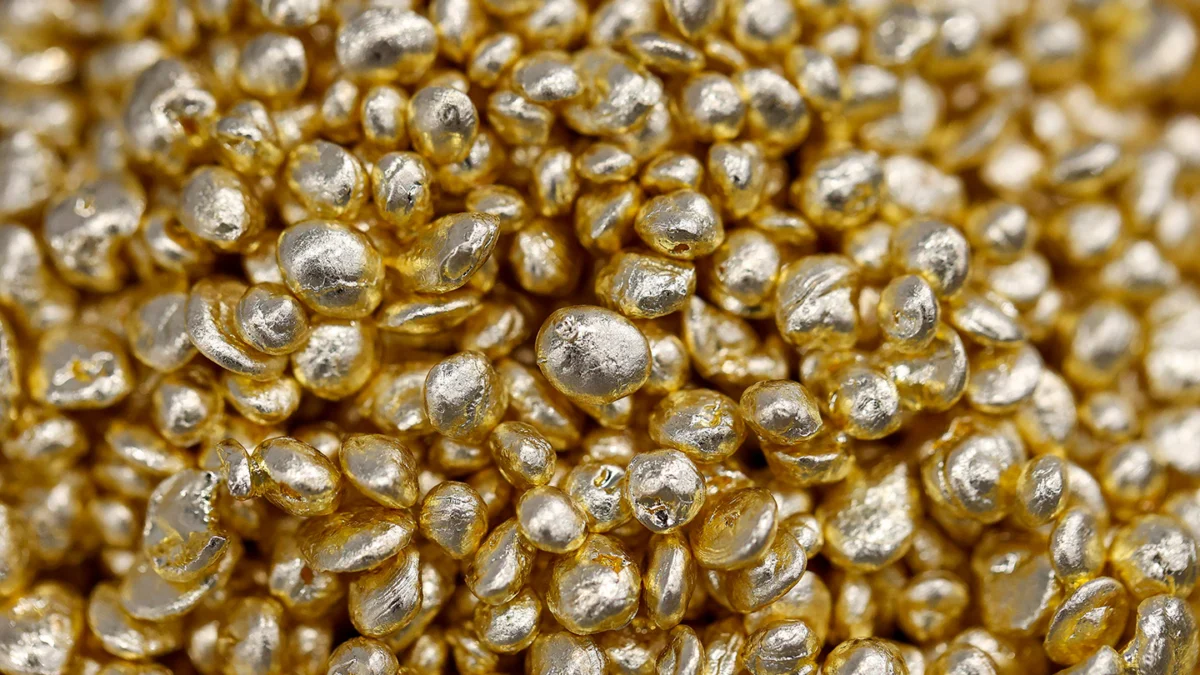
Gold, a metal renowned for its enduring luster and resistance to environmental degradation, owes its remarkable stability to a subtle yet significant atomic rearrangement on its surface. This phenomenon, which prevents the ubiquitous process of oxidation that tarnishes and corrodes most other metals, has long fascinated scientists. Recent research has illuminated the precise mechanisms by which gold’s surface atoms adopt a unique configuration, effectively shielding the underlying metal from reactive oxygen species in the air. This breakthrough offers a deeper understanding of gold’s inherent properties and may pave the way for novel applications in catalysis and material science.
The Enigma of Gold’s Inertness
For centuries, the pristine appearance of gold has set it apart from its metallic counterparts. Unlike iron, which rusts into a brittle reddish-brown oxide, or copper, which develops a green patina of verdigris, gold retains its radiant sheen even after prolonged exposure to the atmosphere. This exceptional inertness stems from gold’s electronic structure and its relatively low reactivity. However, the precise atomic-level details that prevent this reactivity, particularly the interaction with oxygen, have been a subject of ongoing scientific inquiry.
Oxidation, in general terms, is a chemical reaction involving the loss of electrons from a substance. In the case of metals, this often means reacting with oxygen in the air to form metal oxides. These oxides can alter the metal’s physical and chemical properties, leading to corrosion, loss of conductivity, or structural weakening. While most metals readily undergo this process, gold exhibits a remarkable resistance.
Unveiling the Surface Secret: A Geometric Defense
The prevailing scientific understanding has been that gold’s high ionization energy and electron affinity make it less likely to lose electrons and form oxides. However, the new findings delve deeper, revealing that the very arrangement of gold atoms on its surface plays a crucial role. When exposed to air, particularly at elevated temperatures or in the presence of specific catalytic environments, the surface atoms of gold are not static. Instead, they undergo a dynamic rearrangement.
This rearrangement results in a less densely packed, or "facetted," surface structure. In this configuration, the gold atoms expose fewer active sites to the incoming oxygen molecules. Imagine a perfectly smooth surface versus one with deliberate bumps and divots. The smoother surface offers more direct points of contact for oxygen to interact with the metal. The facetted surface, on the other hand, creates a sort of atomic "armor," where the specific arrangement of atoms physically hinders the oxygen molecules from readily binding and initiating the oxidation process.
The Role of Temperature and Environment
The degree to which gold’s surface rearranges is not a constant. Research indicates that this phenomenon is particularly pronounced at temperatures ranging from approximately 200 to 400 degrees Celsius (392 to 752 degrees Fahrenheit). At lower temperatures, the atomic mobility is insufficient for significant rearrangement. Conversely, at extremely high temperatures, other reactions or changes in the gold structure might occur.
Furthermore, the presence of certain gases or the catalytic activity of the gold surface itself can influence this atomic dance. While gold is generally considered inert, it can act as a catalyst for various chemical reactions. In these catalytic contexts, the surface is often highly active, and the dynamic rearrangement of atoms becomes even more critical in controlling its reactivity and stability.
Chronology of Understanding Gold’s Inertness
The recognition of gold’s unique resistance to corrosion dates back to ancient civilizations, who marveled at its enduring brilliance. Early scientific investigations in the 19th and early 20th centuries focused on gold’s electrochemical properties, identifying its noble metal status and low reactivity.
The concept of surface reconstruction – the rearrangement of surface atoms from their bulk positions – gained prominence in materials science in the mid-20th century. This theory began to be applied to understand the behavior of various metal surfaces.
In recent decades, advancements in surface science techniques, such as scanning tunneling microscopy (STM) and atomic force microscopy (AFM), have allowed scientists to visualize and study metal surfaces at the atomic level. These tools have provided crucial evidence for surface reconstruction in many metals, including gold.
The specific findings regarding the faceting of gold surfaces as a direct mechanism to prevent oxidation have emerged from more targeted studies in the late 20th and early 21st centuries, utilizing sophisticated computational modeling and advanced surface characterization methods. These studies have progressively refined our understanding from general inertness to specific atomic-level defensive strategies.
Supporting Data and Experimental Evidence
Experimental data supporting this geometric defense mechanism comes from a variety of sources. High-resolution transmission electron microscopy (HRTEM) and low-energy electron diffraction (LEED) have been instrumental in visualizing the faceted structures on gold surfaces. These techniques allow researchers to observe the atomic arrangement and confirm the presence of specific crystallographic facets, such as the 110 or 111 planes, which are known to exhibit different surface energies and reactivities.
Computational studies, employing density functional theory (DFT), have provided theoretical underpinnings for these observations. These calculations can model the energy landscape of gold surfaces, predicting the most stable atomic configurations under various conditions and quantifying the energy barriers for oxygen adsorption and diffusion. For instance, DFT calculations have shown that the facetted surfaces of gold have a significantly higher energy barrier for oxygen adsorption compared to flat, unreconstructed surfaces.
Moreover, studies involving gas-phase reactions have demonstrated that gold nanoparticles, when engineered to exhibit specific facets, show enhanced stability and catalytic performance in reactions involving oxygen. This practical application reinforces the theoretical and observational evidence.
Expert Reactions and Analysis
Dr. Anya Sharma, a materials scientist at the Royal Institute of Technology, who was not directly involved in the latest research but specializes in noble metal surface chemistry, commented on the significance of these findings. "For years, we’ve understood gold’s nobility through its electronic properties. However, this latest work elegantly demonstrates that surface morphology is not merely a passive consequence of atomic packing but an active defense mechanism," she stated. "The idea that gold’s surface can dynamically reconfigure itself to present a less reactive facade to oxygen is a profound insight. It moves beyond a static understanding of inertness to a more dynamic, responsive model."
Professor Kenji Tanaka, a leading researcher in heterogeneous catalysis at the University of Tokyo, noted the potential implications for catalytic applications. "Gold is a fascinating catalyst, particularly for oxidation reactions like CO oxidation. Understanding how its surface geometry dictates its reactivity is paramount. If we can precisely control the faceting of gold nanoparticles, we might be able to fine-tune their catalytic activity and selectivity, or even enhance their longevity by preventing unwanted surface degradation," he explained. "This research provides a crucial piece of the puzzle for designing next-generation gold-based catalysts."
Broader Impact and Implications
The implications of this research extend beyond the fundamental understanding of gold’s properties.
Catalysis:
The ability to control the surface faceting of gold could lead to the development of more efficient and durable catalysts. Gold is increasingly used in various catalytic processes, including the oxidation of carbon monoxide (a key reaction in catalytic converters), the synthesis of fine chemicals, and even in environmental remediation. By understanding and manipulating the atomic arrangement that prevents unwanted oxidation, scientists can design gold catalysts that are more resistant to deactivation, thereby extending their lifespan and improving their performance. This could translate to more efficient industrial processes and reduced environmental impact.
Materials Science and Engineering:
The principles learned from gold’s surface behavior could potentially be applied to other less noble metals or alloys. While directly mimicking gold’s inertness might be challenging, understanding how to engineer surface structures to resist oxidation could lead to the development of new corrosion-resistant coatings or advanced materials with enhanced durability. This is particularly relevant in industries such as aerospace, automotive, and construction, where material longevity in harsh environments is critical.
Nanotechnology:
In the realm of nanotechnology, where materials are manipulated at the atomic and molecular scale, precise control over surface properties is essential. This research provides a deeper understanding of how gold nanoparticles behave and interact with their environment. This knowledge can inform the design of gold nanoparticles for applications in drug delivery, biosensing, and advanced electronics, where their surface chemistry plays a vital role.
Fundamental Science:
At its core, this research contributes to our fundamental understanding of surface physics and chemistry. It highlights the intricate interplay between electronic structure, atomic arrangement, and reactivity at the nanoscale. This deeper comprehension of matter at its most fundamental level can fuel further scientific inquiry and lead to unforeseen technological advancements.
Conclusion
The enduring brilliance of gold is not merely a passive characteristic but a testament to an active, dynamic defense mechanism at the atomic level. The rearrangement of gold atoms on its surface into specific geometric configurations serves as a sophisticated shield against the pervasive threat of oxidation. This breakthrough in understanding, driven by advanced experimental and computational techniques, not only deepens our appreciation for this ancient and treasured metal but also opens exciting avenues for innovation in catalysis, materials science, and nanotechnology, promising a future where the principles of gold’s resilience can be harnessed for broader technological benefit.















Leave a Reply