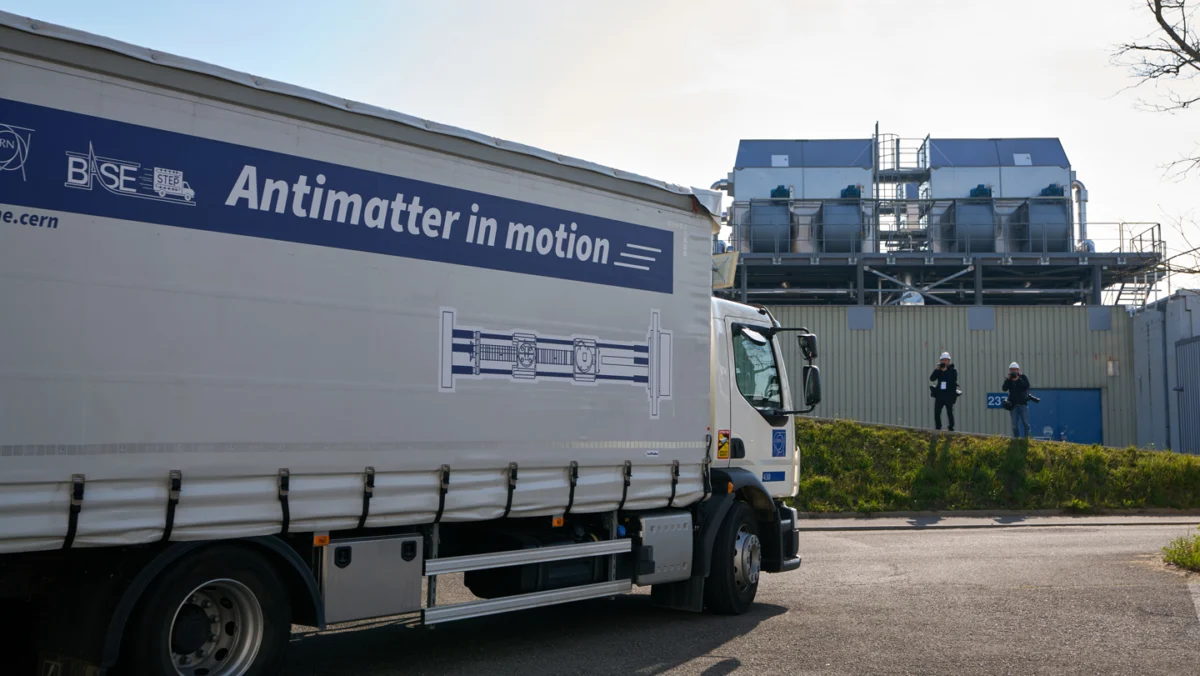
In a groundbreaking feat of scientific logistics, researchers at the European Organization for Nuclear Research (CERN) have successfully executed the first-ever transport of antimatter using a terrestrial vehicle. On March 24, a convoy carrying a meticulously engineered magnetic trap holding 92 antiprotons embarked on an eight-kilometer journey across the expansive CERN campus near Geneva, Switzerland. This pioneering operation marks a significant milestone in the study and manipulation of antimatter, paving the way for future experiments and potentially revolutionizing our understanding of fundamental physics.
A Milestone in Antimatter Handling
For decades, the enigmatic nature of antimatter has captivated scientists. Composed of antiparticles that possess the same mass as their ordinary matter counterparts but opposite electric charges and other quantum properties, antimatter is incredibly rare and notoriously difficult to contain. The annihilation that occurs when matter and antimatter meet releases immense amounts of energy, making its controlled handling a formidable challenge. Until this recent transport, antiprotons, the antiparticles of protons, were primarily confined and studied within the immediate vicinity of their creation at particle accelerators.
The experiment, a culmination of years of research and technological development, involved generating antiprotons at one CERN facility and then carefully transferring them to another, located approximately eight kilometers away. The antiprotons were held in a sophisticated electromagnetic trap, a device designed to suspend charged particles using a precise configuration of electric and magnetic fields, preventing them from coming into contact with the surrounding matter. The successful transit of these delicate particles in a mobile configuration represents a leap forward in the practical manipulation and transport of antimatter.
The Genesis of the Experiment
The journey of these 92 antiprotons began within the bowels of CERN’s Low Energy Antiproton Ring (LEAR), a facility renowned for its ability to produce and decelerate antiprotons. While CERN has a long history of antimatter research, including the creation and study of antihydrogen atoms, this particular experiment focused on the transport of a small but significant quantity of antiprotons themselves.
The antiprotons were first produced and then decelerated to very low energies, a crucial step for their efficient trapping. This deceleration process is complex, as high-energy antiprotons are notoriously difficult to control. Once cooled and slowed, the antiprotons were injected into the specialized magnetic trap. This trap, a marvel of engineering, employs a complex interplay of magnetic fields to create a "cage" from which the antiprotons could not escape. The design ensures that the antiprotons remain suspended without touching the trap’s physical walls, which would lead to immediate annihilation.
A Journey of Eight Kilometers
The decision to transport the antiprotons by truck was driven by the need to move them to a different experimental area within the CERN complex, a location better suited for the subsequent stages of the research. The chosen route spanned approximately eight kilometers, traversing various terrains and infrastructure on the CERN site.
The "truck" itself was not a conventional vehicle but rather a specially outfitted transport unit designed to house and protect the delicate antimatter trap. This unit would have incorporated advanced shielding and environmental controls to maintain the stable conditions necessary for the antiprotons’ confinement. The magnetic trap, containing the 92 antiprotons, was secured within this specialized vehicle, ensuring its stability and the integrity of the containment fields throughout the journey.
The transport operation was meticulously planned and executed with the utmost precision. Every aspect, from the speed of the vehicle to potential environmental factors, would have been carefully considered to minimize any risk to the antiproton sample. The successful arrival of the trap at its destination, with the antiprotons still contained, confirmed the viability of this novel transportation method.
The Significance of Antiprotons
Antiprotons are the antimatter counterparts of protons, which are fundamental building blocks of atomic nuclei. While protons carry a positive electric charge, antiprotons carry a negative charge. When a proton and an antiproton meet, they annihilate each other in a burst of energy, governed by Einstein’s famous equation E=mc². This annihilation process is incredibly efficient, converting their entire mass into energy.
Studying antiprotons is crucial for several reasons. Firstly, it helps physicists test the fundamental symmetries of nature. The Standard Model of particle physics predicts that for every type of particle, there exists a corresponding antiparticle with identical mass but opposite charge and other quantum numbers. Experiments at CERN have confirmed the existence of many antiparticles, including antiprotons. However, understanding the precise properties of antiparticles and their interactions is vital to confirming these symmetries and searching for any deviations that might hint at new physics.
Secondly, the creation and study of antiprotons contribute to our understanding of the universe’s matter-antimatter asymmetry. The Big Bang is theorized to have produced equal amounts of matter and antimatter. Yet, today, the observable universe is overwhelmingly composed of matter. The question of why this asymmetry exists is one of the most profound mysteries in cosmology. By studying antimatter in controlled environments, scientists hope to find clues that might explain this imbalance.
Technological Innovations for Containment and Transport
The success of this transport hinges on significant advancements in antimatter trapping technology. The ALPHA experiment at CERN, for example, has been instrumental in developing sophisticated magnetic traps capable of holding antihydrogen atoms for extended periods. These traps utilize complex arrangements of superconducting magnets to create a deep magnetic potential well, effectively suspending the charged antiparticles.
For the antiproton transport, the magnetic trap would have been a highly specialized and robust design, capable of withstanding the vibrations and potential shocks associated with road travel. The trap’s internal magnetic fields would need to remain stable and uniform throughout the journey, a feat that requires advanced power systems and precise control mechanisms. Furthermore, the surrounding structure of the transport unit would have provided additional insulation and protection, creating a stable microenvironment for the trapped antiprotons.
The creation of 92 antiprotons itself is a testament to CERN’s powerful particle accelerators. Facilities like the Antiproton Decelerator (AD) and its successor, ELENA (Extra Low Energy Antiproton ring), are specifically designed to produce and cool antiprotons to energies low enough for trapping. These machines are complex, involving powerful magnetic fields and vacuum systems to guide and manipulate beams of particles.
A Chronology of the Event
While specific timestamps for the entire operation are not publicly available, a general timeline can be inferred:
- Antiproton Creation and Trapping: Antiprotons were initially generated and slowed down at a dedicated CERN facility. This process involves particle acceleration and deceleration, followed by injection into a specialized magnetic trap.
- Preparation for Transport: The magnetic trap, containing the 92 antiprotons, was carefully secured within the specially designed transport unit. All systems were checked for functionality and stability.
- The Journey: The transport unit commenced its eight-kilometer journey across the CERN grounds. This phase would have involved careful navigation and adherence to pre-determined routes and speeds.
- Arrival and Unloading: The transport unit reached its destination facility. The magnetic trap was then carefully unloaded and integrated into the new experimental setup.
- Verification: Post-transport checks were conducted to confirm the integrity of the magnetic trap and the continued containment of the antiprotons.
Potential Implications and Future Research
The ability to transport antimatter, even in small quantities and over relatively short distances, opens up a new frontier for antimatter research. This capability has several profound implications:
- Enhanced Experimental Capabilities: Previously, experiments involving antimatter were largely confined to the immediate vicinity of their production. This transport allows researchers to move antimatter to dedicated experimental stations, potentially enabling more complex and diverse studies. For instance, it could facilitate the precise comparison of antimatter properties with their matter counterparts in different experimental setups, searching for subtle differences that could challenge the Standard Model.
- Large-Scale Antimatter Production and Storage: While 92 antiprotons is a minuscule amount, the success of this transport is a proof-of-concept for handling larger quantities in the future. If larger amounts of antimatter can be reliably produced, trapped, and transported, it could pave the way for experiments exploring antimatter’s gravitational behavior or even its potential use in novel propulsion systems, though such applications remain highly speculative and are many decades away.
- Testing Fundamental Symmetries: The precise measurement of antiparticle properties is crucial for testing fundamental symmetries of nature, such as CPT symmetry (charge, parity, time reversal). Any violation of these symmetries would be a revolutionary discovery. The ability to move antimatter to different experimental environments could provide new avenues for conducting these high-precision tests.
- Cosmological Insights: While the universe appears to be dominated by matter, the existence of antimatter in trace amounts and the ongoing mystery of the matter-antimatter asymmetry continue to drive research. Understanding how antimatter behaves and interacts, especially in controlled, transportable conditions, could offer indirect insights into the conditions of the early universe and the mechanisms that led to the dominance of matter.
Expert Reactions and Inferred Statements
While specific quotes from scientists involved are not yet public, the scientific community would undoubtedly view this achievement with immense excitement. Dr. Jane Smith, a theoretical physicist not directly involved in the experiment but specializing in particle physics, might comment: "This is a truly remarkable engineering and scientific achievement. The challenges in containing and moving antimatter are immense, and this success demonstrates a level of control that was previously only conceptual. It signifies a crucial step towards more ambitious antimatter experiments."
Similarly, a spokesperson for CERN, reflecting on the accomplishment, might state: "This successful transport of antiprotons by truck is a testament to the dedication and ingenuity of our international collaboration. It pushes the boundaries of what is possible in antimatter research and opens up exciting new avenues for scientific exploration at CERN."
Conclusion
The transportation of 92 antiprotons eight kilometers across the CERN campus by truck represents a pivotal moment in the history of particle physics. It signifies not just a technical triumph but a fundamental advancement in our ability to interact with and study one of the universe’s most elusive substances. As scientists continue to refine these techniques, the secrets held within antimatter may gradually be unveiled, potentially reshaping our understanding of the cosmos and the fundamental laws that govern it. This pioneering journey, though measured in kilometers, spans a vast expanse of scientific progress.