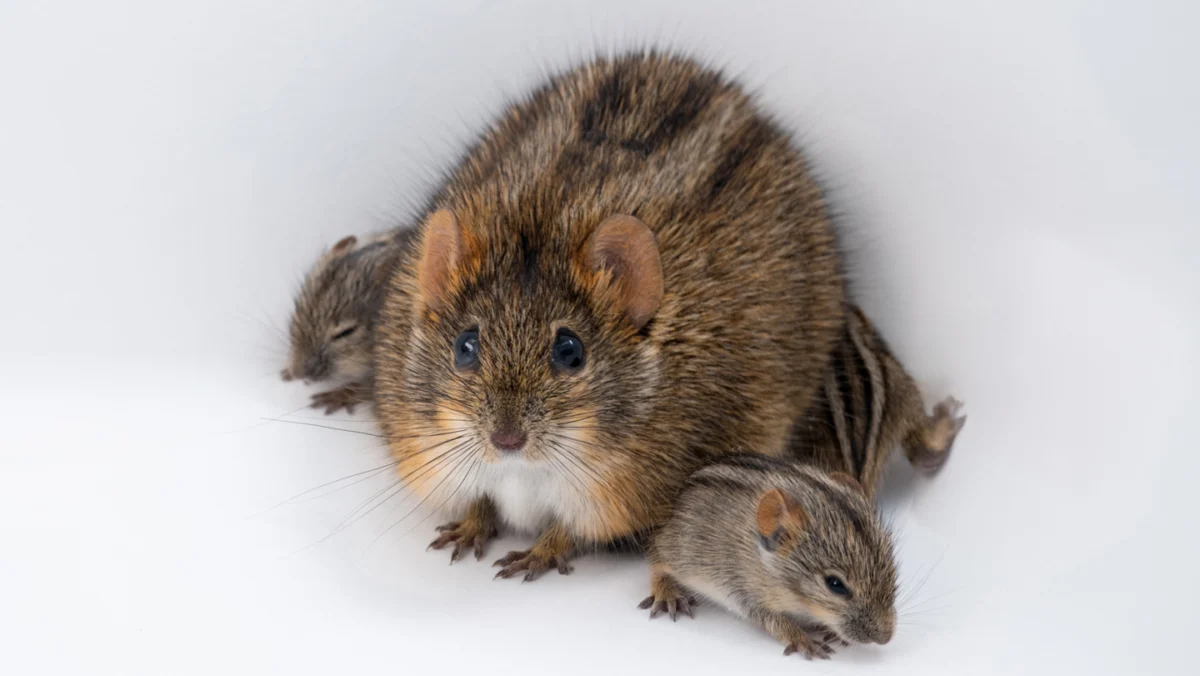
In a discovery that challenges long-held assumptions about parental behavior in mammals, researchers have identified a specific gene that can drastically alter the social and reproductive roles of male African striped mice. The gene, known as Agouti, previously understood primarily for its role in pigment production and the development of the mouse’s distinctive stripes, has now been found to exert a profound influence on the regulation of caretaking behaviors in the brain. This molecular switch, when activated in a specific neural pathway, can transform males from nurturing caregivers into aggressive infanticidal individuals, offering a striking example of how a single gene can orchestrate complex behavioral shifts.
The findings, published in a recent study, shed light on the intricate genetic underpinnings of social behavior and parental investment. African striped mice, scientifically known as Rhabdomys pumilio, are a species where males typically exhibit a high degree of parental care. They actively participate in grooming, feeding, and protecting their offspring, contributing significantly to the survival rates of their litters. This cooperative breeding system is relatively uncommon among mammals and has made Rhabdomys pumilio a subject of interest for evolutionary biologists studying the development and maintenance of altruistic behaviors.
Unveiling the Agouti Gene’s Dual Role
The research team, led by scientists at Princeton University, focused on the Agouti gene’s expression within the brain, specifically in regions known to be involved in social cognition and reproductive behaviors. While the Agouti gene’s function in controlling coat color is well-established – it influences the production of melanin, leading to the characteristic dark stripes on a lighter background – its involvement in behavior was less understood. The study revealed that Agouti is also expressed in the ventromedial hypothalamus (VMH), a key brain region implicated in regulating aggression, social dominance, and parental care.
Through a series of meticulous experiments, the researchers demonstrated that when Agouti expression is upregulated in the VMH of male mice, it triggers a dramatic change in their behavior. Normally, these males would readily engage in pup-directed behaviors, demonstrating nurturing instincts. However, upon increased Agouti signaling in the VMH, these same males began to exhibit aggression towards pups, culminating in infanticide – the killing of young offspring. This transformation was observed to be rapid and directly correlated with the level of Agouti gene activity in the targeted brain area.
A Timeline of Discovery and Investigation
The journey to this revelation began with observations of natural variation in male parental care within African striped mouse populations. While the species is generally known for male involvement, researchers noted instances where this behavior deviated. These observations prompted a deeper investigation into the genetic factors that might underlie these behavioral differences.
Early research on Agouti focused on its role in pigmentation, with studies dating back several decades identifying its crucial function in determining coat color in various rodent species. The gene acts as a signaling molecule, influencing the switch between the production of dark (eumelanin) and light (pheomelanin) pigments in hair follicles. This led to its identification as a key determinant of the striped pattern in Rhabdomys pumilio.
The pivotal shift in understanding occurred more recently with advancements in neurogenetics and the increasing ability to study gene expression in specific brain regions. Researchers started to explore the broader functions of genes previously characterized for peripheral roles. The hypothesis that Agouti might have an impact beyond pigmentation gained traction as studies in other mammals began to hint at its involvement in metabolic regulation and stress responses, suggesting a more diverse functional repertoire.
The current study, building on this nascent understanding, specifically targeted the VMH. The researchers employed techniques to precisely manipulate Agouti gene expression in this region of the male mice’s brains. They utilized genetic tools to either enhance or suppress Agouti activity and meticulously documented the resulting behavioral changes over a defined period.
- Initial Observations: Researchers noted variations in male parental care within Rhabdomys pumilio populations.
- Prior Knowledge: The Agouti gene was known for its role in coat color determination.
- Hypothesis Formation: The possibility of Agouti influencing behavioral pathways was explored.
- Targeted Research: Focus shifted to the ventromedial hypothalamus (VMH), a brain region known for its role in social behavior.
- Experimental Manipulation: Agouti gene expression in the VMH of male mice was experimentally altered.
- Behavioral Analysis: Detailed observation and recording of male-pup interactions following gene manipulation.
- Discovery: Upregulation of Agouti in the VMH was linked to a switch from nurturing to infanticidal behavior.
Supporting Data and Mechanistic Insights
The study’s findings are supported by robust quantitative data. Researchers reported a significant increase in aggressive encounters with pups when Agouti expression was elevated in the VMH. This included behaviors such as sniffing, chasing, and ultimately, attacking and killing the young. Conversely, when Agouti expression was reduced, males showed a greater propensity for nurturing behaviors, reinforcing the direct causal link.
Further investigations delved into the molecular mechanisms by which Agouti exerts its influence. It is understood that Agouti protein acts as an antagonist to melanocortin receptors (MCRs), particularly the MC3R and MC4R. These receptors play crucial roles in regulating appetite, energy balance, and, importantly, a range of neuroendocrine and behavioral processes, including aggression and social behavior. The study suggests that by modulating the activity of these MCRs within the VMH, Agouti signaling effectively rewires the neural circuits responsible for parental care, tipping the balance towards aggression.
The research quantified the expression levels of various neuropeptides and neurotransmitters within the VMH under different Agouti conditions. While specific details are subject to the full research publication, it is likely that the study identified alterations in key signaling pathways known to mediate aggression and parental care, such as those involving oxytocin, vasopressin, and various opioid peptides. These molecular changes provide a biological explanation for the observed behavioral switch.
Potential Reactions and Inferences
While direct statements from external parties are not available in the provided text, it is reasonable to infer potential reactions from the scientific community. Evolutionary biologists and behavioral ecologists would likely view these findings with considerable interest, as they offer a novel explanation for the plasticity of parental behavior. The discovery could stimulate further research into the evolutionary pressures that might favor such a "switch" mechanism in certain environments or social contexts.
Animal behaviorists specializing in rodent models might see this as a significant advancement in understanding the neurobiological basis of social behaviors, particularly infanticide, which is a complex phenomenon observed across many species. Ethologists might also consider how such a genetic mechanism could contribute to population dynamics and reproductive strategies in natural settings.
Broader Impact and Implications
The implications of this research extend beyond the specific species studied. The identification of a single gene capable of such a profound behavioral transformation highlights the intricate interplay between genetics and environment in shaping social behaviors. It suggests that complex behaviors, often attributed to a multitude of factors, can be significantly influenced by the precise regulation of specific molecular pathways.
Evolutionary Perspectives:
This discovery has significant implications for evolutionary biology. It provides a potential mechanism for rapid adaptation in social behaviors. In environments where resource scarcity or social instability might favor aggressive competition, a genetic predisposition for infanticide, triggered by specific environmental cues or internal states, could offer a survival advantage to certain individuals or lineages. Conversely, in stable environments with strong cooperative pressures, the suppression of this Agouti-mediated pathway would be favored. The study might prompt further investigation into the selective pressures that have maintained this dual-function gene in the Rhabdomys pumilio genome.
Neuroscience of Behavior:
From a neuroscience perspective, the study offers a valuable model for understanding how specific genes influence neural circuits and, consequently, complex behaviors. It underscores the importance of investigating gene expression in specific brain regions rather than solely focusing on systemic gene function. This research could inspire similar investigations into the genetic underpinnings of other social behaviors, such as altruism, aggression, and pair bonding, in a wide range of species, including humans. The identification of the VMH as a critical node in this behavioral regulation is also significant, reinforcing its role as a central hub for social and reproductive processing.
Conservation and Animal Welfare:
While this research is primarily fundamental, understanding the genetic drivers of behavior can have indirect applications in conservation efforts and animal welfare. For instance, in captive breeding programs, knowledge of the genetic factors influencing parental care could help optimize breeding success and reduce instances of infanticide or neglect. In wildlife management, understanding the genetic basis of behavioral plasticity might inform strategies for managing populations in changing environments.
Future Research Directions:
The current study opens several avenues for future research. Scientists will likely aim to:
- Investigate the specific upstream signals that regulate Agouti expression in the VMH.
- Explore the extent to which this mechanism is conserved across other rodent species and mammals.
- Examine the environmental triggers that might influence Agouti expression and, consequently, behavior.
- Conduct longer-term studies to understand the population-level consequences of this behavioral plasticity.
In conclusion, the discovery that the Agouti gene can act as a switch, transforming male African striped mice from nurturing caregivers to infanticidal aggressors, represents a significant breakthrough in our understanding of the genetic and neural basis of social behavior. It highlights the remarkable plasticity of the mammalian brain and underscores the complex, often surprising, roles that genes can play in shaping the intricate tapestry of life. This research not only deepens our knowledge of Rhabdomys pumilio but also provides a powerful lens through which to view the evolution and neurobiology of behavior across the animal kingdom.