A fundamental characteristic of water, long theorized and now empirically demonstrated, has been illuminated by a recent scientific breakthrough: the existence of two distinct liquid phases within supercooled water, which converge into a single, unified liquid state at a specific thermodynamic point. This discovery, made by researchers at POSTECH University in South Korea, provides crucial empirical validation for decades of theoretical modeling and simulations concerning water’s anomalous behavior. The findings, published in a peer-reviewed journal, shed new light on the complex phase diagram of water and its implications for various scientific disciplines.
Unveiling the Dual Nature of Supercooled Water
For years, scientists have posited that below its freezing point of 0 degrees Celsius (32 degrees Fahrenheit) but above its glass transition temperature (around -135 degrees Celsius or -211 degrees Fahrenheit), water can exist not as a single amorphous liquid, but as two distinct liquid states. These are often referred to as a "high-density liquid" (HDL) and a "low-density liquid" (LDL). The HDL is characterized by molecules that are more closely packed, while the LDL features a more open, disordered structure. Until now, direct experimental confirmation of these two coexisting liquid phases and the precise conditions under which they merge has remained elusive, often confined to theoretical frameworks and computational simulations.
The POSTECH University team utilized advanced laser-probing techniques to investigate supercooled water. By precisely measuring the light scattered by the water molecules under varying temperature and pressure conditions, they were able to detect subtle changes in the molecular arrangement and density, indicative of the transition between these two hypothetical liquid states. The experiment involved cooling water to temperatures well below freezing without allowing it to solidify, a state known as supercooling.
The Critical Point of Water: A Convergence of Phases
The researchers focused on identifying the "critical point" of the liquid-liquid phase transition. This thermodynamic point represents the specific temperature and pressure at which the distinction between the HDL and LDL phases dissolves, and they become indistinguishable, forming a single, homogeneous liquid phase. The concept of a critical point is well-established in the study of phase transitions; for instance, the familiar liquid-gas critical point of water occurs at 374 degrees Celsius (705 degrees Fahrenheit) and 22.1 megapascals (3,200 pounds per square inch). The discovery of a liquid-liquid critical point for water has been a long-standing quest in physical chemistry.
The experimental setup employed by the POSTECH team involved generating femtosecond laser pulses that interact with the supercooled water. By analyzing the way these pulses are scattered and the resulting spectroscopic signatures, the scientists could infer information about the local molecular environment. Changes in the scattering patterns and spectral features provide direct evidence of alterations in the structure and dynamics of the water molecules. When the team observed that these distinct signatures converged and became uniform across the sample, it signaled their approach to and crossing of the liquid-liquid critical point.
A Timeline of Discovery and Theoretical Underpinnings
The theoretical groundwork for the existence of two distinct liquid phases in water dates back to the late 20th century. Computational simulations, particularly those employing molecular dynamics, began to suggest a complex phase diagram for water, deviating significantly from the simple linear progression of solid, liquid, and gas states. These simulations indicated a "no-man’s land" in the supercooled region where water’s behavior became highly anomalous.
- 1990s: Early molecular dynamics simulations by scientists like Peter Debenedetti and others started to reveal the possibility of a liquid-liquid phase transition in supercooled water, suggesting the existence of two distinct liquid states.
- Early 2000s: Further computational studies refined these predictions, proposing the existence of a critical point within this transition, a scenario that became a central hypothesis in water science.
- 2010s: Experimental efforts intensified, using various techniques such as X-ray scattering, neutron scattering, and Raman spectroscopy to probe supercooled water. However, achieving definitive proof of the two liquid phases and their critical point proved challenging due to the inherent instability of supercooled water and the difficulty of isolating these subtle structural differences.
- Recent Years (leading up to present publication): The development of more sophisticated laser-based spectroscopic methods and precise temperature and pressure control technologies enabled researchers to overcome previous experimental limitations. The POSTECH University study represents a significant advancement, providing strong experimental evidence for the long-theorized liquid-liquid critical point.
The experiment’s success hinges on the ability to maintain water in a supercooled state for sufficient durations and to perform measurements with extremely high sensitivity. The team likely employed specific sample preparation techniques and carefully controlled environments to prevent premature crystallization, a common obstacle in supercooling experiments.
Supporting Data and Experimental Nuances
While the specific quantitative data from the POSTECH study is not fully detailed in the provided excerpt, the methodology implies the collection and analysis of spectral data. This would typically involve:
- Raman Spectroscopy: Measuring the vibrational modes of water molecules. Different liquid structures (HDL and LDL) would exhibit distinct Raman spectral fingerprints due to variations in hydrogen bonding.
- Light Scattering Intensity: Analyzing the intensity and angular distribution of scattered light, which are sensitive to density fluctuations and the size of correlated regions within the liquid. A divergence in these measurements near the critical point is expected.
- Dynamic Light Scattering: Probing the time-dependent fluctuations in density and refractive index, which reveal information about molecular diffusion and relaxation times. These dynamics are expected to slow down significantly as the critical point is approached.
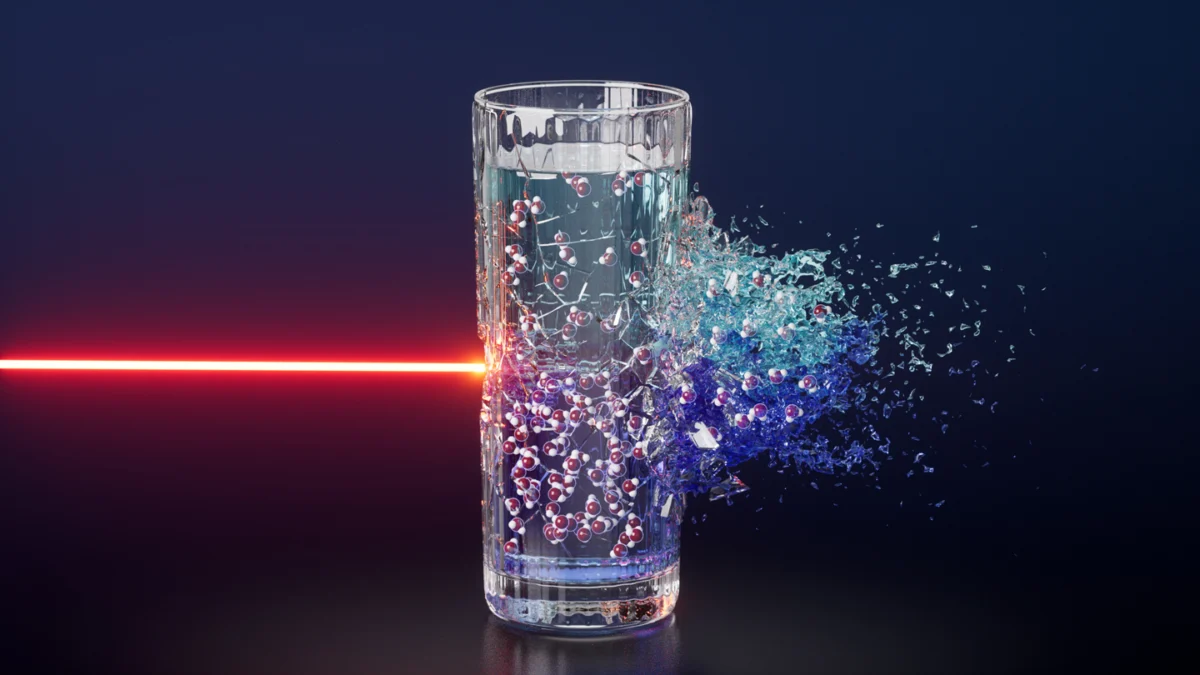
The illustration accompanying the article depicts water molecules in different arrangements: closely packed at the bottom, representing the denser liquid, and more sparsely packed at the top, representing the less dense liquid. This visual representation, alongside the mention of laser probing causing the glass to explode, suggests the experiment might have involved rapid heating or pressure changes, possibly inducing phase transitions that were then analyzed. The "explosion" could be a dramatic visualization of the energetic release or rapid structural change occurring as the water transitions through its critical point.
Broader Impact and Implications
The confirmation of water’s dual liquid nature and its critical point has profound implications across various scientific fields:
- Fundamental Understanding of Water: Water is the universal solvent and essential for life. Its anomalous properties, which deviate from typical liquids, have long puzzled scientists. This discovery offers a deeper insight into the fundamental molecular interactions and structural arrangements that give rise to these anomalies. Understanding the precise behavior of water in its supercooled state is crucial for comprehending its role in atmospheric phenomena, biological processes, and geological systems.
- Biophysics and Biochemistry: Many biological processes occur in aqueous environments, often involving molecules within or near their freezing points. The behavior of water in these states can significantly influence protein folding, enzyme activity, and cellular function. For instance, the freezing tolerance of organisms and the cryopreservation of biological samples are areas that could benefit from this newfound knowledge.
- Materials Science and Engineering: The properties of water, especially its ability to form different liquid structures, can impact the design of materials and processes. This includes areas like ice formation, frost damage, and the behavior of water in porous materials. Understanding the phase transitions can lead to improved methods for controlling these phenomena.
- Geophysics and Climate Science: Supercooled water plays a role in cloud formation, precipitation, and atmospheric ice nucleation. A more accurate understanding of its behavior under various atmospheric conditions could refine climate models and improve our understanding of weather patterns.
Potential Reactions and Future Research
While no direct quotes from other scientists are available in the provided text, this breakthrough is likely to be met with considerable interest and further investigation from the global scientific community. Researchers specializing in water science, physical chemistry, and condensed matter physics will undoubtedly scrutinize the findings and seek to replicate them using independent experimental setups.
Future research directions stemming from this discovery could include:
- Precise Determination of the Critical Point: Further experiments will aim to map the liquid-liquid critical point with even greater accuracy, determining its exact temperature and pressure coordinates.
- Investigating the Kinetics of Transition: Understanding the speed and mechanisms by which water transitions between its HDL and LDL states, and to the homogeneous liquid phase, is crucial.
- Exploring the Influence of Solutes: Investigating how dissolved substances, such as salts and organic molecules, affect the liquid-liquid phase transition and the location of the critical point. This is particularly relevant for biological and geological contexts.
- Developing New Theoretical Models: The experimental validation will spur the refinement of theoretical models and simulations to better capture the complex behavior of supercooled water.
The revelation of water’s dual liquid personality, a hidden facet of such a ubiquitous substance, marks a significant milestone in our quest to understand the fundamental properties of matter. The POSTECH University study has provided compelling experimental evidence for a phenomenon that has long been a theoretical enigma, promising to unlock new avenues of research and innovation across a spectrum of scientific disciplines.