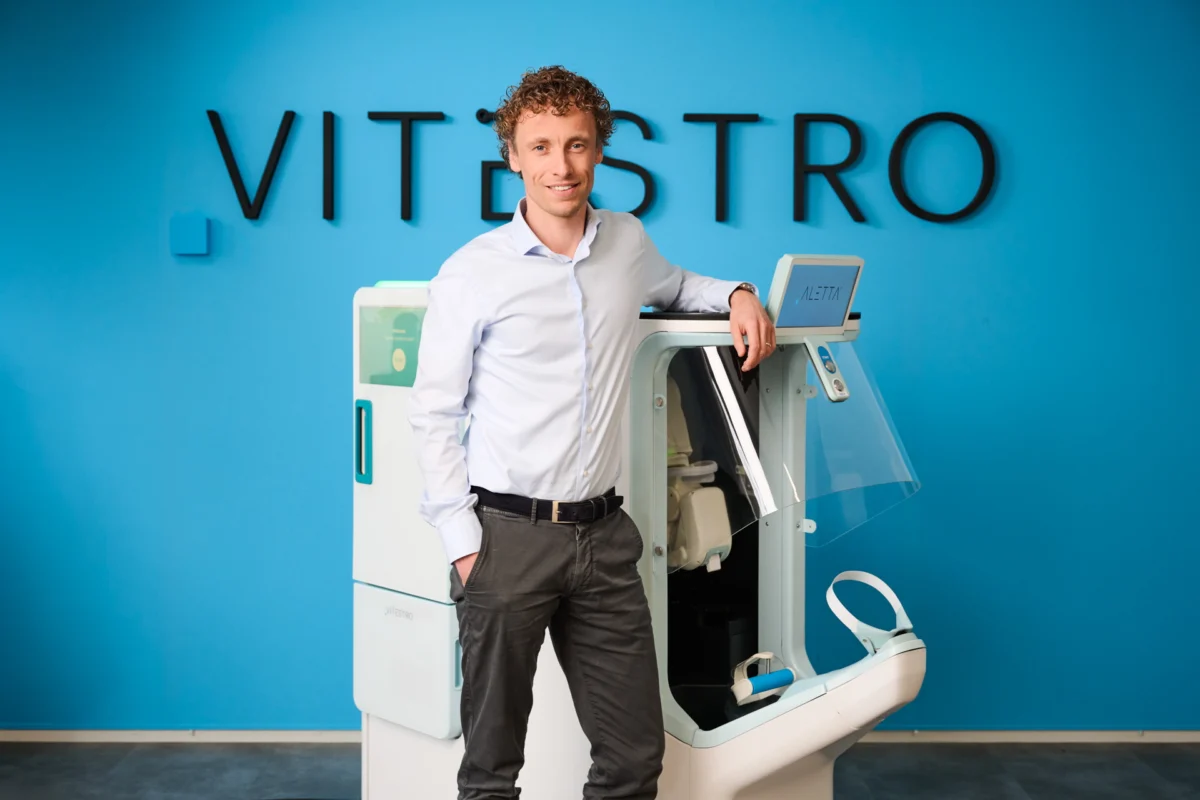
Utrecht, Netherlands – Vitestro, a pioneering medical robotics company, has successfully closed an oversubscribed Series B financing round, securing an impressive $70 million. This substantial capital injection is earmarked to propel the clinical validation, scale manufacturing, and prepare its groundbreaking Aletta Autonomous Robotic Phlebotomy Device (ARPD) for widespread adoption across hospitals and laboratories. The funding marks a pivotal moment for the company, signaling a strong industry conviction in the potential of automation to revolutionize one of healthcare’s most fundamental and high-volume procedures: diagnostic blood collection.
A Significant Financial Milestone for Healthcare Automation
The $70 million Series B round, announced on March 10, 2026, saw participation from a diverse group of strategic healthcare organizations and financial investors. Prominent healthcare entities such as the Labcorp Venture Fund, Mayo Clinic, and Sutter Health provided strategic backing, underscoring their commitment to innovation and addressing critical operational challenges within the healthcare ecosystem. These investments from leading clinical laboratory providers and integrated health systems are particularly noteworthy, as they represent a direct endorsement of Vitestro’s technology as a viable solution for real-world clinical needs.
Complementing these strategic partners, financial investors including InterVest, MGFO, PGGM, Puma Venture Capital, and ROM Utrecht also contributed to the round. Existing investors, such such as Invest-NL, the EIC Fund, Fred Moll, NYBC Ventures, and Sonder Capital, reaffirmed their confidence in Vitestro’s trajectory by participating in this latest financing. This broad spectrum of investors highlights both the financial attractiveness of Vitestro’s venture and the profound strategic importance placed on automating routine yet critical healthcare tasks.
The Aletta ARPD: A Leap Forward in Diagnostic Blood Collection
At the heart of Vitestro’s innovation is the Aletta ARPD, a sophisticated platform engineered to automate routine blood collection in diverse clinical settings. This device represents a significant technological advancement, integrating multimodal imaging, advanced robotics, and artificial intelligence to autonomously identify suitable veins, guide needle insertion with unparalleled precision, and collect blood samples. The objective is to standardize collection quality, minimize human-dependent variability, and ultimately enhance the overall patient experience while improving diagnostic accuracy.
The manual nature of phlebotomy has long been recognized as one of the last remaining manual steps in the extensive laboratory testing workflow. With billions of blood draws performed globally each year, the procedure is the highest-volume invasive medical procedure worldwide. Despite its ubiquity, manual phlebotomy is susceptible to variations in technique, which can lead to complications such as hematomas, nerve injuries, and pre-analytical errors that compromise specimen quality and diagnostic reliability. The Aletta ARPD directly addresses these challenges by offering a consistent, precise, and automated alternative.
Vitestro’s commitment to rigorous validation was evident in earlier clinical trial results, as reported by The Dark Report in March 2025. These trials demonstrated an impressive 95% first-stick success rate, alongside strong patient acceptance. Such outcomes are critical for widespread adoption, as patient comfort and trust are paramount in clinical procedures. The company also recently received CE mark approval in Europe, a crucial regulatory milestone that permits the device’s sale and use within the European Economic Area, paving the way for its initial commercial rollout.
Addressing the Persistent Phlebotomy Staffing Crisis
The investment in Vitestro comes at a critical juncture for healthcare providers globally, who are grappling with persistent and worsening staffing shortages across numerous disciplines, including phlebotomy. According to data from various healthcare workforce studies, the demand for skilled phlebotomists continues to outpace supply, exacerbated by an aging workforce, increasing patient volumes, and the general strain on healthcare systems. This shortage translates into longer patient wait times, increased operational costs, and added stress on existing staff, impacting both the efficiency of laboratory operations and the quality of patient care.
For clinical laboratory leaders, the Aletta ARPD offers a compelling solution to stabilize phlebotomy operations. By automating routine blood draws, robotic platforms like Aletta can mitigate the impact of staffing deficits, allowing existing phlebotomists to focus on more complex cases, patient education, or other critical tasks that require human intervention. This strategic reallocation of human resources can improve workflow predictability, reduce burnout among healthcare professionals, and maintain high patient throughput in busy outpatient settings and hospital environments. The adoption of such technology is not merely about replacing human labor but about augmenting it, enabling a more resilient and efficient healthcare delivery model.
Strategic Vision and Future Roadmap
Vitestro’s CEO and co-founder, Toon Overbeeke, articulated the company’s vision, stating, “Closing our Series B financing reflects strong conviction in our mission to establish a new standard in autonomous robotic venous access and diagnostic blood collection. Diagnostic blood collection remains the highest-volume invasive medical procedure globally, with billions of procedures performed annually.” This sentiment underscores the vast market opportunity and the transformative potential Vitestro aims to unlock.

The newly secured capital will be instrumental in advancing the next generation of the Aletta platform, ensuring continuous innovation and enhancement of its capabilities. Furthermore, Vitestro plans to conduct additional clinical studies, broadening the evidence base for the device’s efficacy, safety, and patient benefits across diverse populations and clinical scenarios. A key focus will also be on scaling manufacturing operations to meet anticipated demand as the company prepares for a broader commercial rollout initially in Europe.
Looking ahead, Vitestro has set its sights on the lucrative and influential United States market. Entry into the U.S. will be pursued through the FDA’s de novo regulatory pathway, a classification typically reserved for novel devices that present low to moderate risk and for which there is no legally marketed predicate device. This pathway requires rigorous demonstration of safety and effectiveness, a process Vitestro is well-prepared to undertake given its prior clinical success and CE mark approval. Successfully navigating the FDA de novo pathway would be a monumental achievement, opening up access to the largest healthcare market in the world and solidifying Vitestro’s position as a leader in medical robotics.
Insights from Strategic Investors: A Commitment to Innovation and Efficiency
The participation of leading healthcare organizations like Labcorp, Mayo Clinic, and Sutter Health is more than just a financial investment; it represents a strategic alignment with Vitestro’s mission. These institutions are at the forefront of healthcare innovation and are constantly seeking ways to improve patient outcomes, enhance operational efficiency, and address systemic challenges.
- Labcorp Venture Fund: As one of the world’s largest clinical laboratory networks, Labcorp is acutely aware of the challenges posed by phlebotomy staffing and pre-analytical variability. Their investment signals a proactive approach to integrating advanced technologies that can standardize sample collection, reduce errors, and improve turnaround times, ultimately benefiting their extensive network of clients and patients. Investing in autonomous phlebotomy aligns with Labcorp’s broader strategy of leveraging technology to optimize laboratory services and maintain its competitive edge.
- Mayo Clinic: Renowned globally for its patient-centered care and commitment to cutting-edge medical research, Mayo Clinic’s involvement underscores the potential for the Aletta ARPD to enhance patient experience and clinical quality. For an institution that handles a massive volume of diagnostic tests, improving the consistency and efficiency of blood draws can have a significant positive impact on patient flow, wait times, and the accuracy of diagnostic pathways. This investment reflects Mayo Clinic’s ongoing pursuit of innovations that deliver superior healthcare outcomes.
- Sutter Health: As a large integrated healthcare delivery system, Sutter Health faces the dual challenge of managing extensive patient populations while ensuring high-quality, cost-effective care. Automating phlebotomy can contribute to greater operational efficiency across its network of hospitals and clinics, alleviate staffing pressures, and free up human capital for more complex and compassionate care activities. Sutter Health’s investment likely stems from a desire to adopt technologies that streamline operations and improve resource allocation across its diverse care settings.
These strategic investments are a clear indication that the healthcare industry is increasingly looking towards automation and artificial intelligence to solve some of its most pressing operational and quality challenges.
Broader Implications for Clinical Laboratories and Patient Care
The advent of autonomous robotic phlebotomy holds profound implications for clinical laboratories. Beyond addressing staffing shortages, the Aletta system promises to significantly reduce pre-analytical errors, which account for a substantial percentage of all laboratory errors and can lead to misdiagnoses, delayed treatments, and increased healthcare costs. By providing consistent, standardized sample collection, the technology can enhance the reliability of test results, leading to more accurate diagnoses and better patient management.
Furthermore, the automation of routine blood draws could transform the patient experience. For many, blood collection can be a source of anxiety or discomfort, especially for those with difficult-to-access veins or for pediatric patients. A highly precise robotic system with a high first-stick success rate could alleviate these concerns, making the process faster, less painful, and more consistent. The potential for reduced wait times in high-volume settings also contributes to a more positive overall patient journey.
The economic benefits for healthcare providers are also considerable. Improved efficiency, reduced errors, and optimized staff utilization can translate into significant cost savings over time. While the initial investment in robotic systems may be substantial, the long-term returns through enhanced quality, improved throughput, and mitigated labor costs are expected to be compelling.
The Evolving Landscape of Medical Robotics
Vitestro’s success is emblematic of a broader trend in healthcare: the increasing integration of robotics and AI across various clinical domains. From surgical robots assisting complex operations to automated pharmacy dispensing systems and intelligent diagnostic tools, technology is reshaping how healthcare is delivered. Autonomous phlebotomy represents a crucial step in automating routine, yet critical, procedures that have historically relied solely on human skill.
While concerns about job displacement are often raised with automation, the prevailing view in the healthcare sector is that these technologies will augment, rather than replace, human roles. Phlebotomists may find their roles evolving to include overseeing robotic operations, managing more challenging cases, performing advanced procedures, or engaging in patient education and support—tasks that require uniquely human skills like empathy and complex problem-solving. This evolution could lead to higher-skilled, more satisfying roles within the healthcare workforce.
The forthcoming issue of The Dark Report is poised to delve deeper into this transformative technology, featuring exclusive interviews with Vitestro executives and offering a comprehensive analysis of what autonomous robotic phlebotomy could mean for clinical laboratories. This includes a detailed examination of its potential impact on staffing models, workflow efficiency, and the critical domain of specimen quality, providing invaluable insights for industry stakeholders.
In conclusion, Vitestro’s successful Series B financing marks a significant validation of its pioneering work in autonomous phlebotomy. With strategic backing from key healthcare players and robust financial support, the company is well-positioned to bring its Aletta ARPD to market, addressing critical challenges in healthcare efficiency, workforce management, and diagnostic accuracy. As the healthcare industry continues its inexorable march towards greater automation and technological integration, Vitestro stands at the forefront of a revolution poised to redefine the standards of diagnostic blood collection globally.