Invisible to the naked eye, the human body, the ground we walk upon, and the buildings we inhabit are constantly traversed by an invisible rain of subatomic particles originating from the deepest reaches of space. These microscopic travelers pass through matter effortlessly, entirely undetected by our senses. Yet, thanks to an innovative, low-cost device developed by a University of Delaware physicist, capturing these ghosts of the cosmos has shifted from the realm of multi-million-dollar national laboratories to high school classrooms, undergraduate workshops, and kitchen tables around the world.
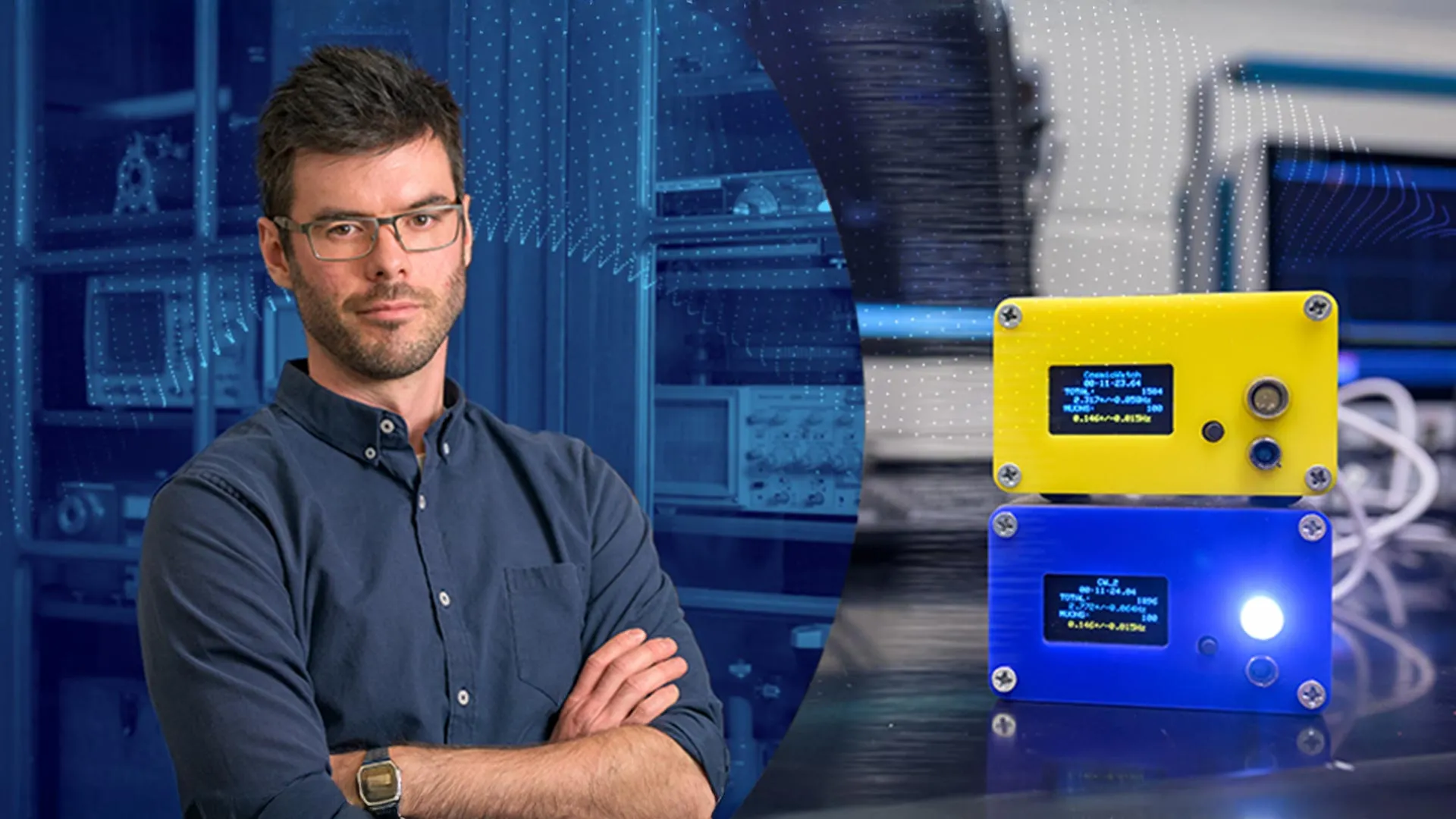
The device, known as CosmicWatch, represents a paradigm shift in how experimental physics is taught and practiced. Measuring roughly the size of a box of animal crackers and assembled from off-the-shelf electronic components totaling about $100, the desktop detector flashes and logs data whenever a muon—a secondary particle born from cosmic ray collisions high in Earth’s atmosphere—passes through its sensing volume. Originally conceived as a modest educational tool, CosmicWatch has rapidly evolved into a versatile instrument used in cutting-edge astrophysics research, deep-underground dark matter detection, and high-altitude balloon experiments touching the edge of space.
The Genesis of CosmicWatch: From Antarctic Ice to the Classroom
The story of CosmicWatch dates back to 2017, when Spencer Axani was working as a graduate student at the Massachusetts Institute of Technology (MIT). At the time, Axani was tackling engineering challenges for the IceCube Neutrino Observatory, a massive, cubic-kilometer detector buried deep beneath the Antarctic ice sheet designed to hunt for elusive neutrinos—subatomic particles with little to no mass and no electrical charge.
Operating IceCube requires meticulously filtering out "noise" generated by atmospheric muons, which continually bombard the surface and penetrate deep underground. To help differentiate between these atmospheric muons and the cosmic neutrinos the facility sought to isolate, Axani needed a compact, energy-efficient muon detector.
As he refined the technology, Axani recognized a broader application. Traditional muon detection setups in undergraduate academic settings typically relied on cumbersome racks of electronics comparable in size to small bookshelves, often costing thousands of dollars. By scaling down the necessary circuitry and optimizing energy consumption, Axani realized he could democratize access to particle physics.
Following his transition to the University of Delaware faculty in 2022, Axani continued to iterate on the design. In October, details of the third-generation CosmicWatch were published in the Journal of Instrumentation, co-authored by Axani and doctoral student Masooma Sarfraz. This latest iteration boasts advanced capabilities, including environmental monitoring, enhanced radiation tolerance, and faster data acquisition speeds.
"Even though I had studied cosmic rays, I didn’t fully appreciate the rich physics behind the working of these detectors to actually ‘see’ the world and atmospheric particle production," Sarfraz noted regarding her transition from theoretical coursework to hands-on experimental validation.
Demystifying Muons and Their Astrophysical Origins
To understand the utility of CosmicWatch, one must examine the nature of cosmic rays and the particles they spawn. Cosmic rays are extremely energetic atomic nuclei and subatomic particles—primarily protons—accelerated to near-light speeds by some of the most cataclysmic events in the universe, including supernovae explosions, the birth pangs of black holes, gamma-ray bursts, and active galactic nuclei known as blazars.
When these ultra-high-energy cosmic rays collide with gas atoms in Earth’s upper atmosphere, they trigger a cascade of secondary particles. Among the most resilient of these decay products are muons. Heavier cousins of the electron, muons are unstable particles with a mean lifetime of roughly 2.2 microseconds. However, because they travel at velocities close to the speed of light, relativistic time dilation allows a vast number of them to reach Earth’s surface before decaying.
The historical significance of muons extends far back into the annals of modern physics. In the early 1940s, precise measurements of muon flux provided some of the earliest empirical confirmations of Albert Einstein’s theory of special relativity, demonstrating that fast-moving particles experience time more slowly than stationary observers.
Beyond theoretical physics, muons offer practical utility for probing dense materials on Earth. Because muons can travel through solid structures—such as stone, concrete, and rock—without causing structural damage, scientists leverage them for a technique called muon radiography, or muography. By tracking the trajectory and attenuation of muons passing through large structures, researchers can map internal densities. Notably, this technology was famously employed in 2016 to discover a previously unknown, large void hidden deep inside the Great Pyramid of Giza.
Bridging Education and Professional Research
While large-scale physics facilities utilize sophisticated detectors, the prohibitive cost and size of such equipment have historically restricted hands-on experimentation to elite research institutions. CosmicWatch has systematically dismantled this barrier.
At the University of Delaware, Axani integrates the detectors directly into his curriculum, having students physically assemble the hardware, write analysis scripts, and design original experiments. This pedagogical model has been adopted by other premier institutions, including Cornell University.
Dr. Natasha Holmes, the Ann S. Bowers Associate Professor of Physics at Cornell, has incorporated CosmicWatch into her introductory physics courses. According to Holmes, the hardware provides students with a rare glimpse into the authentic frustrations and triumphs of experimental science. Students learn to write code, troubleshoot hardware failures, and handle delicate electronic components—experiences vastly different from standard, predetermined laboratory modules. Many students have reported that using the device is their first encounter with "real science."
The versatility of the device was further demonstrated by Musarate Shams, a doctoral student in Delaware’s quantum science and engineering program. Shams integrated temperature and pressure sensors into a custom CosmicWatch unit and launched it aboard a high-altitude meteorological balloon. Ascending to 100,000 feet near the edge of space, the device successfully recorded how cosmic ray flux shifts dramatically as altitude increases, proving that affordable, student-built hardware can yield sophisticated atmospheric data.
Expanding Applications: Dark Matter and Aerospace
Beyond the classroom, CosmicWatch has graduated to professional research laboratories. The ruggedness and reliability of the third-generation hardware make it ideal for calibrating massive particle detectors.
Currently, CosmicWatch units are deployed within the NuDot experiment at the University of Delaware and at the Coherent CAPTAIN-Mills (CCM) dark matter detector situated at Los Alamos National Laboratory in New Mexico. In these settings, the small devices assist researchers in background characterization and particle tracking.
Looking ahead, aerospace engineers are exploring iterations of the technology capable of operating aboard rockets and spacecraft. Measuring primary cosmic rays outside the filtering envelope of Earth’s atmosphere could yield unprecedented insights into solar weather and galactic radiation patterns. Furthermore, developmental offshoots of the technology aim to create distributed sensor networks for satellites, enabling spacecraft to autonomously communicate regarding localized space weather anomalies, such as incoming solar flares, and execute protective power-down protocols.
Implications and the Vision for a Global Citizen Science Network
The broader implications of the CosmicWatch project extend well beyond individual classroom achievements or laboratory calibrations. With an estimated thousands of units built and deployed globally over the past eight years, the foundation for a massive, crowdsourced scientific initiative is already in place.
Axani envisions scaling CosmicWatch into a worldwide citizen science network. Under this prospective framework, amateur scientists, educators, and enthusiasts across diverse geographical coordinates could continuously monitor local muon rates and upload their telemetry to a centralized, public database. Aggregating thousands of simultaneous data points from across the globe would grant researchers a dynamic, high-resolution mapping of atmospheric particle dynamics, space weather events, and geomagnetic fluctuations that traditional, isolated observatories cannot capture alone.
What began as an expedient engineering solution for a remote observatory in Antarctica has blossomed into an international movement, bridging the gap between theoretical astrophysics and accessible, hands-on inquiry. As the hardware continues to evolve, CosmicWatch demonstrates that profound scientific discovery does not always require billion-dollar budgets—sometimes, it fits neatly inside a box of animal crackers.