The global landscape of immunology has been irrevocably altered by the COVID-19 pandemic, leaving behind a massive, worldwide cohort of individuals with robust, durable immune memory against the SARS-CoV-2 virus. Now, a Cleveland-based biotechnology firm, Celloram, is pivoting this epidemiological reality into a novel therapeutic strategy. In a study recently published in Nature Communications, researchers from Celloram, in collaboration with Case Western Reserve University and University Hospitals Cleveland Medical Center, have unveiled Protexi, a dendritic cell-based cancer vaccine that repurposes the body’s existing COVID-19 immune infrastructure to target and eliminate malignant tumors.
The Mechanism: Bridging Viral Memory and Oncology
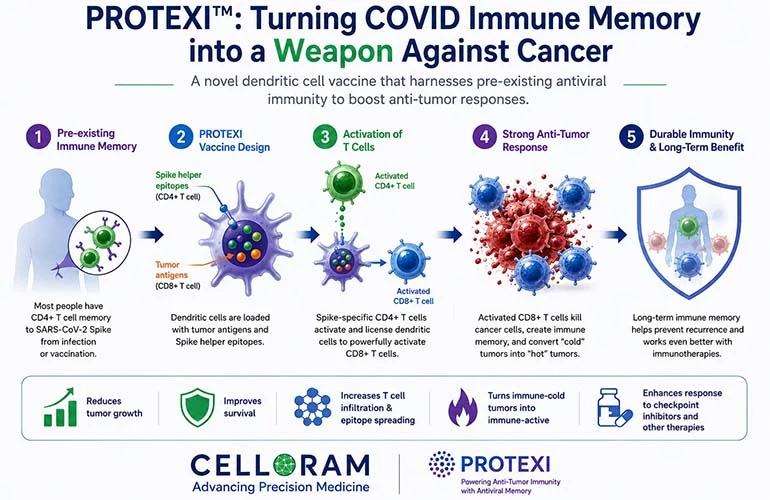
Traditional dendritic cell vaccines function by presenting tumor antigens to the immune system, primarily aiming to stimulate CD8+ "killer" T cells to identify and destroy cancer cells. Despite decades of research, the clinical success of these vaccines has been notoriously limited, with historical data suggesting an objective response rate of only approximately 15% in cancer patients. The primary failure point often lies in the inability to achieve a sustained, high-magnitude activation of these CD8+ cells.
Protexi seeks to overcome this bottleneck by employing a dual-target strategy. By incorporating specific epitopes—small, recognizable protein fragments—from the SARS-CoV-2 Spike protein alongside tumor-specific antigens, the vaccine recruits the patient’s pre-existing COVID-19 immune memory. The Spike-specific CD4+ T cells, which are abundant in the vaccinated or previously infected population, act as critical "helper" cells. These CD4+ cells provide the essential cytokine signals required to fully prime and activate the tumor-specific CD8+ T cells, effectively turning the immune system’s response to a past viral threat into a powerful weapon against current malignancy.
A Chronology of Discovery and Development
The development of Protexi is the culmination of several decades of immunological evolution. The foundational science dates back to the 1990s, when researchers first established that CD4+ T helper cells were not merely supportive but absolutely essential for the optimal induction of CD8+ responses, particularly against tumors that lack MHC-II expression.
In the late 2010s, subsequent research refined this understanding, demonstrating that successful tumor rejection during immunotherapy requires a coordinated effort between both CD4+ and CD8+ tumor-specific T cells. However, the field hit a practical snag: identifying the precise CD4+ epitopes for individual patient tumors is a computationally intensive, time-consuming, and often imprecise process.
The emergence of the COVID-19 pandemic provided the final, unexpected piece of the puzzle. As global vaccination efforts moved forward, clinical observations suggested that patients who had received COVID-19 vaccines often exhibited improved outcomes when undergoing checkpoint inhibitor therapies. This prompted the Celloram team to propose a "plug-and-play" approach. Rather than searching for patient-specific tumor epitopes, they realized they could utilize a universally recognized, highly immunogenic target—the SARS-CoV-2 Spike protein—to kickstart the necessary immune cascade.
Empirical Evidence: Preclinical Results in Mouse Models
The experimental data provided in the Nature Communications paper highlights a significant leap in efficacy compared to conventional dendritic cell vaccines. In controlled mouse models, the administration of Protexi demonstrated a 100% survival rate to day 40, a marked improvement over the 40% survival observed in cohorts treated with traditional, non-Spike-loaded vaccines.
In a melanoma model, the results were equally compelling. By day 26 of the study, five out of seven mice treated with the Protexi protocol exhibited tumor volumes of less than 200 cubic millimeters, suggesting a profound slowing of tumor progression.
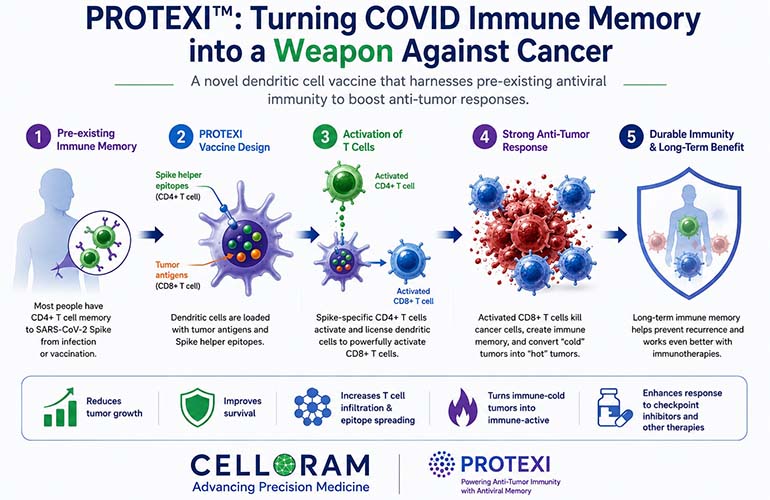
Addressing concerns regarding patients who may lack strong pre-existing COVID immunity, the research team developed a "priming" strategy. In mice, researchers administered a short, preparatory dose of dendritic cells loaded with Spike and ovalbumin. This intervention successfully induced a strong CD4+ T cell response even in subjects without prior exposure to the virus. This built-in "fallback" mechanism is designed to ensure that the therapy remains viable for the minority of the population who may not have robust, pre-existing Spike-specific immune memory.
Expert Perspectives and Strategic Implications
Dr. John Letterio, a co-author of the study, has emphasized that the durability of the immune response is a cornerstone of the platform. "Spike-specific CD4+ T-cell memory is broadly durable across the population that has been vaccinated or infected," Letterio stated. He pointed to data suggesting that, while COVID-19 memory has been observed to last between two and four years in vaccinated individuals, historical data on SARS-CoV-1 indicates that such viral T cell memory can be retained for as long as 17 years, suggesting that the Protexi platform could potentially provide long-term protection.
The implications for the broader oncology sector are significant. If this platform is successfully validated in humans, it could drastically reduce the time and cost associated with personalized cancer vaccine production. By using a known, standardized "helper" epitope, manufacturers could simplify the manufacturing process, focusing their resources on the patient’s specific tumor antigens while relying on the universally present COVID-19 memory to handle the necessary immune system stimulation.
Future Clinical Outlook
The research team is now shifting its focus from the laboratory to the clinic. Celloram is currently working to prepare an Investigational New Drug (IND) application for submission to the U.S. Food and Drug Administration (FDA). The proposed first-in-human clinical trial is slated to target patients with sarcoma, to be conducted at the Angie Fowler Adolescent & Young Adult Cancer Institute.
This transition from murine models to human trials will be a critical test of whether the high-magnitude immune activation observed in mice can be replicated in the complex, immunosuppressive environment of a human tumor. Furthermore, the trial will need to confirm the safety profile of utilizing the Spike protein as an immune adjuvant in cancer patients, many of whom are already immunocompromised due to their disease state or concurrent treatments.
Broader Impact on Immunotherapy
The success of Protexi would validate a shift in perspective within the field of immunotherapy. For years, the industry has focused almost exclusively on identifying unique, neoantigen-driven pathways to "teach" the immune system to recognize cancer. The Celloram approach flips this logic by leveraging the body’s existing, highly trained defensive memory.
If the technology proves effective, it could serve as a blueprint for future therapies. The researchers noted that while they chose the SARS-CoV-2 Spike protein because of its ubiquity and the depth of existing scientific data, the mechanism is theoretically agnostic. Any CD4+ T-cell epitope that a patient population has strong, durable memory against—whether from a previous vaccine, a common childhood illness, or another ubiquitous pathogen—could, in theory, be used as an adjuvant to drive the same "helper" effect.
As the scientific community awaits the outcome of the upcoming clinical trials, the study serves as a potent reminder of how interdisciplinary collaboration—merging the fields of infectious disease and oncology—can yield innovative solutions to some of medicine’s most stubborn challenges. By repurposing the "scars" left by the pandemic into a potential shield against cancer, Celloram is positioning itself at the frontier of a new generation of adaptive immunotherapies.