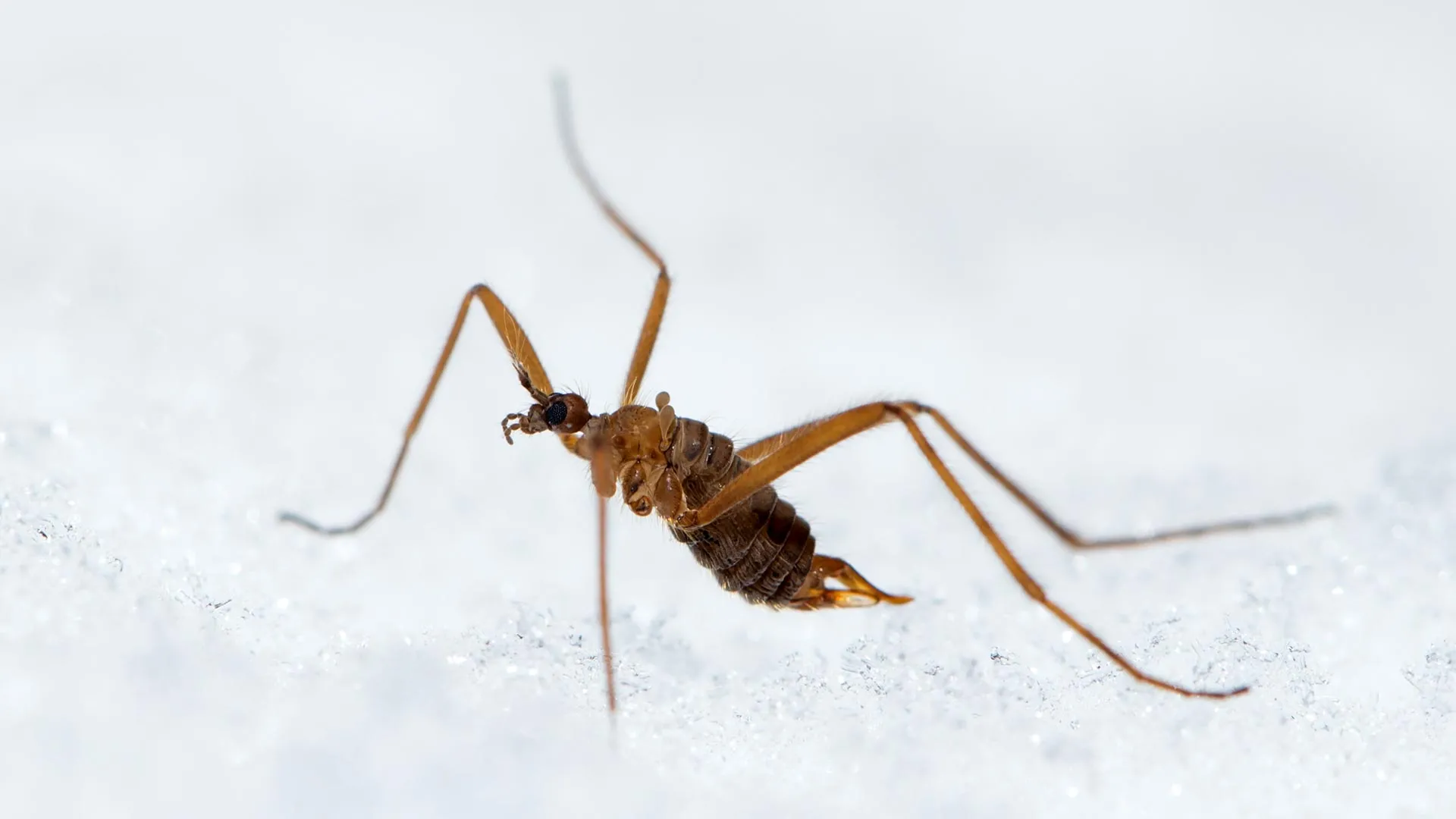
Snow flies might seem like ordinary insects, but their survival strategy is anything but typical. In a groundbreaking new study published in the journal Current Biology on March 24, scientists at Northwestern University have unveiled the extraordinary mechanisms that allow these small, wingless creatures to thrive in frigid, snow-covered environments. Far from being passive victims of the cold, snow flies possess a remarkable arsenal of biological tools, including the ability to generate their own body heat and produce potent antifreeze proteins, enabling them to remain active at temperatures as low as -6 degrees Celsius (21.2 degrees Fahrenheit). This research significantly advances our understanding of life’s resilience in extreme conditions and opens new avenues for cryoprotection technologies.
The Unconventional Survival of the Snow Fly
Unlike the vast majority of insects, which enter a dormant state or perish when temperatures dip below freezing, snow flies actively seek out and navigate snowy terrains. Their primary motivations for this seemingly counterintuitive behavior are reproduction: finding mates and laying eggs. This stark contrast to typical insect behavior prompted the Northwestern University research team, led by Marco Gallio, the Soretta and Henry Shapiro Research Professor in Molecular Biology and professor of neurobiology, to investigate the underlying adaptations.
"Insects are cold-blooded, so they are at the mercy of external temperatures," explained Gallio. "But they have a mind-boggling ability to adapt to extremes. When it gets cold, a common strategy is to find shelter and become dormant until conditions get better. But instead of slowing down, snow flies actually prefer freezing cold, snowy conditions and hide away when the snow melts and it gets warm. They really push the limit of what’s possible. Now we’ve found snow flies aren’t just tolerating the cold, they have multiple ways to counteract it."
The study, co-led by Marcus Stensmyr, a biology professor at Lund University in Sweden, involved a multidisciplinary team including William Kath from Northwestern’s McCormick School of Engineering and Alessia Para from Weinberg College of Arts and Sciences. Gallio and Kath also hold affiliations with the NSF-Simons National Institute for Theory and Mathematics in Biology (NITMB), underscoring the study’s foundation in theoretical and mathematical biology.
Unraveling the Genetic Blueprint of Cold Tolerance
The initial phase of the research focused on deciphering the genetic underpinnings of the snow fly’s exceptional cold tolerance. For the first time, Gallio’s team sequenced the genome of the snow fly, Chionea alexandriana, and conducted comparative analyses with related insect species not adapted to cold. This was a complex undertaking, meticulously carried out by Richard Suhendra, a Ph.D. student working under Kath. By analyzing RNA expression in freezing temperatures, the researchers aimed to pinpoint genes actively engaged in survival.
The results of this genomic sequencing were astonishing. "We couldn’t find many of the genes within any database," Gallio reported. "Initially, I thought we must have sequenced some alien species. It’s very rare for an active gene, which makes a protein, to not have a match." This anomaly pointed towards a unique evolutionary trajectory, where novel genetic sequences had emerged to address the specific challenges of a sub-zero existence.
The Power of Antifreeze Proteins
Further investigation revealed that these unusual genes are responsible for producing antifreeze proteins (AFPs). These molecules, structurally similar to those found in Arctic fish, play a crucial role in preventing the formation and growth of ice crystals within the snow fly’s cells. By binding to nascent ice crystals, AFPs inhibit their expansion, thereby safeguarding cellular integrity from the damaging effects of freezing.
"Remarkably, some of the antifreeze proteins we found are actually structurally related to those of Arctic fish," Gallio noted. "That suggests evolution came to the same solution for a common problem." This convergence of evolutionary solutions across vastly different taxa highlights the fundamental challenges and ingenious adaptations that life can develop in response to similar environmental pressures. The presence of such sophisticated AFPs in a terrestrial insect is particularly noteworthy, expanding the known repertoire of cryoprotective mechanisms in the animal kingdom.
Generating Internal Warmth: A Mammalian-Like Trait
Beyond passive protection against ice formation, the study uncovered another remarkable capability: the ability of snow flies to actively generate their own body heat. Analysis of the snow fly genome identified genes associated with energy metabolism and cellular processes known to be involved in thermogenesis, a process by which organisms produce heat.
"We found genes that in larger animals are associated with mitochondrial thermogenesis in brown adipose tissue," Gallio explained. "Many animals like marmots and polar bears have brown fat, which is there to produce heat. When they go into hibernation, they burn this stored fat to produce heat rather than to produce chemical energy. So, in some ways snow flies use a combination of the strategies used by polar bears and by Arctic fish." This suggests that snow flies employ a dual strategy, combining the passive cryoprotection of fish with the active heat generation seen in endothermic mammals, albeit at a much smaller scale and for a different purpose.
Experimental Validation of Survival Mechanisms
To empirically validate these findings, researchers conducted a series of controlled experiments. Matthew Capek, a Ph.D. student in the Gallio Lab, ingeniously modified fruit flies to express one of the snow fly’s identified antifreeze proteins. When subjected to freezing temperatures in a laboratory freezer, these modified fruit flies exhibited significantly higher survival rates compared to their unmodified counterparts, providing direct evidence of the proteins’ protective function.
In parallel, experiments were designed to confirm heat generation. Researchers meticulously monitored the internal temperature of snow flies as the ambient temperature was gradually lowered below freezing. The results showed that snow flies consistently maintained an internal temperature a few degrees Celsius warmer than expected for other insects under similar conditions.
"Other insects, like bees and moths, shiver to increase their heat," observed Stensmyr. "But we found no evidence of shivering. Snow flies instead likely produce heat at the cellular level, more similar to how mammals and even some plants generate heat." This cellular-level thermogenesis, without the gross muscular activity of shivering, is a highly efficient mechanism for generating small but crucial amounts of warmth. This slight internal temperature boost is likely critical for providing enough time to find shelter or avoid lethal freezing during sudden temperature drops.
Diminished Sensitivity to Cold-Induced Pain
The researchers also identified a novel adaptation related to sensory perception. Snow flies appear to possess a significantly reduced sensitivity to the noxious stimuli associated with extreme cold. In most organisms, cold exposure triggers a cascade of cellular events that activate sensory receptors, signaling harm and prompting avoidance behaviors. However, in snow flies, a key sensory protein involved in detecting these harmful stimuli is markedly less responsive.
"It turns out that a specific irritant receptor is 30 times less sensitive in snow flies than in mosquitoes and fruit flies," Gallio stated. This reduced sensitivity means that snow flies can tolerate higher levels of cold-related cellular stress and continue to function in conditions that would incapacitate most other species. This adaptation allows them to remain active and pursue their life cycle even when facing intense cold.
Implications and Future Directions
The implications of this research extend far beyond understanding insect biology. The discovery of novel antifreeze proteins and efficient thermogenic pathways in snow flies offers valuable insights for developing advanced cryopreservation techniques. Such technologies could revolutionize organ transplantation, fertility preservation, and the long-term storage of sensitive biological materials, minimizing damage caused by freezing and thawing.
"These findings provide new insight into how life adapts to extreme environments," the study emphasizes. "They may also help researchers develop new ways to protect cells, tissues and materials from damage caused by cold."
The research team plans to delve deeper into the intricate cellular mechanisms of heat generation in snow flies and to fully catalog the diversity of their antifreeze proteins. This future work aims to uncover whether similar sophisticated cold-adaptation strategies are employed by other organisms inhabiting extreme environments, potentially revealing a broader spectrum of life’s resilience.
The study, titled "Coordinated molecular and physiological adaptations enable activity at subfreezing temperature in the snow fly Chionea alexandriana," is set to be featured on the cover of the April 6th volume of Current Biology. The extensive research was supported by a consortium of prestigious funding bodies, including the National Institutes of Health, the Pew Scholars Program, the McKnight Foundation, the Paula M. Trienens Institute for Sustainability and Energy, the Crafoord Foundation, the National Science Foundation, the Simons Foundation, and NITMB. External collaborators from the DNAzoo project, including Olga Dudchenko and Erez Lieberman Aiden from Rice University and Baylor College of Medicine, also contributed significantly to this landmark study. This collaborative effort underscores the complex and multifaceted nature of modern biological research.