The universe, as we observe it today, presents a profound imbalance: matter overwhelmingly dominates antimatter. This stark asymmetry has long puzzled cosmologists, as the prevailing theories of the Big Bang suggest that matter and antimatter should have been created in equal quantities. Now, a compelling new hypothesis proposes that primordial black holes, born in the universe’s infancy, could be the architects of this cosmic imbalance, explaining why we exist in a matter-dominated cosmos.
The Enigma of Matter-Antimatter Asymmetry
For decades, the question of why the universe is not a symmetrical expanse of matter and antimatter has been a cornerstone of cosmological research. The standard model of particle physics and the Big Bang theory predict that for every particle of matter created, an antiparticle of antimatter should also have been formed. When a particle and its antiparticle meet, they annihilate each other, releasing energy. If the early universe had indeed contained equal amounts of matter and antimatter, this annihilation process would have resulted in a universe devoid of both, leaving behind only radiation.
The observable universe, however, is teeming with galaxies, stars, planets, and life – all composed of matter. While antimatter exists, it is exceedingly rare, typically found only in specific high-energy phenomena or produced in controlled laboratory settings. This discrepancy, known as the baryon asymmetry problem, implies that some unknown process must have tipped the scales, favoring the survival of matter over antimatter in the universe’s nascent moments.
Primordial Black Holes: Cosmic Catalysts
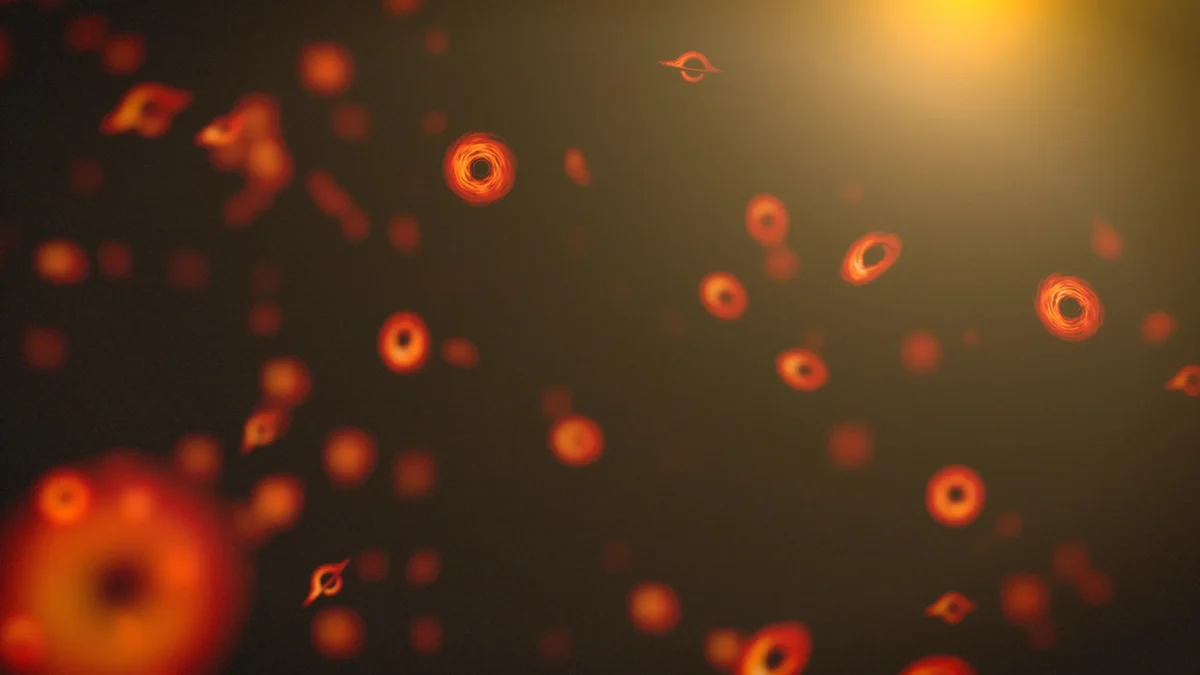
The latest research, drawing upon theoretical models and simulations, suggests that a population of hypothetical primordial black holes (PBHs) could hold the key to this mystery. These are not the black holes formed from the collapse of massive stars in the present universe, but rather exotic objects believed to have formed directly from the extreme densities and energy fluctuations present in the very first moments after the Big Bang, potentially within the first second.
The hypothesis posits that these PBHs, which could have ranged in mass from subatomic particles to thousands of times the mass of the sun, played a crucial role during a critical phase known as baryogenesis. This is the hypothetical period in the early universe when the asymmetry between matter and antimatter was established.
The Mechanism: Explosive Annihilation and Particle Production
According to the theory, as the universe expanded and cooled, these PBHs would have also cooled. However, due to their immense density, they would have retained a significant amount of energy. When the universe reached a specific temperature and density threshold, these PBHs would have begun to evaporate, not through the gentle Hawking radiation typically associated with stellar-mass black holes, but through a more violent, explosive process.
This explosive evaporation would have released an enormous surge of energy and particles. Crucially, the conditions during these explosions, particularly the extreme energy densities and particle interactions, are theorized to have favored the creation of matter particles over antimatter particles. This process, akin to a highly energetic particle accelerator operating on a cosmic scale, would have effectively "cooked" matter into existence, or at least significantly amplified its abundance relative to antimatter.
Supporting Data and Theoretical Frameworks
While direct observational evidence for primordial black holes remains elusive, theoretical frameworks provide a compelling basis for their existence. Cosmological inflation, a period of rapid expansion in the universe’s earliest moments, is thought to have created quantum fluctuations that could have seeded the formation of these dense regions destined to become PBHs.
Furthermore, various particle physics models, including those that go beyond the Standard Model, predict the existence of new particles and interactions that could have occurred during baryogenesis. The energetic explosions from evaporating PBHs could have provided the necessary conditions for these processes to occur, leading to the observed matter-antimatter imbalance.
For instance, some models suggest that the decay of specific heavy particles, which could have been abundant in the high-energy environment of PBH evaporation, might have produced a slight excess of matter particles. If these PBHs were sufficiently numerous and their evaporation occurred during the crucial baryogenesis epoch, the cumulative effect could have been substantial enough to explain the current state of the universe.
A Timeline of Cosmic Events
Understanding the potential role of PBHs requires placing their hypothetical existence within a broader cosmological timeline:
- The Planck Epoch (t < 10^-43 seconds): The earliest moments of the universe, where all fundamental forces were unified. Extreme conditions could have allowed for the formation of PBHs.
- Inflation (approx. 10^-36 to 10^-32 seconds): A period of exponential expansion. Quantum fluctuations generated during inflation might have led to the formation of overdense regions that collapsed into PBHs.
- Baryogenesis (shortly after inflation, potentially within the first second): The hypothetical era where the matter-antimatter asymmetry was established. If PBHs existed, their evaporation could have occurred during this period.
- Big Bang Nucleosynthesis (approx. 3 minutes to 20 minutes): The formation of light atomic nuclei. The ratio of matter to antimatter established by baryogenesis would have influenced the outcome of this process.
- Cosmic Microwave Background (CMB) Formation (approx. 380,000 years): The release of the CMB radiation, providing a snapshot of the early universe. Observations of the CMB have placed constraints on the abundance of PBHs.
- Present Day: The universe is dominated by matter, with antimatter being a rare commodity.
Implications and Broader Impact
The implications of this PBH-driven baryogenesis theory are far-reaching:
- Unification of Cosmology and Particle Physics: It offers a potential bridge between the large-scale structure of the universe and the fundamental laws of particle physics, addressing a persistent gap in our understanding.
- New Avenues for Observational Searches: If confirmed, the theory would spur new observational efforts to detect PBHs through gravitational lensing, their potential contribution to dark matter, or their influence on the CMB.
- Refined Models of the Early Universe: It would necessitate a re-evaluation of existing cosmological models, potentially leading to more accurate predictions about the universe’s evolution.
- Understanding the Nature of Dark Matter: Some theories suggest that PBHs could constitute a significant fraction, if not all, of dark matter, further integrating them into our cosmological picture.
Challenges and Future Research
Despite its promise, the PBH hypothesis faces significant challenges. The existence of PBHs is still theoretical, and their direct detection remains a major goal for observational cosmology. Current observational constraints, particularly from the CMB and gravitational wave detectors, place limits on the mass range and abundance of PBHs that could have formed.
Future research will focus on refining the theoretical models of PBH formation and evaporation, as well as developing more sensitive observational techniques. Experiments such as the Laser Interferometer Gravitational-Wave Observatory (LIGO) and its successors, along with future space-based telescopes like the Nancy Grace Roman Space Telescope, could provide crucial data to either support or refute the role of PBHs in explaining the universe’s matter-antimatter imbalance.
The scientific community generally views this research with cautious optimism. While no definitive proof exists yet, the elegance of the PBH hypothesis in addressing a fundamental cosmological puzzle makes it a highly active and promising area of investigation. The pursuit of this answer continues to drive innovation in both theoretical physics and observational astronomy, pushing the boundaries of our understanding of the universe’s most profound mysteries.