Nature’s relentless process of evolution, a sophisticated form of biological engineering, continuously refines the intricate machinery within cells. Through the generation of diverse DNA, RNA, and protein variants, natural selection meticulously favors organisms exhibiting optimal functionality. This fundamental principle, observed throughout the natural world, has been consciously employed by humans for millennia. Early agriculturalists, for instance, acted as agents of evolution by selectively breeding crops and livestock, ensuring that the most robust and productive individuals passed on their advantageous traits to subsequent generations. This ancient practice laid the groundwork for modern scientific endeavors aimed at manipulating biological systems for specific purposes.
Today, scientists are leveraging these same evolutionary principles in laboratory settings through a powerful technique known as directed evolution. This methodology allows researchers to systematically improve the performance of crucial biomolecules, particularly proteins such as enzymes and antibodies. These engineered proteins find widespread applications across diverse fields, from life-saving pharmaceuticals and industrial manufacturing processes to everyday consumer products like laundry detergents. The ability to precisely tailor protein function has revolutionized our capacity to address complex challenges and create innovative solutions.
The Limitations of Traditional Directed Evolution
Despite the remarkable successes achieved with standard directed evolution, a significant limitation has persisted. Traditional approaches typically impose a constant selection pressure, favoring proteins that maintain high activity levels under all conditions. However, this approach often fails to replicate the nuanced and dynamic nature of biological systems. Many essential proteins function not as static workhorses, but as sophisticated signaling molecules, molecular switches, or "logic gates." These proteins are designed to respond to fluctuating environmental cues, dynamically shifting their states to process information and make cellular decisions.
Consider a protein that acts as a cellular switch. In a natural environment, such a protein might activate for a brief period, then deactivate, only to re-engage later under different circumstances. Standard directed evolution experiments, by rewarding only a single, sustained active state, can inadvertently lead to the degradation of other crucial functional states. This can result in proteins losing their ability to switch effectively between states, a deficit that can have detrimental consequences for cellular health and survival. The challenge of engineering proteins capable of complex, multi-state behavior has therefore remained a significant hurdle for existing directed evolution methodologies.
Introducing Optovolution: A Light-Driven Revolution
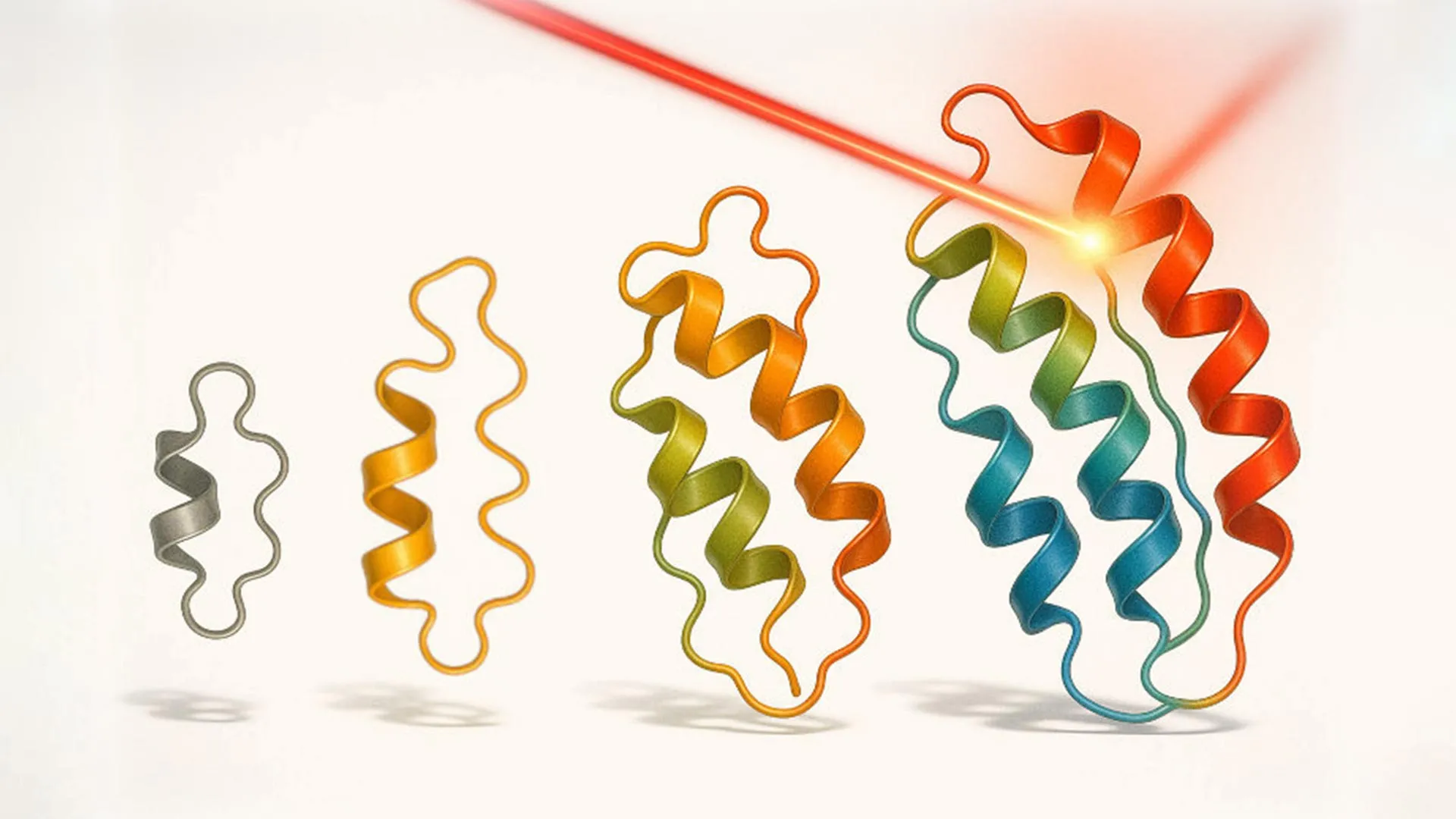
Researchers, spearheaded by Sahand Jamal Rahi at EPFL’s Laboratory of the Physics of Biological Systems, have introduced a groundbreaking new approach designed to overcome these limitations. Dubbed "optovolution," this innovative method harnesses the power of light to guide the evolution of proteins. Optovolution enables the development of proteins that can perform dynamic functions, including exhibiting complex switching behaviors and executing simple computational tasks that operate on yes-or-no principles.
This pioneering study, published in the esteemed journal Cell, represents a significant leap forward in aligning directed evolution with the natural operational modes of living cells. In biological systems, the precise timing of events and the ability to switch between different states are often as critical as the strength of a given signal. Optovolution directly addresses this fundamental biological reality by creating an evolutionary environment that rewards dynamic functionality.
Engineering Yeast Cells for Dynamic Protein Selection
The researchers ingeniously employed the budding yeast Saccharomyces cerevisiae as their experimental platform. This organism, a staple in both the brewing industry and scientific research, provided a robust and well-understood cellular system for their investigations. The team meticulously redesigned the yeast cell cycle, making cell division contingent upon the dynamic behavior of the protein under evolutionary scrutiny. The core principle was that the protein must transition cleanly between its active and inactive states for the cell to survive and proliferate.
To achieve this, the scientists established a critical link between the protein’s output signal and a regulator governing the cell cycle. This regulator, essential for a specific phase of the cell cycle, becomes toxic to the cell if it remains active during another. Consequently, if the evolved protein remained locked in either an "on" or "off" state for an extended duration, the yeast cell would either stall in its division process or perish. Only those yeast cells that contained proteins capable of switching states at precisely the correct moments were able to continue dividing, effectively acting as a natural selection mechanism for dynamic protein function.
Precision Control with Light: Optogenetics in Action
Light emerged as the crucial element for exerting precise control over this evolutionary process. The researchers utilized optogenetics, a sophisticated technique that employs light to activate or deactivate specific genes. By delivering precisely timed pulses of light, they were able to artificially induce the protein of interest to alternate between its distinct functional states.
Each yeast cell cycle, lasting approximately 90 minutes, provided a rapid and efficient pass-or-fail test for the protein’s switching performance. Proteins that exhibited optimal dynamic behavior allowed the host cell to survive and reproduce, while variants with suboptimal switching patterns were naturally eliminated. This automated selection process, driven by light and cellular survival, allowed optovolution to identify and enhance proteins with superior dynamic characteristics without the need for laborious manual screening or repeated experimental adjustments. This marks a significant acceleration in the directed evolution pipeline.
Novel Protein Variants and Expanded Color Sensitivity
The efficacy of optovolution was powerfully demonstrated through the successful evolution of several distinct protein types. Initially, the researchers focused on improving a widely used light-controlled transcription factor. This resulted in the generation of 19 novel variants that exhibited enhanced sensitivity to light, reduced activity in the absence of light, or, remarkably, the ability to respond to green light instead of the previously required blue light. The engineering of proteins that can respond to longer wavelengths of light, such as green or red, has historically been an exceptionally challenging endeavor due to the inherent light absorption properties of such protein systems. The success in this area highlights the potent capability of optovolution to push the boundaries of protein engineering.
In a further demonstration of the technique’s versatility, the team successfully evolved a red light optogenetic system. This advancement eliminated the need for researchers to add an external chemical cofactor, simplifying experimental procedures. The evolutionary process yielded an unexpected mutation that inactivated a native yeast transport protein. This serendipitous alteration allowed the optogenetic system to utilize light-sensitive molecules already present within the yeast cell, thereby enhancing the ease of use and applicability of the system.
Proteins as Biological Computers: The Dawn of Logic Gates
Perhaps one of the most profound implications of this research is the demonstration that optovolution can extend beyond the realm of simple light-sensing proteins. The scientists successfully evolved a transcription factor that functions as a rudimentary biological computer. This engineered protein was designed to activate gene expression only when presented with two specific inputs simultaneously: a light signal and a chemical signal. This represents a significant step towards creating proteins that can perform complex logical operations within living cells, akin to the logic gates found in electronic circuits.
The ability of proteins to exhibit dynamic behavior is fundamental to a vast array of biological processes. These include sensing environmental changes, making intricate decisions within the cell, and orchestrating complex processes like cell division. By enabling these dynamic behaviors to evolve continuously within living organisms, optovolution opens up unprecedented possibilities for advancements in synthetic biology, biotechnology, and fundamental biological research.
Broader Implications and Future Directions
The implications of optovolution are far-reaching. Scientists may now be able to design more sophisticated cellular circuits capable of performing complex computations. The development of optogenetic tools that can respond independently to different colors of light will enable more precise control and multiplexing of cellular functions. Furthermore, this technique offers a powerful new lens through which to understand how complex protein behaviors arise and evolve naturally within biological systems.
The potential applications are extensive. In synthetic biology, researchers could engineer cells with custom-designed responses to environmental stimuli, leading to novel biosensors or therapeutic delivery systems. In biotechnology, optovolution could accelerate the development of industrial enzymes with improved efficiency and specificity, or create new diagnostic tools. For fundamental research, it provides an unparalleled method for dissecting the evolutionary pathways that lead to complex biological functions.
The study’s contribution to the field of directed evolution is substantial, addressing a long-standing limitation by introducing a method that closely mirrors natural biological dynamics. By integrating light-based control with a robust evolutionary selection mechanism, optovolution offers a powerful and versatile tool for engineering proteins with unprecedented functional sophistication. The ability to evolve proteins that act as biological logic gates and respond dynamically to external cues heralds a new era in our ability to engineer and understand life at its most fundamental level. The EPFL team’s work not only pushes the boundaries of protein engineering but also provides a compelling example of how understanding evolutionary principles can lead to transformative technological advancements. The future holds immense promise for the continued development and application of optovolution in tackling some of science’s most pressing challenges.