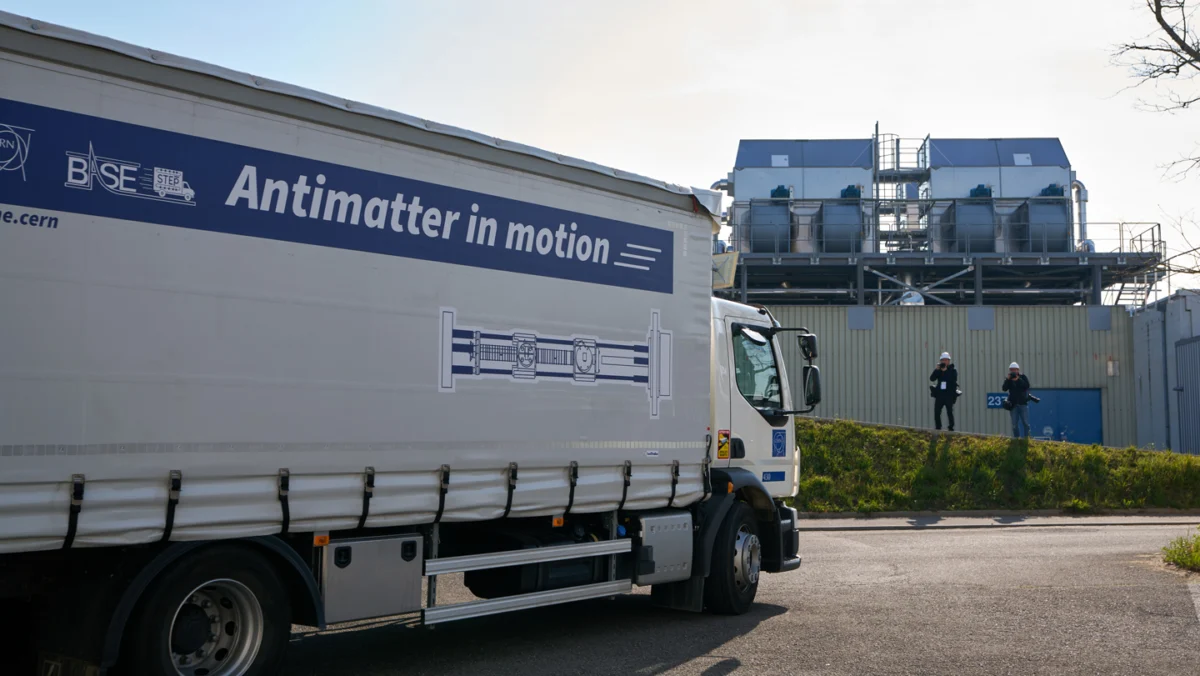
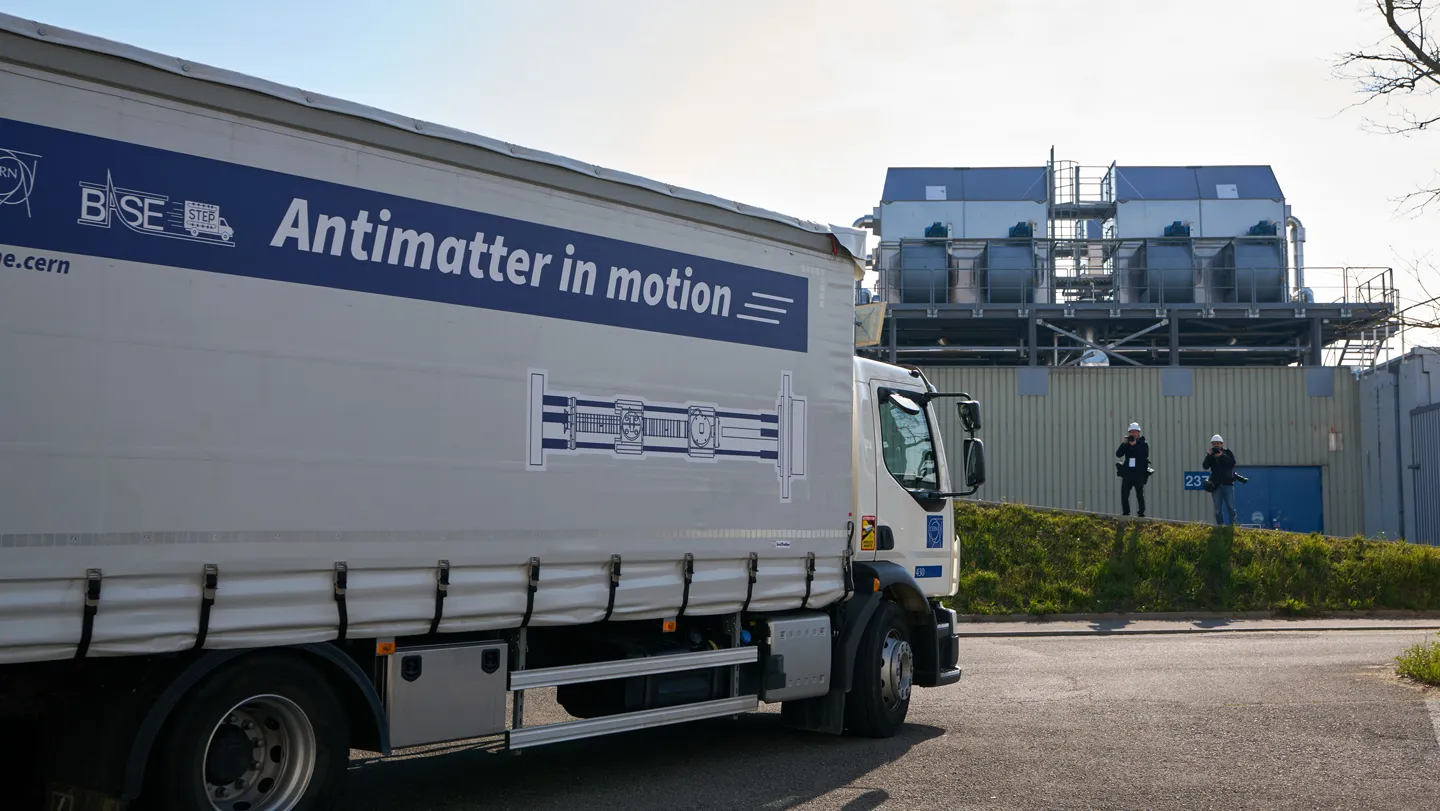
In a groundbreaking achievement for particle physics, scientists at the European Organization for Nuclear Research (CERN) have successfully transported 92 antiprotons over a distance of eight kilometers across the laboratory’s grounds. This marks the first time antimatter has been moved by truck, a critical step forward in the ability to conduct highly precise antimatter experiments at diverse locations. The delicate operation, conducted on March 24, involved carefully containing the antiprotons within a sophisticated magnetic trap mounted on a specialized truck, ensuring their survival during the journey from their creation point to a new experimental facility.
The Challenge of Antimatter Transport
Antimatter, the mirror image of ordinary matter, possesses the peculiar property of annihilating upon contact with its matter counterpart, releasing a tremendous amount of energy. This inherent instability makes handling and transporting antimatter an extraordinarily complex undertaking. The antiprotons, which are the negatively charged counterparts of protons, were meticulously confined using powerful electromagnetic fields within the BASE-STEP (Baryon Antibaryon Symmetry Experiment – Storage, Trapping, and Experimentation Program) antimatter trap. These fields act as an invisible cage, preventing the elusive antiprotons from interacting with the surrounding matter of the trap’s walls or the environment.
The journey itself presented numerous challenges. The eight-kilometer route, while within the CERN complex, involved navigating varied terrain and potential vibrations inherent in road transport. The magnetic trap had to maintain its integrity and the strength of its containment fields throughout the entire transit. The success of this operation is a testament to the advanced engineering and precise control achieved by the research team.
A Carefully Orchestrated Operation
The transport was the culmination of extensive planning and preparation. The BASE-STEP project, a collaborative effort involving scientists from institutions worldwide, aims to facilitate more advanced antimatter research by enabling the movement of antimatter to specialized experimental sites. These sites are designed to be free from the background electromagnetic noise that can interfere with sensitive measurements at large accelerator facilities like CERN.
The antiprotons were initially produced and trapped at CERN’s Antiproton Decelerator (AD), a facility dedicated to producing and slowing down antiprotons for experiments. Once a sufficient quantity of antiprotons was accumulated and cooled within the magnetic trap, the trap itself was carefully loaded onto a truck. This process required specialized cranes and meticulous attention to safety protocols, given the volatile nature of the cargo. The truck then proceeded to its destination, a new experimental area within the CERN campus, where the antiproton trap was unloaded without incident.
Context and Historical Precedent
This successful antiproton transport builds upon previous advancements in antimatter handling. In 2024, a similar demonstration involved the successful transport of protons by truck, paving the way for the more challenging antiproton experiment. While protons are stable and do not pose the same annihilation risk, the proton transport served as a crucial test of the logistics and the containment systems in a mobile setting. The antiproton transport represents a significant escalation in complexity and scientific ambition.
The ability to transport antimatter is crucial for addressing some of the most profound questions in physics, particularly the mystery of baryogenesis – why the universe is overwhelmingly composed of matter and not antimatter. According to the Big Bang theory, matter and antimatter should have been created in equal quantities. However, the observable universe is dominated by matter, with antimatter being exceedingly rare. Understanding this asymmetry is a central goal of modern physics.
The Scientific Imperative: Unraveling the Matter-Antimatter Imbalance
Scientists are meticulously investigating the fundamental properties of antimatter to uncover any subtle differences that might explain this cosmic imbalance. These investigations include precise measurements of antimatter particles’ charge-to-mass ratios, their atomic energy levels, and their response to gravity, as predicted by Einstein’s theory of general relativity. Experiments have confirmed that antiprotons behave similarly to protons in many respects, including falling under gravity as expected. However, any minute deviation from these expected behaviors could provide crucial clues to the missing antimatter in the universe.
The BASE-STEP project’s ability to move antimatter to dedicated experimental facilities is expected to significantly enhance the precision and scope of these investigations. By isolating experiments from the complex electromagnetic environment of large accelerator facilities, researchers can achieve unprecedented levels of accuracy in their measurements. This heightened precision is essential for detecting the extremely subtle differences that might exist between matter and antimatter.
Expert Reactions and Future Prospects
Physicists involved in the project expressed considerable enthusiasm about the achievement. Dr. Stefan Ulmer of RIKEN in Wako, Japan, a leading figure in the BASE-STEP collaboration, highlighted the significance of the transport during a press conference announcing the success. He described the demonstration as "a starting point of a really exciting journey," underscoring its potential to usher in a new era of antimatter research.
The successful transport opens up possibilities for a network of antimatter research facilities across Europe. This decentralization of antimatter experiments could accelerate the pace of discovery and foster greater international collaboration. Future experiments will likely focus on trapping larger quantities of antiprotons for longer durations, as well as investigating the properties of anti-atoms, such as antihydrogen.
Broader Implications and the Road Ahead
The ability to safely and reliably transport antimatter has implications beyond fundamental physics research. While still largely theoretical, the prospect of harnessing antimatter’s immense energy density for propulsion systems or advanced medical imaging continues to be a subject of scientific fascination. However, the immediate focus remains on scientific exploration.
The successful eight-kilometer journey of 92 antiprotons is not merely a logistical triumph; it is a critical enabler for unlocking deeper insights into the fundamental nature of the universe. It represents a significant step towards answering one of the most enduring mysteries: why we exist in a universe seemingly dominated by matter. The journey of these antiprotons, though short in distance, signifies a giant leap in humanity’s quest to understand its cosmic origins. The BASE-STEP project’s continued efforts promise to yield further groundbreaking discoveries as scientists push the boundaries of what is possible with antimatter.