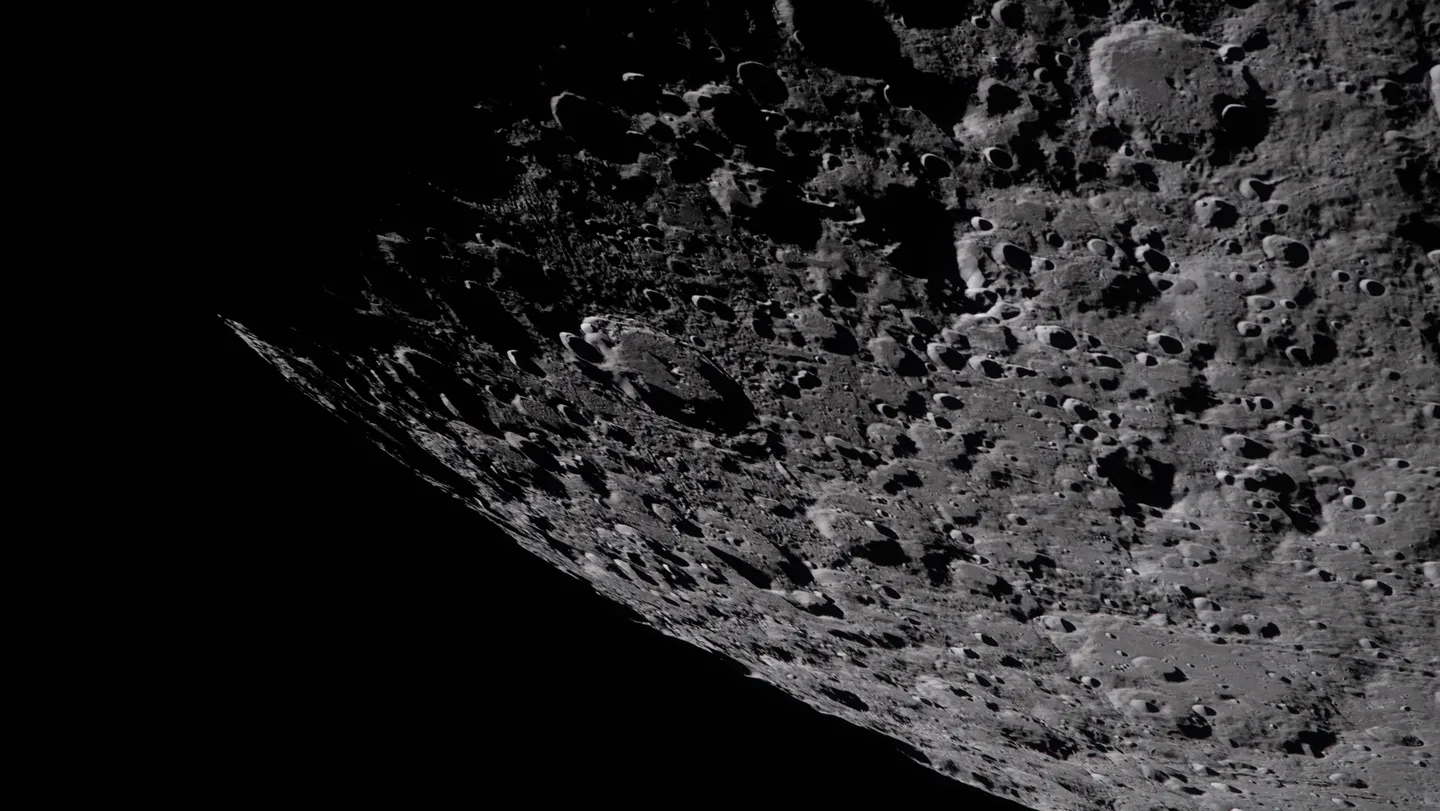
HOUSTON – As the Artemis II astronauts make their way inexorably back toward Earth, with splashdown scheduled for April 8, scientists on the ground are already poring over the data taken during a historic flight around the moon. The mission, which saw four astronauts orbit the lunar body, has yielded unprecedented visual and scientific data, promising to reshape our understanding of Earth’s closest celestial neighbor. The stunning imagery, captured in vibrant color and high resolution, offers a detailed view of lunar topography and geology, particularly along the eastern edge of the South Pole-Aitkin basin, a region of immense scientific interest due to its potential to hold clues about the moon’s early formation and evolution.
A New Era of Lunar Exploration Dawns
The Artemis II mission, a crucial precursor to future crewed landings on the Moon, marked a significant milestone in humanity’s return to deep space exploration. Launched on April 3, 2026, the Orion spacecraft, carrying Commander Reid Wiseman, Pilot Victor Glover, Mission Specialist Christina Koch, and Mission Specialist Victor Glover, embarked on a 10-day journey that included a lunar flyby. This voyage was not just about reaching a destination; it was about the journey itself and the scientific discoveries made along the way. The astronauts’ close proximity to the Moon allowed for the collection of data with a level of detail previously unattainable by robotic probes or distant observations.
The image provided, taken on April 6, 2026, showcases the dramatic terminator – the line dividing lunar day and night – rendered with stark relief. The rugged, cratered surface, illuminated by the sharp angle of the sun, reveals intricate details of impact formations and geological features. This visual fidelity is a testament to the advanced imaging capabilities of the Artemis program and the astronauts’ skill in operating them. Scientists anticipate that the analysis of these high-resolution images, combined with other sensor data collected during the mission, will provide invaluable insights into lunar geology, the distribution of resources such as water ice, and the potential for future human habitation.
Chronology of a Historic Lunar Flyby
The Artemis II mission unfolded over several critical days, each marked by significant achievements:
- April 3, 2026: The Orion spacecraft, atop the Space Launch System (SLS) rocket, successfully launched from Kennedy Space Center in Florida, initiating its journey to the Moon.
- April 5, 2026: The Orion spacecraft reached its furthest point from Earth, demonstrating the capability of the vehicle for deep space transit.
- April 6, 2026: The mission achieved its primary objective: a crewed lunar flyby. During this phase, the astronauts executed maneuvers to orbit the Moon, capturing extensive photographic and scientific data. The image highlighted in this report was taken on this day, focusing on the lunar surface near the South Pole-Aitkin basin.
- April 7, 2026: The Orion spacecraft began its trajectory back towards Earth, having completed its lunar reconnaissance.
- April 8, 2026: Splashdown of the Orion spacecraft in the Pacific Ocean, marking the successful conclusion of the Artemis II mission.
This carefully orchestrated sequence allowed for the optimization of scientific data collection, ensuring that the astronauts had ample opportunity to document and study the lunar environment during their closest approach.
Unlocking Lunar Secrets: The South Pole-Aitken Basin
The specific region captured in the iconic image, the eastern edge of the South Pole-Aitken basin, is of paramount scientific importance. This colossal impact basin, one of the largest and oldest in the solar system, is believed to have excavated material from deep within the Moon’s mantle. Studying its composition could offer direct evidence of the Moon’s internal structure and its primordial history, potentially revealing details about the giant impact event that is theorized to have formed the Moon itself.
The high-resolution imagery from Artemis II provides an unprecedented view of the basin’s geological features, including ejecta blankets, impact melt deposits, and the complex topography sculpted by billions of years of cosmic bombardment. Scientists will be able to map these features with a precision never before possible, aiding in the identification of areas with unique mineralogical compositions or geological significance. This level of detail is crucial for planning future missions, including potential robotic landers or even crewed expeditions, aimed at in-situ resource utilization and further scientific investigation.
Supporting Data and Technological Advancements
The Artemis II mission leveraged a suite of advanced scientific instruments and imaging systems aboard the Orion spacecraft. While specific details on all the data collected are still under analysis, the mission was equipped to gather a broad spectrum of information, including:
- High-Resolution Imaging: The spacecraft’s cameras, capable of capturing images in visible light and other spectrums, provided unprecedented detail of the lunar surface. This includes stereoscopic imaging capabilities, allowing for the creation of detailed topographic maps.
- Spectroscopic Analysis: Instruments designed to analyze the chemical composition of lunar rocks and regolith will provide critical data on the abundance of various elements and minerals, including those that could be indicative of water ice or other valuable resources.
- Radiation Monitoring: The mission included extensive monitoring of space radiation levels, crucial data for understanding the long-term health risks for astronauts on extended lunar or Martian missions and for designing effective shielding.
- Environmental Sensors: Various sensors collected data on the lunar environment, including temperature, atmospheric pressure (or lack thereof), and dust characteristics.
The data captured by Artemis II is expected to augment and refine existing lunar maps and models, providing a more comprehensive understanding of the Moon’s geological evolution and its potential for supporting human endeavors.
Official Responses and Scientific Anticipation
NASA leadership and the broader scientific community have expressed immense enthusiasm for the Artemis II mission’s success and the forthcoming scientific bounty.
"This mission has not only demonstrated the robustness of our Orion spacecraft and the Artemis program but has also provided humanity with an unparalleled window into our closest celestial neighbor," stated NASA Administrator Bill Nelson. "The images and data returned by the Artemis II crew will undoubtedly fuel scientific discovery for years to come and pave the way for future lunar exploration and beyond."
Dr. Sarah Johnson, a planetary geologist at the Lunar and Planetary Institute, commented on the significance of the captured imagery: "The detail in these photographs is simply astounding. We can see features that were previously only hinted at in lower-resolution images. This will allow us to refine our geological models of the Moon and pinpoint areas of particular interest for future exploration. The South Pole-Aitken basin, in particular, is a treasure trove of information about the Moon’s deep past, and Artemis II has given us a much clearer view of its surface."
The scientific community eagerly awaits the full release and analysis of the mission’s data, anticipating breakthroughs in our understanding of lunar formation, resource potential, and the broader context of planetary evolution in our solar system.
Broader Impact and Future Implications
The success of Artemis II extends far beyond the immediate scientific returns. It represents a critical step in NASA’s overarching Artemis program, which aims to establish a sustainable human presence on the Moon and eventually serve as a stepping stone for missions to Mars. The mission’s achievements have:
- Validated Deep Space Capabilities: The Orion spacecraft and SLS rocket have proven their ability to carry humans safely on a trajectory around the Moon, a crucial validation for future, longer-duration missions.
- Enhanced Public Engagement: The stunning visuals and compelling narrative of the Artemis II mission have reignited public interest in space exploration, inspiring a new generation of scientists, engineers, and explorers.
- Strengthened International Collaboration: The Artemis program, while led by NASA, involves significant international partnerships, fostering global cooperation in space exploration. The data and lessons learned from Artemis II will benefit all participating nations.
- Paved the Way for Lunar Landings: Artemis II serves as a vital technological and operational testbed for Artemis III and subsequent missions, which will involve astronauts landing on the lunar surface, including potentially at the lunar south pole.
The detailed imagery and scientific data from Artemis II are not merely beautiful photographs; they are the building blocks of future lunar exploration. They provide the granular detail needed to select landing sites, identify potential resources, and understand the challenges of living and working on another world. As the Orion capsule safely returns to Earth, the scientific community embarks on the next phase of discovery, ready to unlock the secrets that the Moon has held for millennia, now brought into sharper focus by the brave astronauts of Artemis II. The era of human lunar exploration has truly been revitalized, with this mission marking a significant turning point in our ongoing quest to understand our place in the cosmos.