The global landscape of regenerative medicine and cell therapy manufacturing has reached a significant operational milestone with the official introduction of StemFit Basic04CT. Developed by Amsbio, a prominent life sciences enterprise headquartered in Oxford, United Kingdom, this advanced cell culture medium is engineered to be entirely animal-origin-free, chemically defined, and ready to use. Designed to support the lifecycle of human pluripotent stem cells (hPSCs) from initial induced pluripotent stem cell (iPSC) generation through large-scale cellular expansion, the product targets a critical bottleneck in translational science: the friction inherent in transitioning protocols from academic research benches to heavily regulated clinical manufacturing facilities.
As the biotechnology sector increasingly shifts toward cell-based therapies for degenerative conditions, autoimmune disorders, and oncological applications, the standardization of raw materials has emerged as an operational imperative. Regulatory authorities, including the United States Food and Drug Administration (FDA) and the European Medicines Agency (EMA), maintain rigorous oversight regarding the use of animal-derived components in clinical-grade manufacturing due to inherent risks of pathogen transmission and batch-to-batch variability. Amsbio’s latest offering directly addresses these regulatory hurdles by providing a fully xeno-free formulation that minimizes contamination risks while optimizing workflow efficiencies across scalable production systems.
Main Facts and Product Architecture
StemFit Basic04CT distinguishes itself in the competitive cell culture market through a simplified one-bottle formulation. Traditional media preparations often require complex multi-component mixing, intricate reconstitution steps, and precise timing, which introduce human error and variance into cell culture pipelines. By providing a ready-to-use solution, Amsbio has effectively eliminated several preparation steps, thereby reducing workflow complexity for laboratory technicians and biomanufacturing operators alike.
Beyond its physical formulation, the medium is manufactured in strict adherence to Good Manufacturing Practice (GMP) standards within a certified ISO 13485 facility. Each distributed lot of StemFit Basic04CT is accompanied by a comprehensive certificate of analysis. Furthermore, robust supporting quality and manufacturing documentation is made readily available to researchers and commercial developers navigating the stringent validation requirements associated with translational and clinical-grade applications.
The integration of these quality controls ensures traceability and reproducibility, two fundamental pillars required for successful regulatory submissions in advanced therapy medicinal product (ATMP) development.
Comparative Performance and Workflow Economics
In comprehensive empirical testing and comparative benchmarking against other leading xeno-free human pluripotent stem cell culture products on the market, StemFit Basic04CT demonstrated notable advantages in workflow efficiency, ease of adoption, and overall operational economics.
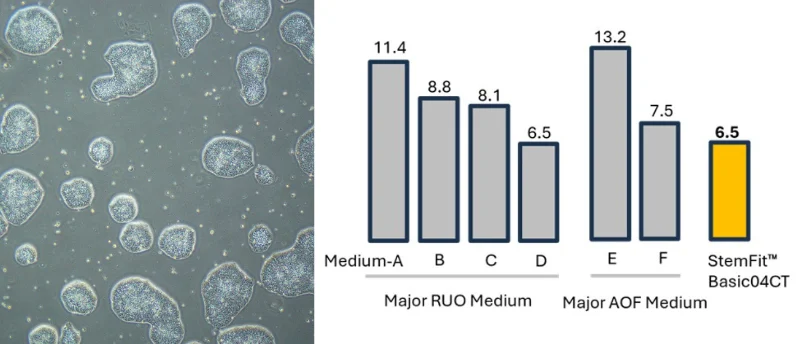
Cost containment remains a persistent challenge for laboratories scaling up iPSC production for high-throughput screening or clinical trials. Economic evaluations of the new medium indicate that it achieves the lowest cost-per-well among its primary market competitors. This financial efficiency is realized not only through the direct pricing of the reagent but also via indirect savings: reduced preparation time, minimized risk of failed batches, and lower consumption of complementary auxiliary reagents.
Furthermore, the physical resilience of hPSCs cultured in Basic04CT contributes to higher viable cell yields per passage. This performance metric is particularly vital for industrial-scale operations where bioreactor vessel capacity and media volume directly correlate with operational expenditure and final product yield.
Industry Perspectives and Transition Logistics
A primary deterrent for research laboratories and biopharmaceutical companies considering a change in basal media is the perceived disruption to established protocols. Transitioning hPSCs typically demands rigorous adaptation phases, modifications to extracellular matrix substrates, or alterations to enzymatic passaging techniques, any of which can destabilize fragile cultures or invalidate months of empirical data.

Dr. Philipp Boder, Stem Cell Products Manager at Amsbio, addressed these operational concerns during the product rollout, emphasizing the intentional design behind the medium’s transition profile.
"One of the biggest concerns when changing hPSC media is disrupting an established workflow," Dr. Boder noted. "What stood out to me in the new Basic04CT data is how straightforward the transition from another medium can be; with no adaptation step, no change to substrate or passaging conditions, and comparable expansion across three passages. That removes an important practical barrier for labs considering a change of medium."
This seamless transition capability is attributed to the balanced biochemical composition of the medium, which provides immediate physiological support to hPSCs without inducing the metabolic shock frequently observed during media switches. Consequently, laboratories can pivot to a GMP-compliant, animal-origin-free system late in a development pipeline without necessitating a complete re-optimization of upstream processes.
Broader Corporate Context and Ecosystem Integration
The introduction of StemFit Basic04CT occurs within the broader strategic framework of Amsbio’s parent organization, the Europa Biosite group. As a recognized authority in life sciences reagents, Amsbio has cultivated a diverse portfolio spanning drug discovery, 3D cell culture models, cryopreservation, and advanced genomics.
The company’s offerings are structured to support researchers across the complete continuum of scientific inquiry—from early target discovery and assay development to complex disease modeling and clinical manufacturing. Within this ecosystem, StemFit Basic04CT functions as a cornerstone component of Amsbio’s integrated stem cell platform.
This proprietary platform synergizes three core technological pillars:
- StemFit media lines for stable, scalable cell maintenance.
- iMatrix recombinant laminins for defined, animal-free cellular attachment matrices.
- CELLBANKER cryopreservation technology to ensure high post-thaw viability rates during cell banking procedures.
By pairing these complementary technologies with established extracellular matrix solutions, biospecimens, and custom viral delivery services, Amsbio aims to provide a cohesive infrastructure for translational researchers. The firm’s extensive experience with GMP compliance and its comprehensive human and animal biorepository have established its reputation as a reliable partner for academic institutions, biotechnology startups, and major pharmaceutical enterprises alike.
Implications for Regenerative Medicine and Clinical Translation
The commercial availability of advanced, scalable media like StemFit Basic04CT reflects the maturing state of the regenerative medicine sector. As cell-based therapies transition from early-stage academic trials to multi-center Phase III clinical evaluations and commercialization, the demand for standardized, scalable, and fully defined inputs intensifies.
Variability introduced by animal-derived components, such as fetal bovine serum or crude extracellular matrix extracts, has historically represented a major vulnerability in clinical manufacturing reproducibility. By shifting the industry toward chemically defined, animal-origin-free alternatives governed by ISO 13485 and GMP standards, suppliers like Amsbio are helping to mitigate translational risks.
The broader implications of these technological refinements include shortened development timelines, smoother regulatory audits, and a higher probability of successful clinical translation for novel cell therapies targeting conditions ranging from Parkinson’s disease and cardiovascular failure to diabetes and inherited genetic disorders. As manufacturing standards continue to tighten globally, products that balance cost-efficiency with uncompromising regulatory compliance will increasingly dictate the operational benchmarks of the biotechnology industry.