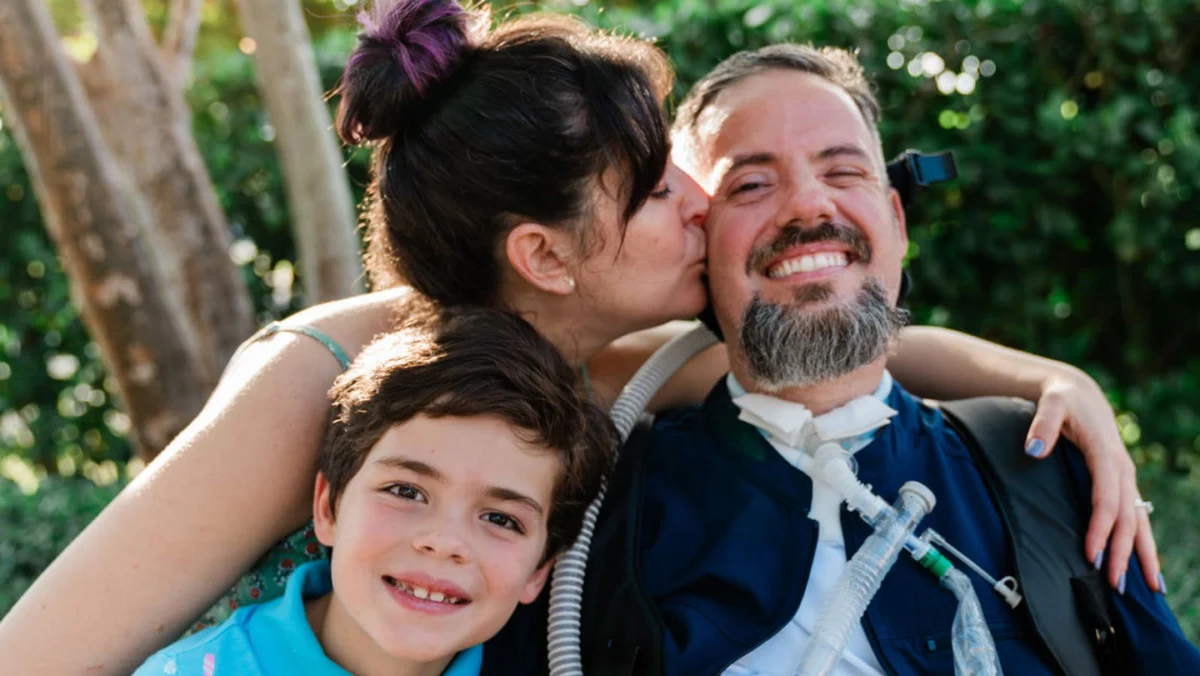
Jules Rodriguez once occupied a world defined by the vibrancy of sound. As a former science teacher, a dedicated husband, a father to his nine-year-old son, Skyler, and a stand-up comedian, his identity was inextricably linked to his ability to communicate, joke, and connect through the spoken word. However, since his 2020 diagnosis with amyotrophic lateral sclerosis (ALS), that primary bridge to the outside world has been systematically dismantled. Today, Rodriguez—like thousands of others navigating the progressive neurodegenerative disease—relies on eye-tracking technology and AI-generated voice cloning to project his thoughts, an evolution in medical technology that highlights both the fragility of human identity and the profound intersection of neuroscience and artificial intelligence.
The Clinical Progression of ALS and Communication Loss
Amyotrophic lateral sclerosis, frequently referred to as Lou Gehrig’s disease, is a progressive, fatal condition that affects motor neurons in the brain and spinal cord. As these neurons degenerate, the brain loses the ability to initiate and control muscle movement. While the physical toll—the inability to walk, button a shirt, or even swat a gnat—is often the focus of medical reports, the loss of speech is frequently cited by clinicians as the most devastating psychological blow.
The timeline for patients is often rapid and unpredictable. Rodriguez’s own journey saw his speech begin to decay by 2022, a process he and his wife, Maria Aleandra Fernandez, captured in the audio archives of their podcast. For patients like Rodriguez and Patrick Darling, a 33-year-old from Bristol, England, who was diagnosed in 2022, the loss of voice is not merely a loss of utility; it is a fundamental erasure of the persona they presented to the world. Research in speech-language pathology indicates that when a person loses the ability to speak, the resulting isolation can exacerbate the physical symptoms of the disease, leading to a profound sense of "fading away."
The Neuroscience of the Human Voice
The human brain is biologically hardwired to prioritize vocal input. According to Greg Bryant, a cognitive scientist at UCLA, there is a dedicated "voice-selective region" in the brain that activates early in development. This is why human beings are prone to "auditory pareidolia," or the tendency to hallucinate voices in environmental noise, such as the wind or mechanical hums.
From an evolutionary standpoint, the voice is a dense data package. It carries emotion, historical context, and individual personality in a single auditory signal. Infants, even while in the womb, begin identifying their mother’s voice, rhythm, and language patterns long before birth. When this sensory input is removed from a person’s life, the impact on social integration and mental health is substantial. Speech-language pathologist Kate Nilson notes that because the voice is so central to one’s identity, the absence of it creates a "persistent silence" that forces others to perceive the patient differently, often leading to the uncomfortable social phenomenon where people forget the individual still possesses a fully functioning mind.
Proactive Measures: Voice Banking and AI Synthesis
In response to the inevitable progression of ALS, medical professionals like Nilson are increasingly focusing on "voice banking." This proactive clinical strategy involves recording a patient’s speech while they are still able to produce it. These recordings are then used to build a synthetic, AI-generated voice clone. This technology allows patients to use eye-tracking devices—which detect where a user is looking on a screen to select letters and words—to generate speech that retains the cadence and tone of their original voice.
The implications of this technology are twofold. First, it restores a level of autonomy that was previously impossible for non-verbal patients. Second, it creates a digital legacy. For families, the ability to preserve a loved one’s voice for the future provides a profound emotional anchor. However, clinicians emphasize that the technology is not a perfect substitute. Many patients report that the effort required to type every word using only eye movements is significant, leading to "communication fatigue."
An Empirical Look at the "Silent Experience"
To better understand the psychological toll, speech-language pathologists have begun conducting empathy-based training for students. In a study-based exercise at the University of Minnesota, students were required to go two hours without speaking, relying solely on text-to-speech apps. The results were consistent across participants: they felt isolated, self-censored their thoughts, and ultimately stopped trying to communicate because the process felt "too artificial" and slow.
This experiment mirrors the daily reality for ALS patients. When the effort of communication increases, the frequency of interaction drops. The logistical barriers are immediate: simple requests—asking for water, adjusting a pillow, or engaging in a casual conversation—become complex, time-consuming tasks. This "social friction" is what leads many patients to withdraw, not because they lack the desire to speak, but because the medium of their expression feels like a barrier rather than a bridge.
Broader Implications for Assistive Technology
The case of Jules Rodriguez serves as a microcosm for a broader, ongoing shift in assistive technology. We are currently moving into an era where human voices no longer require a human body to function. As AI models become more sophisticated, the latency between thought and speech will likely decrease, potentially using brain-computer interfaces (BCIs) to "read" thoughts and translate them into speech in real-time.
However, researchers caution that while technology can replicate the sound of a voice, it cannot replicate the nuance of human connection. The "robotic" nature of some current systems still serves as a reminder of the patient’s condition, which can be disarming for both the patient and their loved ones. The goal of current clinical research, therefore, is not just to replace the physical function of speech, but to maintain the dignity and personality of the individual.
Conclusion: The Future of the Human Voice
As Rodriguez continues to navigate life with ALS, his story highlights the critical importance of early intervention in voice preservation. The medical community is increasingly viewing voice banking as a standard of care rather than an elective option. For many, the ability to say "I love you" in their own voice, even when the rest of their body has stopped responding, is the final line of defense against the totalizing nature of the disease.
The transition from biological sound to digital synthesis is not merely a technological advancement; it is a fundamental redesign of human communication. As we look toward the future, the integration of these tools will play an increasingly central role in the lives of those with neurodegenerative conditions, ensuring that even when the body falls silent, the person behind the diagnosis remains heard. The ongoing work of researchers, clinicians, and patients like Rodriguez serves as a testament to the enduring power of the human voice—a phenomenon that is not just a mechanism of survival, but the very essence of who we are.