The landscape of preclinical drug discovery is undergoing a profound transformation as the traditional, linear approach to histology yields to a data-centric paradigm. Historically, the lifecycle of a tissue slide was terminal: a pathologist would examine a glass specimen, record a summary finding, and consign the sample to long-term storage, effectively siloing potentially invaluable biological data. Today, the digitization of these slides, accelerated by the operational demands of the global pandemic, has turned these archives into a "gold mine" of information, offering a sustainable alternative to the repeated use of animal models.
The Paradigm Shift in Digital Pathology
The transition from analog to digital pathology has moved well beyond the mere convenience of remote sign-outs. Aleksandra Zuraw, DVM, PhD, a veterinary pathologist at Charles River Laboratories, characterizes this shift as moving from a "pathology endpoint" defined by a static report to a "data endpoint" defined by pixels. By digitizing slides, researchers are now capable of deploying machine learning algorithms to detect subtle, high-dimensional patterns—such as molecular alterations—that were previously invisible to the human eye.
This evolution is not merely technological; it is a fundamental shift in how pharmaceutical companies view their legacy assets. A slide that was once considered "read and done" is now treated as a high-fidelity data source. When integrated with comprehensive pathology reports and molecular measurements, these digital assets enable the training of sophisticated models capable of predicting biological responses, effectively decoupling the information extracted from the tissue from the physical act of the original experiment.
Chronology of Regulatory and Technical Advancement
The movement to reduce animal testing through technological innovation has been punctuated by significant milestones over the last several years:
- 2022: The enactment of the FDA Modernization Act 2.0 marked a legislative turning point, formally allowing non-animal methods to support applications for human clinical trials.
- April 2024: Charles River Laboratories launched its Alternative Methods Advancement Project, signaling an industry-wide commitment to integrating advanced modeling and historical data into preclinical workflows.
- April 2025: The FDA published a comprehensive roadmap detailing the path to reducing animal testing in preclinical safety studies, beginning with monoclonal antibodies and extending toward a broader suite of chemical entities.
- September 2026: The FDA released updated guidance further refining the criteria for utilizing New Approach Methodologies (NAMs), signaling an institutional goal to make animal studies the exception rather than the rule within a three-to-five-year window.
Maximizing Efficiency through Virtual Control Groups
A critical component of this transition involves the optimization of existing animal data. In standard toxicology protocols, a substantial number of animals are utilized solely as concurrent control groups. These animals are subjected to the same environmental and handling conditions as the test subjects but receive no active compound.
Charles River’s virtual control group initiative aims to replace a portion of these concurrent controls with high-quality, matched historical data. By leveraging vast archives of previous study results, researchers can establish a baseline that is statistically robust enough to serve as a control, thereby reducing the total number of animals required for new studies. However, the rigor of this method relies on the ability to prove that historical conditions and animal subjects are sufficiently comparable to the current study, necessitating advanced computational models to account for potential variables.
The Role of FFPE Archives in Molecular Discovery
Formalin-fixed, paraffin-embedded (FFPE) blocks have long been the industry standard for tissue preservation. These blocks represent an immense, underutilized library of biological responses. While researchers have historically collected fresh-frozen tissue for molecular analysis—a process that requires significant foresight—the ability to now extract high-quality molecular data from legacy FFPE samples allows for "retrospective investigation."
According to the Organisation for Economic Co-operation and Development (OECD) 2025 guidance on sample collection for omics analysis, the quality of FFPE-derived data is heavily dependent on precise preparation and storage protocols. When these standards are met, researchers can perform gene expression and protein analysis on archived tissue, answering critical safety questions that may emerge long after the original in vivo study has concluded. This capability eliminates the need to initiate new, resource-intensive animal experiments to address post-study queries.
Emerging Frontiers: Virtual Staining and Beyond
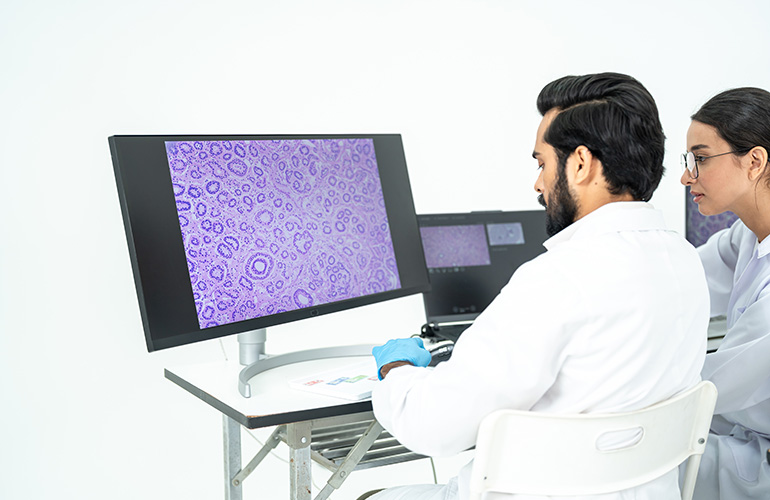
Perhaps the most ambitious frontier in this digital shift is the rise of "virtual staining." By utilizing digitized, unstained tissue sections, software can now generate the visual appearance of traditional histological stains. This approach not only reduces the chemical and physical overhead of manual staining but also allows for a greater variety of analytical stains to be applied to a single tissue section, maximizing the data yield from every sample.
As noted in recent reviews of the technology, the proliferation of virtual histology is moving from experimental demonstration toward standardized clinical use. The technical infrastructure required to support this—high-speed scanners, cloud-based storage, and specialized algorithms—is becoming an essential investment for modern laboratories. As labs adopt these systems, a "snowball effect" is expected, where the ease of data sharing and the richness of the digital archive drive further innovation in predictive modeling.
Implications for the Pharmaceutical Industry
The implications for drug discovery are significant. The shift toward digital-first pathology addresses both ethical mandates to minimize animal use (the 3Rs: Replacement, Reduction, and Refinement) and the economic necessity of accelerating drug development timelines.
However, the industry faces the "early adopter hurdle." As Dr. Zuraw emphasizes, regulatory bodies require precedent to fully embrace these NAMs. The labs that choose to integrate these digital techniques now are effectively acting as architects for the future of the field. By troubleshooting the integration of digital sign-outs, virtual controls, and retrospective molecular analysis, these organizations are establishing the standard operating procedures that will allow the rest of the industry to follow.
The move away from traditional animal-heavy testing is no longer a distant theoretical goal; it is a practical, ongoing industrial migration. By repurposing archived tissue and embracing the digital pixel as a primary data point, the research community is finding that the most effective way to design the future of medicine is by re-examining the lessons of the past. As the FDA moves toward a framework where animal models are the exception, the integration of digital pathology will likely remain the foundational technology that makes this transition not only possible but scalable.
Data Integrity and Future Challenges
While the promise of digital pathology is vast, it brings with it the imperative of data integrity. The transition requires a level of standardization in how images are captured, how models are validated, and how historical data is curated. If a virtual control group is to be used in a regulatory submission, the transparency of the data lineage is paramount.
Furthermore, the storage and processing of massive amounts of high-resolution digital pathology data present new logistical challenges. As companies transition from physical slide cabinets to petabytes of digital storage, cybersecurity, data sovereignty, and interoperability between different scanning platforms will become as critical as the biological science itself.
Ultimately, the transformation of digital pathology into a core discovery tool reflects a broader change in scientific methodology: the transition from "hypothesis-driven, single-question" experiments to "data-driven, multi-purpose" research. In this new era, every slide is an asset, every archive is a potential discovery, and every digitized image is a step toward reducing the reliance on animal testing while simultaneously enhancing the precision of preclinical drug safety assessments.