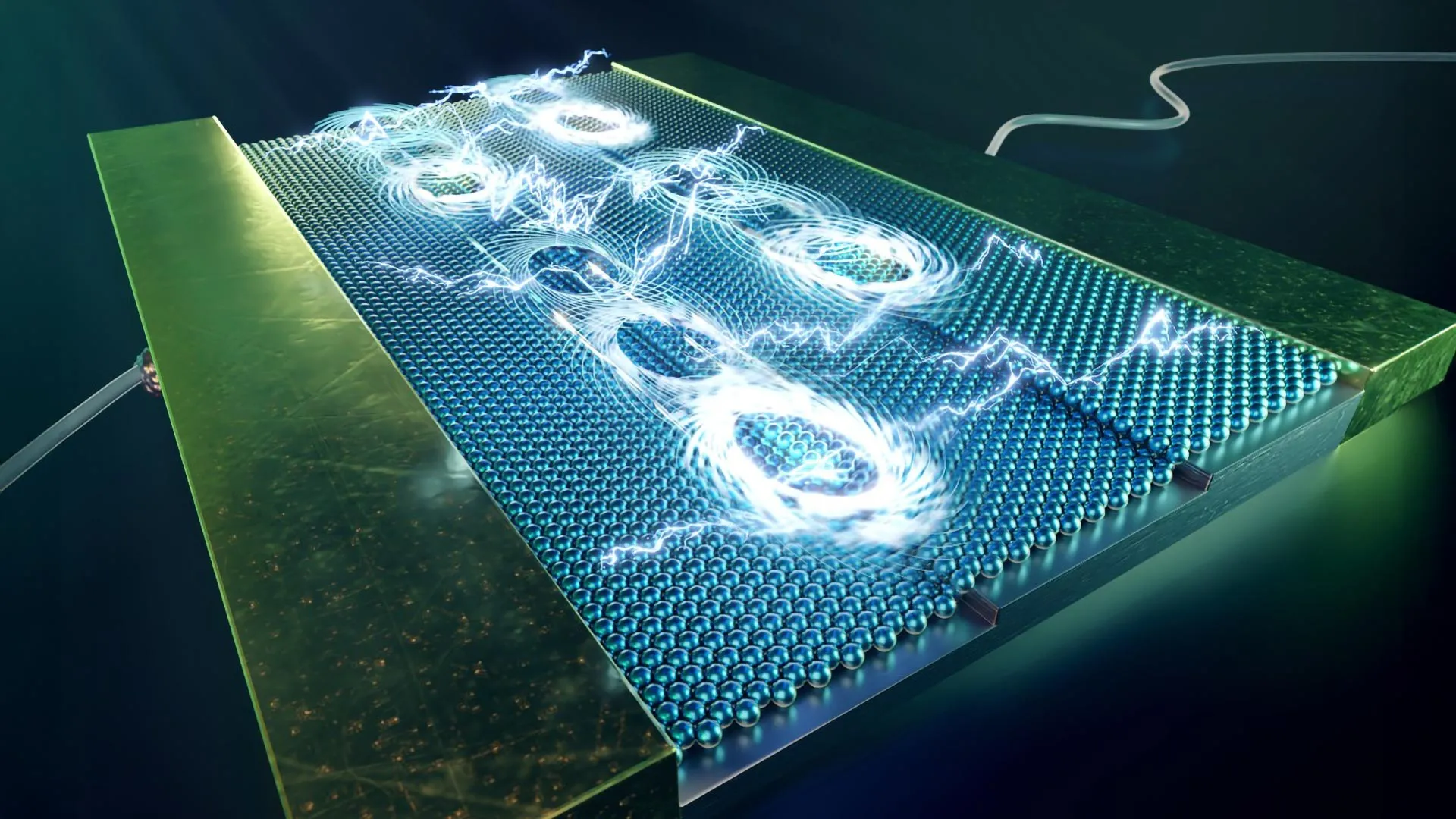
In the strange and counterintuitive realm of quantum mechanics, physical contact and direct exposure are no longer prerequisites for influence. Demonstrating this profound departure from classical physics, a team of researchers at the University of Oxford has successfully recreated a decades-old theoretical phenomenon using a hybrid quantum computer. By simulating the famous Aharonov-Bohm effect, the Oxford scientists demonstrated how an entirely invisible magnetic influence—one that a particle never physically touches—can bring simulated particle movement to a complete, unyielding halt.
The breakthrough, published in the journal Nature Physics, highlights the rapidly advancing capabilities of hybrid quantum architectures. By uniting qubits, the foundational units of quantum information, with quantum oscillators representing physical vibration, the research team has unlocked a novel method for investigating complex interactions between matter and fundamental fields. This achievement not only validates a cornerstone of theoretical physics in a novel experimental setting but also provides a powerful blueprint for tackling computational challenges that have long overwhelmed classical supercomputers.
A Century-Spanning Puzzle: The Origins of the Aharonov-Bohm Effect
To understand the significance of the Oxford experiment, one must look back to the foundational shifts in twentieth-century physics. In classical Newtonian physics, a charged particle responds exclusively to the electric and magnetic fields through which it directly passes. If a particle travels entirely outside the boundaries of a magnetic field, classical laws dictate that it should remain completely indifferent to that field’s presence.
Quantum mechanics, however, dismantled these intuitive boundaries. In 1959, theoretical physicists Yakir Aharonov and David Bohm published a groundbreaking paper proposing that a charged particle could indeed experience the consequences of a magnetic flux, even while moving entirely outside the spatial region where the magnetic field exists. Rather than feeling a direct magnetic Lorentz force along its trajectory, the particle undergoes a fundamental alteration in its quantum phase.
Quantum phase governs the wave-like behavior of particles, determining how different potential pathways interfere with one another constructively or destructively. Although the phase itself cannot be measured directly as a static scalar quantity, differences in phase produce distinctly observable interference patterns.
Over the subsequent decades, the Aharonov-Bohm effect was verified through a series of increasingly sophisticated experiments involving real electrons passing around microscopic magnetic solenoids. It evolved from a radical theoretical prediction into one of the most compelling proofs that nature operates at a fundamental level under rules defying classical intuition. Yet, observing and manipulating this effect within more complex, dynamic environments—such as those describing the fundamental forces of the universe—remained a formidable experimental bottleneck.
The Computational Bottleneck of Lattice Gauge Theories
Modern particle physics relies heavily on mathematical frameworks known as lattice gauge theories to describe how fundamental matter interacts with force-carrying fields. In these models, space is conceptualized as a discrete grid or lattice, where matter resides at individual intersections while gauge fields represent the dynamic connections linking those points together.
These theoretical models are indispensable for high-energy physics, quantum chromodynamics, and the study of subatomic particles. However, they carry an astronomical computational cost. As researchers attempt to scale these systems to include more interacting components and higher dimensions, the underlying mathematics escalates exponentially in complexity.
Traditional supercomputers, reliant on binary architecture and sequential processing, quickly hit a computational wall. Calculating how a multi-component system of matter and fields evolves over time becomes intractable, even for the world’s most advanced classical hardware.
This computational barrier catalyzed the development of quantum simulation. Instead of utilizing classical algorithms to compute the behavior of a quantum system from the outside, scientists can construct a controlled quantum system that naturally obeys the same underlying mathematical rules. By directly observing the engineered quantum simulator, researchers can bypass the prohibitive calculations required by classical machines.
Chronology of the Oxford Experiment
The path to the recent Oxford breakthrough represents a multi-year collaborative effort bridging experimental quantum optics and theoretical physics.
- 2022: Lead author Dr. Sebastian Saner and Dr. Oana Bazavan initiate a project at the University of Oxford aimed at designing a scalable quantum simulation framework for lattice gauge theories. Recognizing the theoretical complexities involved, the team establishes a partnership with Dr. Alejandro Bermudez of the Instituto de Física Teórica in Madrid.
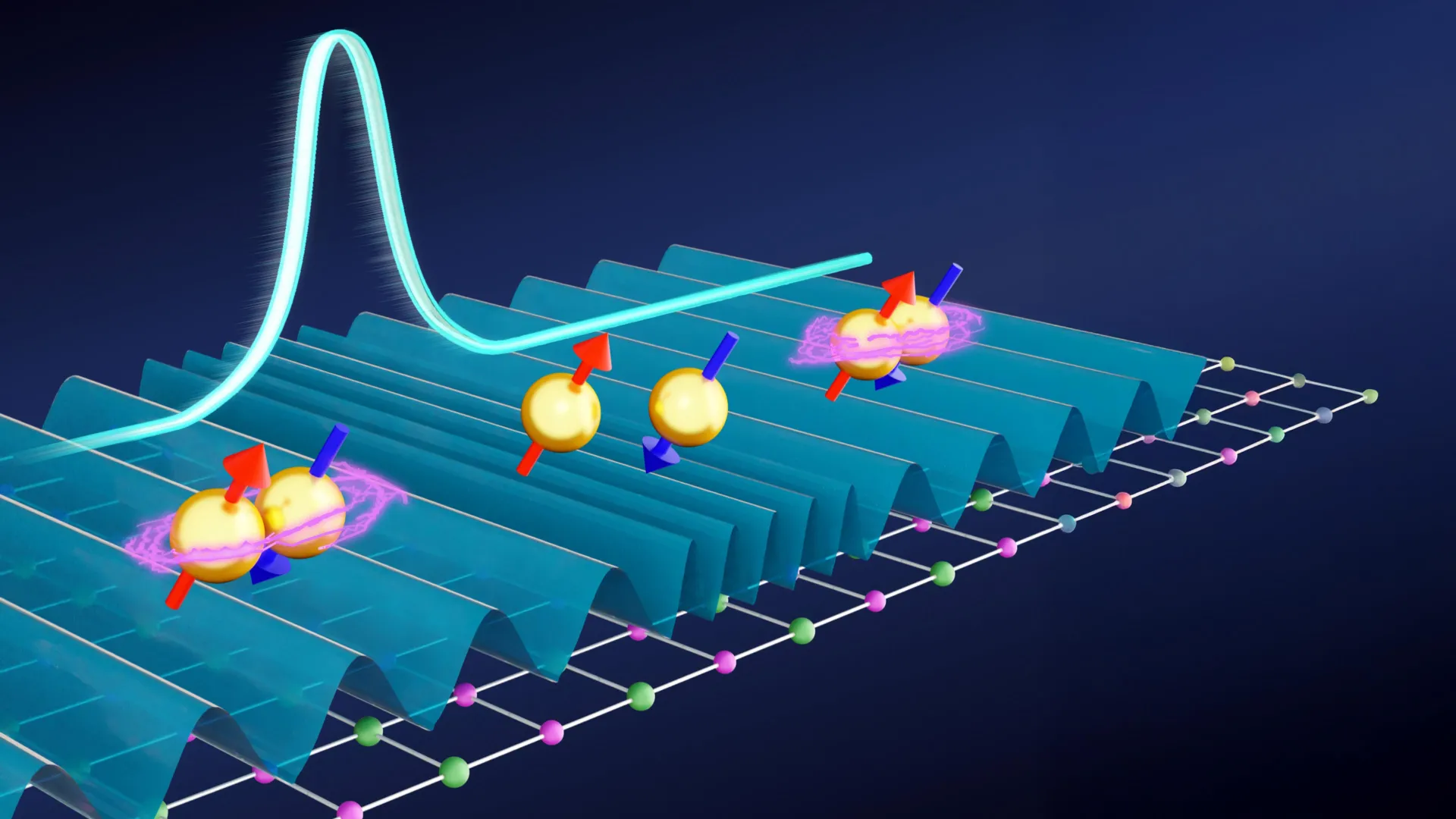
- 2023: The researchers formulate an experimental architecture relying on trapped atomic ions—specifically, electrically charged atoms suspended and manipulated via electromagnetic fields. They conceptualize a hybrid system where internal electronic states function as qubits (representing gauge fields), while the collective mechanical vibrations of the trapped ions serve as quantum oscillators (representing matter).
- Early 2024: The team successfully constructs a closed-loop configuration consisting of two matter oscillators and two connecting gauge qubits. This minimalist setup serves as the fundamental unit cell of a lattice gauge lattice gauge theory.
- Mid-2024: Rather than imposing a static, unchanging background magnetic field—a technical hurdle that exceeded their hardware capabilities—the researchers encode the magnetic flux directly into the entangled states of the qubits. This pivotal pivot transforms the magnetic flux from a passive external constraint into a fully dynamical participant in the quantum system.
- Late 2024 to Publication: Running simulations on the hybrid hardware, the team observes that introducing the simulated flux alters the relative quantum phases of alternative particle pathways, resulting in destructive interference that halts particle tunneling. The findings are finalized and submitted to Nature Physics, culminating in coordinated publication alongside complementary research from the University of Maryland.
Harnessing Quantum Entanglement and Dynamical Fields
The technical innovation underpinning the Oxford experiment lies in how the researchers handled the simulation of the magnetic flux. Initially, the team intended to introduce the magnetic flux as an external, static condition governing the path of the simulated matter particle. However, the precise hardware controls required to maintain a static background flux while simultaneously permitting matter to evolve presented an insurmountable engineering barrier.
The solution came from leaning into the unique properties of quantum mechanics itself. By encoding the magnetic flux directly into the internal states of the qubits and placing those qubits into an entangled quantum state, the researchers bypassed the need for an external magnetic source.
Entanglement—a phenomenon famously described by Albert Einstein as "spooky action at a distance"—links the quantum states of particles such that the condition of one instantaneously influences the other, regardless of spatial separation. In the Oxford experiment, this entanglement effectively embodied the presence of magnetic flux passing through the center of the simulated loop.
Crucially, this workaround yielded a scientifically superior outcome. By integrating the flux directly into the qubits, the magnetic influence became dynamical. It was no longer a static backdrop against which matter moved, but an active participant evolving in tandem with the matter particle.
"For us, the exciting step was to encode the magnetic flux in a gauge field that was itself dynamical," noted Dr. Saner during discussions of the findings. "Rather than having matter evolve in a fixed background, the matter and gauge field become part of the same quantum dynamics."
Freezing Motion Through Destructive Interference
With the hybrid lattice successfully established, the researchers turned their attention to the movement of a matter particle through the loop via quantum tunneling. Quantum tunneling is a distinctly non-classical phenomenon wherein a particle passes through an energy barrier that it theoretically lacks the classical energy to surmount.
When the Oxford team executed the simulation in the absence of simulated magnetic flux, the matter particle tunneled freely around the loop, traversing the discrete points of the lattice without obstruction.
The introduction of the dynamical magnetic flux altered the system entirely. Because the particle possessed two distinct potential pathways around the closed loop, the presence of the embedded magnetic flux shifted their relative quantum phases. As the particle’s wavefunctions propagated along the two routes, the phase shift induced precise destructive interference. The wave amplitudes canceled one another out entirely, halting the tunneling process and freezing the simulated particle securely in its original state.
This observed cessation of movement confirmed that the Aharonov-Bohm effect can be successfully operationalized within a lattice gauge framework where fields and matter are fully interactive.
Broader Implications and Independent Validation
The significance of the Oxford publication is underscored by its simultaneous appearance alongside complementary research from the University of Maryland, spearheaded by Professor Norbert Linke. While the Maryland team utilized an independent hybrid quantum system to simulate the Yukawa potential—a mathematical description crucial to nuclear and particle physics—both groups demonstrated the burgeoning power of hybrid quantum architectures. Although developed independently, the two teams coordinated their submissions to Nature Physics to highlight the converging capabilities of contemporary quantum hardware.
The implications of these experiments extend far beyond academic validation. As quantum processors scale in qubit count and fidelity, researchers anticipate that hybrid architectures will become indispensable instruments for exploring high-energy physics, condensed matter dynamics, and quantum chemistry.
By allowing fields and matter to be represented as interacting quantum components rather than static computational inputs, scientists can model phenomena that defy analytical calculation and outstrip the capacities of classical supercomputing clusters.
The successful recreation of the Aharonov-Bohm effect in an Oxford laboratory bridges a 1965 theoretical framework with the cutting edge of twenty-first-century quantum engineering. In doing so, it offers the scientific community a sophisticated new lens through which to observe and decode the deeply interconnected rules governing the subatomic universe.