The contemporary labor market for quantitative professionals is defined by a pervasive and elusive phrase: AI experience. As organizations across sectors race to integrate artificial intelligence into their core operations, job postings for data analysts, statisticians, and quantitative researchers increasingly mandate this qualification. However, a comprehensive analysis of recruitment patterns reveals that the term functions less as a standardized technical metric and more as a catch-all marketing label. A retail conglomerate, a biotechnology startup, and a multinational financial services institution may use the identical requirement of "AI experience" while envisioning entirely disparate skill sets, operational frameworks, and technological competencies.
This linguistic ambiguity creates significant friction for job seekers. Traditional technical qualifications—such as proficiency in R, five years of regression analysis experience, or mastery of SQL—carry universally understood definitions across the technology and corporate landscapes. In contrast, "AI experience" lacks a shared industry taxonomy. Consequently, qualified statisticians and data analysts frequently screen themselves out of viable positions due to a misunderstanding of what hiring managers actually require, while underqualified applicants may apply based on superficial tool familiarity. Understanding how to interpret these job postings, map existing statistical foundations to emerging business needs, and navigate the shifting expectations of modern recruitment is critical for quantitative professionals aiming to secure roles in an evolving ecosystem.
The Evolution of Job Market Terminology and the Rise of AI Mandates
To understand the current ubiquity of the AI requirement, one must examine the macroeconomic shifts governing corporate technology investments over the past decade. The maturation of machine learning frameworks in the mid-2010s transitioned predictive modeling from academic research labs into enterprise boardrooms. Initially, companies hired specialized machine learning engineers and data scientists to build proprietary algorithms from scratch. During this phase, job descriptions were hyper-specific, demanding deep expertise in neural network architectures, optimization algorithms, and specialized software libraries like TensorFlow or PyTorch.
By the turn of the decade, the commoditization of cloud-based AI infrastructure and the subsequent explosion of generative artificial intelligence fundamentally altered the corporate talent strategy. Rather than employing isolated pockets of elite algorithm developers, organizations began seeking enterprise-wide technological fluency. Human resources departments and hiring managers, often lacking deep technical literacy themselves, adopted "AI experience" as a shorthand signifier of modernity, adaptability, and technological awareness.
This shift accelerated dramatically following the widespread commercialization of large language models and automated analytics platforms. Corporate surveys conducted by enterprise recruitment agencies indicate that mentions of artificial intelligence and machine learning in non-technical job postings—including marketing, finance, and operations—surged by more than 300% between 2021 and 2024. Yet, talent acquisition specialists admit in internal surveys that they frequently struggle to define the precise competencies they are filtering for. The phrase persists not because of its technical precision, but because it acts as an effective psychological filter, attracting candidates who stay abreast of technological shifts while repelling those resistant to digital transformation.
Deconstructing the Four Categorical Definitions of AI Experience
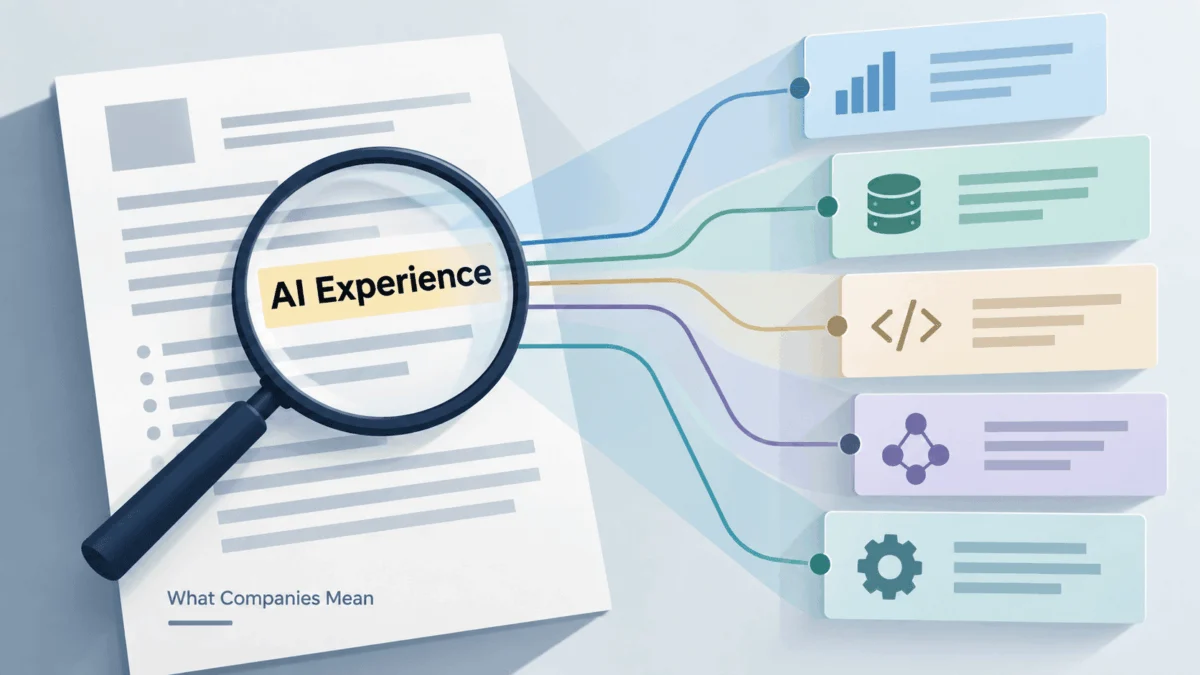
A rigorous examination of corporate recruitment data reveals that despite the broad phrasing of job advertisements, employer expectations consistently crystallize around four distinct operational categories. Recognizing which category applies to a specific role is the single most important step in framing a professional background effectively.
The first category centers on tool familiarity and operational literacy. In these roles, employers are not asking candidates to design or train algorithms. Instead, they require professionals who can seamlessly integrate existing software interfaces—such as generative text tools, automated dashboard generators, or low-code predictive analytics suites—into daily workflows. This requirement is particularly common in administrative, marketing, and junior analytical positions where efficiency and speed supersede algorithmic innovation.
The second category involves conceptual awareness and data governance. Here, organizations seek professionals who understand the theoretical capabilities and inherent limitations of machine learning systems. These roles require individuals who can critically evaluate AI-generated insights, identify potential algorithmic bias, and ensure regulatory compliance in data usage. Financial institutions and healthcare providers frequently target this profile, prioritizing risk management and ethical oversight over hands-on coding proficiency.
The third category demands hands-on statistical modeling and technical execution. These positions resemble traditional data science roles but have been rebranded under the AI umbrella. Employers expect candidates to write custom code, preprocess large datasets, train predictive models, and deploy them into production environments. Mastery of Python, SQL, and established machine learning libraries is non-negotiable for this tier.
The fourth category focuses on domain-specific artificial intelligence application. This encompasses highly specialized sectors, such as natural language processing for legal tech, computer vision for manufacturing quality control, or reinforcement learning for supply chain optimization. Candidates must possess deep industry context coupled with the technical capability to tailor algorithms to niche operational problems.
Bridging Statistical Foundations and Enterprise Expectations
For traditional statisticians, econometricians, and quantitative researchers, the transition into roles demanding AI experience does not require a wholesale reinvention of professional identity. Rather, it requires a strategic translation of existing competencies into the lexicon of modern enterprise technology. The foundational mathematics underpinning statistical modeling—probability theory, linear algebra, hypothesis testing, and multivariate regression—form the bedrock of what contemporary business lexicon labels as artificial intelligence.
When a hiring manager reviews a resume that states "built predictive regression models to forecast quarterly demand," they are reading a description of supervised learning. The underlying mechanics of evaluating root mean squared error, assessing out-of-sample validity, and identifying multicollinearity are identical whether applied in a classical econometric framework or a modern gradient-boosting algorithm. The gap between a traditional statistician and an AI practitioner is primarily one of nomenclature and software tooling, not analytical reasoning.
To bridge this gap successfully, professionals must reframe their career histories around business outcomes and decision-making processes rather than software utilities alone. Highlighting how statistical outputs guided strategic decision-making, mitigated financial risk, or optimized operational efficiency signals to hiring managers that the candidate possesses the critical judgment required to manage complex technological implementations.
Methodological Approaches to Analyzing Job Postings
Navigating contemporary job descriptions requires treating recruitment text with the same methodological rigor applied to statistical datasets. Job postings are inherently aspirational documents; human resources departments frequently compile exhaustive lists of ideal competencies, knowing that no single applicant will possess every listed attribute.
To extract actionable intelligence from a job description, candidates must differentiate between headline requirements and operational body text. A brief mention of "AI experience" buried within a bulleted list of twelve general responsibilities carries significantly less diagnostic weight than the specific daily duties outlined in the role description.
Industry analysts recommend categorizing job posting indicators based on specific linguistic modifiers:
- "AI experience preferred" generally indicates an exploratory preference, where the organization is willing to train an otherwise strong analytical candidate.
- "AI experience required" without further technical elaboration typically points toward Category 1 (tool literacy) or Category 2 (conceptual governance).
- Explicit technical prerequisites—such as mandates for specific programming languages, framework proficiencies, or cloud deployment experience—signal Category 3 or Category 4 technical execution roles.
By evaluating the distribution of responsibilities across the posting, applicants can accurately assess the organization’s true technological maturity and determine whether their quantitative background aligns with the core mandate of the position.
Seniority-Based Expectations and Strategic Alignment
The interpretation of AI experience shifts dramatically in direct correlation with the seniority level of the position. Understanding these organizational tiers allows candidates to tailor their interview narratives to address the specific pain points of hiring executives.
Junior-level roles prioritize adaptability and psychological readiness. At this career stage, employers are rarely looking for seasoned machine learning architects. Instead, they seek analysts who demonstrate comfort with emerging software interfaces, a willingness to learn proprietary internal systems, and an absence of apprehension when interpreting automated outputs.
Mid-level positions demand informed collaboration. Professionals at this tier are expected to act as bridges between technical engineering teams and non-technical business stakeholders. This requires the ability to participate meaningfully in model evaluation conversations, translate complex algorithmic findings into actionable business strategies, and maintain quality control over data pipelines.
Senior-level roles require rigorous strategic judgment. For executive, director, or principal positions, the mandate centers on organizational governance and risk assessment. Senior leaders must possess the discernment to evaluate when artificial intelligence is an appropriate operational solution and when traditional statistical methods or manual processes remain superior. Furthermore, senior leaders are tasked with communicating systemic limitations to executive leadership, helping the organization navigate the financial, ethical, and operational costs of careless technological deployment.
Dispelling Prevailing Misconceptions in Quantitative Recruitment
Misunderstandings surrounding the nature of AI recruitment continue to disadvantage qualified applicants. Chief among these is the misconception that candidates must list every artificial intelligence tool, software package, or generative interface they have ever interacted with on their resumes. In practice, this strategy frequently backfires. Hiring managers consistently report that they prioritize candidates who demonstrate rigorous critical thinking and methodological judgment over those who merely catalog software access. Listing tools as supporting context for a broader narrative of problem-solving yields superior results.
A second pervasive myth is that candidates without experience building machine learning models completely from scratch are automatically disqualified from the talent pool. For the vast majority of enterprise roles, this is false. Employers are far more frequently limited by a shortage of professionals capable of thinking critically about data quality, identifying underlying model assumptions, and interpreting results within a broader economic context. These are core statistical competencies, and they represent the primary skill set organizations require.
Finally, the belief that obtaining a generic online certification in artificial intelligence is a prerequisite for application often deters qualified statisticians. While credentials can provide helpful supplementary signaling, hiring managers evaluating analytical talent focus primarily on a candidate’s reasoning processes during the interview phase. The capacity to articulate precisely when and why an automated system might fail is demonstrably more valuable to a modern enterprise than any completed digital course.
Broader Economic Implications and Future Outlook
The maturation of AI recruitment practices carries profound implications for the global labor market. As organizations move past the initial phase of speculative technology adoption, the demand for indiscriminate technical implementation is being replaced by a sophisticated appreciation for data integrity and statistical governance.
Labor economists note that this transition marks a normalization phase in the technology sector. The early years of enterprise AI integration were characterized by inflated job titles and opaque technical requirements. As human resources departments refine their recruitment strategies and corporate leadership develops a clearer understanding of return on investment, job descriptions are becoming increasingly pragmatic.
For statisticians, data analysts, and quantitative researchers, this evolution represents a significant strategic advantage. The foundational mathematical training that underpins traditional quantitative analysis remains the most reliable defense against technological obsolescence. While software tools, programming languages, and AI frameworks will inevitably continue to evolve at a rapid pace, the principles of rigorous data evaluation, probabilistic reasoning, and empirical validation remain constant.
Ultimately, navigating the modern job market requires looking past marketing buzzwords and recognizing the underlying analytical challenges organizations are attempting to solve. By decoding job postings with methodological precision, translating traditional statistical competencies into contemporary enterprise vocabulary, and focusing interviews on critical reasoning rather than software enumeration, quantitative professionals can position themselves at the forefront of the next phase of technological integration.