The Hugging Face Hub reached a watershed moment in mid-2026, officially registering nearly 3 million public model repositories, a substantial climb from the 2.43 million repositories documented at the commencement of the year. For professional machine learning practitioners, data scientists, and enterprise developers, the modern bottleneck is no longer raw access to state-of-the-art architectures. Instead, the primary operational challenge lies in distinguishing which models deliver genuine utility, identifying which legacy systems have been superseded by rapid technological iteration, and determining which foundational networks are actively powering production pipelines regardless of prevailing academic benchmarks.
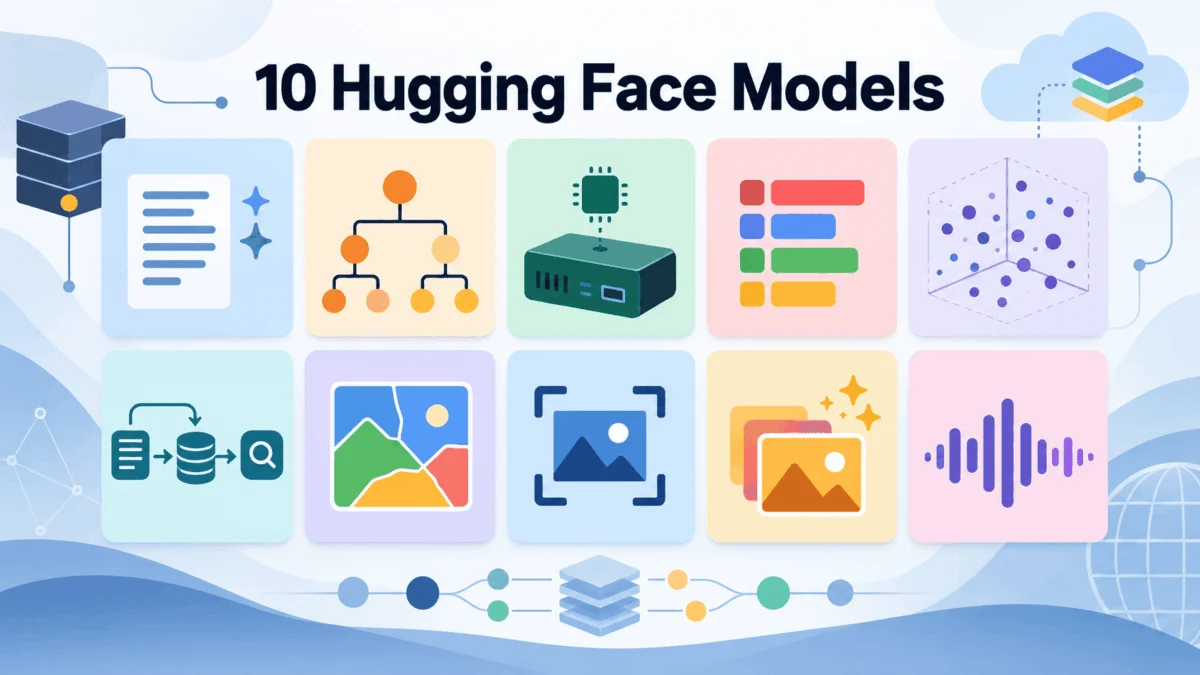
Industry analysts note that the sheer velocity of open-source artificial intelligence development has created a paradoxical environment. While thousands of new checkpoints emerge monthly, production-grade deployments demand rigorous vetting regarding hardware consumption, licensing compliance, latency, and downstream integration capabilities. To navigate this saturated ecosystem, a definitive curation of ten indispensable models has been established based on empirical Hub adoption metrics, benchmark performance, licensing terms, and recurring applicability across professional machine learning workflows. Several widely cited frameworks from 2024 and 2025 have been intentionally omitted or replaced by their direct successors, reflecting the unforgiving pace of architectural evolution in the sector.
Foundation, Reasoning, and Edge Deployment
The foundational text and reasoning category continues to anchor modern natural language processing pipelines, though deployment paradigms have shifted significantly toward native multimodality and hardware-efficient scaling. Modern instruction-tuned models rely heavily on standardized chat-template formatting rather than raw string inputs to optimize inference behavior. Engineers must utilize updated library ecosystems, ensuring installations of the latest transformers, diffusers, and sentence-transformers packages to leverage distributed layer mapping via device managers and native precision casting.
At the forefront of community-adopted base models stands Qwen3.8-27B. Qwen-derived repositories have achieved staggering dominance on the Hugging Face Hub, accounting for over 151,000 community derivatives—more than double the total repository footprint of Meta’s comparable ecosystem. Furthermore, monthly GGUF downloads for the Qwen family exceed 39 million, dwarfing equivalent Llama utilization metrics by a factor of five. Released under the permissive Apache 2.0 license, Qwen3.8-27B is natively multimodal, processing high-resolution images and video streams alongside traditional text through a single unified checkpoint. This native integration eliminates the operational overhead of managing separate vision-language weights, streamlining dependency management for enterprise deployment teams.
For enterprise-grade reasoning and complex coding tasks, DeepSeek-V4.1-Flash represents a monumental leap in mixture-of-experts (MoE) architecture. Boasting a massive 552 billion backbone parameter count, the model optimizes computational efficiency by activating only 8 billion parameters per token during prefill phases and 16 billion during decoding stages. Supporting expansive context windows of up to one million tokens and governed by the MIT license, DeepSeek-V4.1-Flash has posted extraordinary benchmark scores, achieving 74.2 on DeepSWE v1.1 and 90.6 on Terminal-Bench 2.1. Due to its sheer scale, direct Python execution is typically bypassed in favor of distributed serving frameworks like vllm or integration via Hugging Face Inference Providers.
Simultaneously, the imperative for localized, resource-constrained computing has been addressed by Google’s Gemma 4 family, introduced in April 2026. Transitioning fully to an Apache 2.0 license—a decisive departure from the restrictive source-available terms that historically governed earlier Gemma generations—the family spans four distinct configurations. These range from the ultra-compact E2B variant designed for seamless execution on standard laptops and mobile devices, up to the robust 31B Dense variant. This architectural scalability allows developers to deploy high-performing intelligence directly to the edge without relying on costly cloud-based infrastructure.
Retrieval, Representation, and Encoder Specialization
While generative decoders dominate public discourse, production environments frequently rely on encoder-only architectures and specialized embedding models for text classification, named entity recognition, and retrieval-augmented generation (RAG) indexing.
ModernBERT-base has emerged as the definitive standard for encoder tasks, extending the historical BERT context window to 8,192 tokens while integrating Flash Attention mechanisms to drastically accelerate inference speeds at elevated sequence lengths. Designed explicitly for domain-specific fine-tuning on labeled datasets rather than zero-shot prompting, ModernBERT-base provides enterprise search and classification pipelines with high throughput and reliable accuracy on standard GPU hardware.
In the domain of dense retrieval, Qwen3-Embedding-0.6B currently commands leadership on the open-weight Massive Text Embedding Benchmark (MTEB) leaderboard for its parameter tier. Featuring 596 million parameters, the model offers unprecedented flexibility through user-defined output dimensions ranging from 32 to 1,024, directly mitigating storage and retrieval latency constraints in large-scale vector databases. Utilizing last-token pooling with L2 normalization and specific instruction prefixes for query processing, it integrates cleanly into modern vector search engines including FAISS, Pinecone, and Weaviate.
Conversely, historical download metrics underscore the enduring presence of legacy architectures in enterprise codebases. The sentence-transformers/all-MiniLM-L6-v2 model accumulated 1.55 billion downloads in the first seven months of 2026 alone, averaging approximately 220 million downloads monthly. Intriguingly, historical data reveals that none of the models published in 2026 feature in the Hub’s all-time top 25 download list, with thirteen of those top positions belonging to models established in 2022. This disparity highlights a central reality of machine learning engineering: production systems evolve far slower than academic research, making foundational understanding of legacy embeddings vital for debugging enterprise retrieval failures and assessing migration costs.
Vision, Multimodal, and Generative Media Systems
The computer vision and generative media sectors have undergone significant consolidation, driven by stricter licensing frameworks and increasingly sophisticated zero-shot capabilities.
Meta’s SAM 3 represents a paradigm shift in image and video segmentation by transitioning from traditional point-and-box prompting to open-vocabulary text recognition. By accepting natural language strings—such as descriptive object phrases—the model generates precise segmentation masks across video frames while utilizing memory-based trackers to maintain consistent object identities. Access to SAM 3 requires users to navigate gated repository protocols and accept specific terms on the Hugging Face Hub.
Similarly, Meta’s DINOv3 has established itself as the premier framework for general-purpose visual feature extraction. Eschewing text-alignment paradigms in favor of visual self-supervision, DINOv3 produces rich feature representations optimized for dense image retrieval and linear-probe classification. However, enterprise adoption requires careful legal review, as the DINO family operates under custom commercial licensing terms distinct from standard Apache 2.0 structures.
In generative image systems, FLUX.2—released by Black Forest Labs—has supplanted its predecessor as the open-weight benchmark for visual fidelity. The 4B klein variant operates under an Apache 2.0 license, requiring approximately 13 GB of VRAM and utilizing a four-step distillation process to accelerate inference workflows. Practitioners must remain vigilant regarding model variants, as larger developer editions are governed by restrictive non-commercial licenses requiring separate enterprise agreements.
Audio Transcription and Operational Implications
Rounding out the core infrastructure tier, OpenAI’s Whisper large-v3-turbo continues to serve as the industry standard for multilingual automatic speech recognition. Although competing models have occasionally surpassed Whisper on raw Word Error Rate metrics across specialized leaderboards, Whisper’s native support for over 90 languages, MIT licensing, and seamless three-line transformers integration secure its position in production environments. Providing both segment-level and word-level timestamp generation, it facilitates streamlined subtitle creation and audio search indexing without requiring complex alignment pipelines.
Comprehensive Model Overview
| Model | Primary Application | Hub Checkpoint Identifier | Licensing Structure | Hardware and Deployment Considerations |
|---|---|---|---|---|
| Qwen3.8-27B | General text generation with native vision capabilities | Qwen/Qwen3.8-27B |
Apache 2.0 | Requires ~56 GB VRAM at BF16, or ~16 GB via 4-bit quantization |
| DeepSeek-V4.1-Flash | Frontier reasoning and multi-token context handling | deepseek-ai/DeepSeek-V4.1-Flash |
MIT | 552B MoE backbone; requires multi-GPU serving or Inference Providers |
| Gemma 4 | Edge computing and localized on-device execution | google/gemma-4-E2B-it to google/gemma-4-31B-it |
Apache 2.0 | Four scalable sizes; E2B variant executes locally on consumer hardware |
| ModernBERT-base | Fine-tuned classification, NER, and RAG indexing | answerdotai/ModernBERT-base |
Apache 2.0 | Encoder-only architecture with an 8,192-token context window |
| Qwen3-Embedding-0.6B | Dense text retrieval and vector embedding generation | Qwen/Qwen3-Embedding-0.6B |
Apache 2.0 | Flexible output dimensions (32–1,024); requires query instruction prefixes |
| all-MiniLM-L6-v2 | Production semantic search and legacy baseline comparison | sentence-transformers/all-MiniLM-L6-v2 |
Apache 2.0 | Lightweight CPU execution; constrained multilingual capabilities |
| SAM 3 | Open-vocabulary text-prompted image/video segmentation | facebook/sam3 |
Custom SAM License | Gated repository requiring explicit Hub terms acceptance |
| DINOv3 | Unsupervised visual feature extraction and correspondence | facebook/dinov3-vitb16-pretrain-lvd1689m |
Custom DINOv3 License | Custom commercial use terms necessitate legal review prior to deployment |
| FLUX.2 klein 4B | High-fidelity open-weight image generation | black-forest-labs/FLUX.2-klein-4B |
Apache 2.0 (Dev is non-commercial) | Requires ~13 GB VRAM; 4-step distillation for optimized inference |
| Whisper large-v3-turbo | Multilingual speech-to-text transcription | openai/whisper-large-v3-turbo |
MIT | Supports 90+ languages with native segment and word timestamps |
Strategic Implications for Enterprise AI
The comprehensive survey of the 2026 Hugging Face landscape highlights two overarching realities for the artificial intelligence sector. First, tracking technological obsolescence is as critical as monitoring state-of-the-art advancements. The clear trajectories from DeepSeek-R1 to V4.1, from FLUX.1 to FLUX.2, and from SAM 2 to SAM 3 illustrate how targeted architectural refinements directly resolve previous throughput and hardware bottlenecks. Understanding the catalysts behind these upgrades empowers engineering leadership to anticipate future paradigm shifts.
Second, the persistent dominance of legacy frameworks like all-MiniLM-L6-v2 demonstrates the inherent inertia of enterprise software architecture. Academic research consistently outpaces production deployment cycles, resulting in a substantial temporal gap between cutting-edge benchmarks and operational pipelines. Successfully balancing the adoption of frontier models with the maintenance of stable, battle-tested baseline systems remains the defining challenge for machine learning practitioners scaling enterprise intelligence into the latter half of the decade.