The economics of enterprise data science have shifted dramatically over the past two years, moving away from closed, high-cost software ecosystems toward robust open-source alternatives. Historically, establishing a fully functional data science stack required steep capital expenditures. Organizations routinely allocated tens of thousands of dollars annually for single-seat licenses of platforms like DataRobot or H2O Driverless AI, alongside substantial recurring monthly budgets for commercial large language model (LLM) application programming interfaces (APIs), proprietary coding assistants, and cloud-based analytics warehouses. However, the maturation of open-weight models and community-driven frameworks has closed the capability gap, allowing local, self-hosted infrastructure to rival—and in some cases surpass—commercial offerings.
This structural evolution addresses two persistent challenges that have long constrained analytical teams: escalating software expenditures and stringent data privacy requirements. As proprietary platforms scale their per-user, per-token, or per-gigabyte pricing models, corporate technology budgets face unprecedented upward pressure. Concurrently, strict data governance mandates, such as the European Union’s General Data Protection Regulation (GDPR) and the California Consumer Privacy Act (CCPA), have made the transmission of proprietary code and sensitive user data to third-party cloud servers an increasingly complex compliance risk. The adoption of open-source architectures mitigates both concerns by enabling organizations to execute sophisticated machine learning workflows entirely on local or private hardware without incurring marginal transaction fees.
The Financial Burden of Legacy Enterprise Stacks
To understand the current migration toward open-source tools, one must examine the baseline costs of traditional enterprise data science infrastructure. A single enterprise seat for advanced automated machine learning (AutoML) platforms frequently exceeds $50,000 annually, with comprehensive enterprise packages surpassing $250,000 depending on deployment scale and compute allocation. Similarly, enterprise visual analytics tools such as Tableau Creator and Power BI Premium demand continuous per-user subscription fees ranging from several hundred to over a thousand dollars per year.
Furthermore, the integration of generative AI into daily operations has introduced unpredictable variable costs. Commercial LLM APIs charge per token, meaning that data-intensive organizations running continuous text extraction, summarization, or synthetic data generation pipelines routinely face monthly inference fees running into thousands of dollars with no predictable upper bound. Coding assistants like GitHub Copilot Business and Tabnine add further fixed per-seat overhead, while cloud-based data warehouses such as Snowflake and BigQuery incur substantial compute and storage charges for routine exploratory data analysis. For mid-sized teams, these cumulative software expenses can easily drain hundreds of thousands of dollars from operating budgets annually, prompting leadership to seek viable, cost-effective alternatives.
Chronology of the Open-Source Open-Weight Revolution
The transition from proprietary dominance to open-source parity did not happen overnight. It is the result of a multi-year technological progression driven by academic research, corporate open-sourcing initiatives, and community collaboration.
The foundational shift began around 2023 with the rapid advancement of open-weight foundational models. While early open-source models lagged significantly behind proprietary counterparts from major artificial intelligence laboratories, the release of architectures matching or approaching state-of-the-art performance changed the industry calculus. Projects like Meta’s Llama series, Mistral AI’s models, and deep-reasoning networks such as DeepSeek-R1 demonstrated that high-performing AI models could be publicly distributed and executed on consumer- or enterprise-grade local hardware.
Concurrently, developer toolchains matured rapidly. The introduction of optimized local inference runtimes like Ollama in late 2023 and 2024 democratized the deployment of complex language models, eliminating the requirement for specialized systems engineering expertise. Tooling for Retrieval-Augmented Generation (RAG), automated machine learning (such as AWS’s AutoGluon), and local SQL execution (such as DuckDB) evolved from experimental research repositories into production-ready software packages. By 2025, the performance parity between paid enterprise platforms and their open-source equivalents reached a tipping point, prompting enterprise data science teams to systematically audit their software stacks and migrate workloads inward.
Ten Essential Open-Source Replacements Across the Data Science Lifecycle
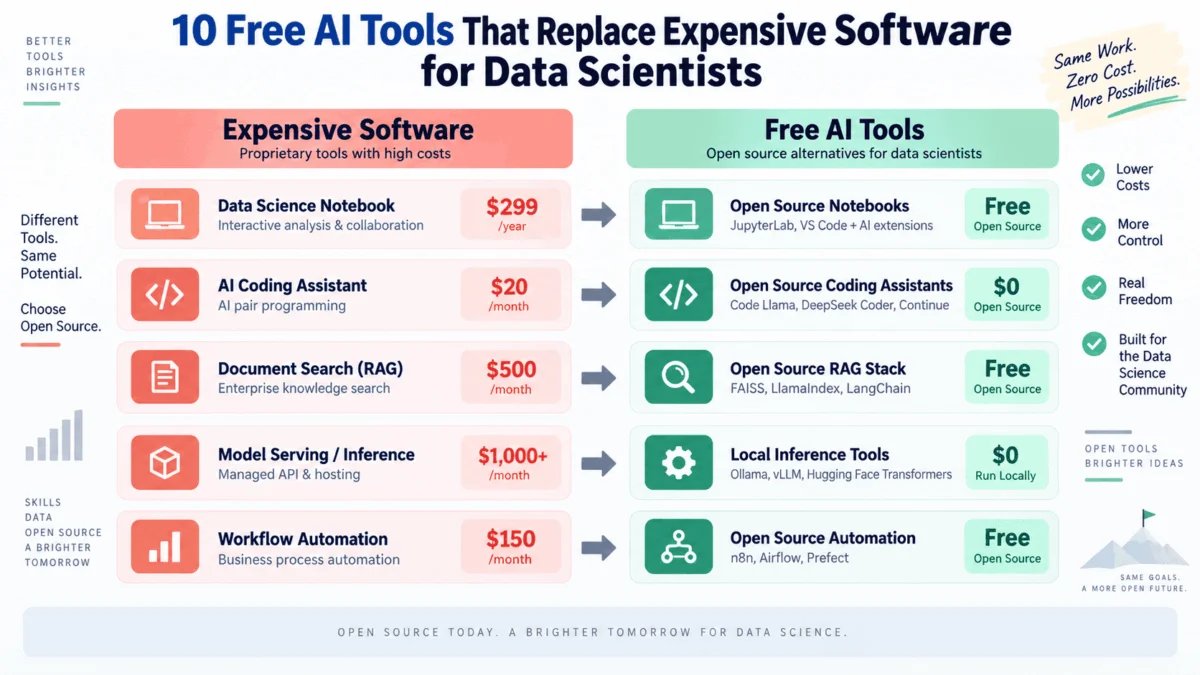
Modern data science workflows encompass a broad spectrum of technical tasks, ranging from local model inference and code completion to automated machine learning, visual analytics, and experiment tracking. The contemporary open-source ecosystem provides credible, zero-cost substitutes for every major commercial software category.
1. Local Inference: Ollama and Open WebUI
Commercial LLM APIs impose continuous per-token costs that scale linearly with operational usage. Ollama enables organizations to download and execute open-weight models—including DeepSeek-R1, Llama 3.3, Mistral, and Phi-4—directly on local hardware. Paired with Open WebUI, which provides a browser-based chat interface mirroring commercial platforms, teams can conduct multi-turn conversations, process file uploads, and execute text extraction pipelines without incurring API fees or transmitting proprietary data across external networks.
2. AI-Assisted Coding: Tabby
Proprietary coding assistants like GitHub Copilot Business and Tabnine carry significant per-user monthly subscription fees and require source code to be processed on third-party servers. Tabby offers a self-hosted, open-source alternative that integrates seamlessly into Integrated Development Environments (IDEs) such as VS Code, JetBrains, and Vim. By leveraging repository-level context indexing and running entirely on local infrastructure, Tabby ensures complete data sovereignty while delivering context-aware code completions tailored to internal organizational libraries and coding standards.
3. Automated Machine Learning: AutoGluon
Enterprise AutoML platforms such as DataRobot and H2O Driverless AI command steep annual licensing fees. Developed and maintained as an open-source project by Amazon Web Services (AWS), AutoGluon automates the end-to-end machine learning lifecycle for tabular, text, image, and multimodal data. Its sophisticated ensemble stacking methodology consistently ranks at the top of competitive machine learning benchmarks, outperforming many manually tuned pipelines while executing entirely within a local Python environment without row-based pricing restrictions.
4. Natural Language Data Exploration: PandasAI
Business intelligence and natural language querying tools like ThoughtSpot and Alteryx incur substantial licensing costs per user. PandasAI bridges the gap between natural language processing and data manipulation by embedding an intelligent query layer directly on top of standard Pandas and Polars DataFrames. Data scientists and non-technical stakeholders alike can interrogate datasets using plain English, dramatically accelerating exploratory data analysis (EDA) and democratizing data access within Jupyter notebook environments.
5. Enterprise Knowledge Management: AnythingLLM
Proprietary RAG platforms and internal document search tools can cost thousands of dollars monthly based on user counts and document volume. AnythingLLM is a full-stack RAG application that ingests local files, PDFs, code repositories, and structured databases to create a fully queryable, secure AI knowledge base. Operating locally in conjunction with Ollama, it provides automated document chunking, vector storage, and source-cited retrieval without requiring external cloud infrastructure.
6. Dataset Annotation: Autodistill
Manual computer vision annotation platforms like Scale AI and Labelbox charge per labeled item or per seat, driving project costs skyward for large image datasets. Autodistill leverages large foundation models, including Grounding DINO and the Segment Anything Model (SAM), to automatically generate labels for computer vision datasets via zero-shot natural language detection. This process, termed "distillation," allows teams to bootstrap custom object detection models entirely from unlabeled imagery, bypassing manual annotation bottlenecks and platform subscriptions.
7. Visual Analytics: PyGWalker
Standalone visual analytics suites such as Tableau Creator and Power BI Premium involve recurring per-user software expenditures. PyGWalker transforms standard Pandas or Polars DataFrames into interactive, drag-and-drop visual exploration interfaces directly inside Jupyter notebooks. By replicating Tableau’s shelf-based interaction model within the analysis environment, PyGWalker enables rapid prototyping and exploratory visualization without requiring separate data connections or export steps.
8. Experiment Tracking: MLflow
Enterprise configurations of experiment tracking platforms like Weights & Biases introduce significant per-seat costs and require telemetry data to be transmitted to external servers. MLflow serves as the open-source industry standard for tracking machine learning parameters, metrics, artifacts, and model versions. With robust native support for modern LLM applications—tracking prompt versions, response latency, and token consumption—MLflow provides a centralized, self-hosted interface for managing the entire model lifecycle securely on private infrastructure.
9. Local Analytical Databases: DuckDB
Small- and medium-sized analytics teams frequently spend thousands of dollars monthly on cloud data warehouse compute and storage via platforms like Snowflake and BigQuery. DuckDB is an in-process analytical database designed to execute high-performance SQL queries directly against Parquet, CSV, JSON, and DataFrame formats. For datasets under approximately 100 gigabytes, DuckDB delivers query speeds comparable to managed cloud warehouses entirely on local hardware, eliminating network latency and cloud infrastructure bills.
10. LLM Observability: Langfuse
Managed LLM observability platforms such as LangSmith charge per seat and per trace, creating unpredictable scaling costs for production applications. Langfuse is an open-source observability and evaluation platform that captures detailed traces of every LLM interaction, including prompts, outputs, token counts, latency, and cost estimates. Deployable via Docker in minutes, Langfuse empowers engineering teams to debug complex pipelines, evaluate prompt performance, and monitor production quality without incurring commercial platform fees.
Strategic Implications for Enterprise Technology Budgets
The widespread viability of open-source data science tools marks a maturation point in the software-as-a-service (SaaS) economy. For corporate chief technology officers and chief information officers, the availability of high-performance open-source alternatives alters vendor negotiation leverage and long-term capital allocation strategies. Organizations are no longer compelled to lock themselves into expensive, multi-year software contracts simply to maintain competitive analytical capabilities.
Industry analysts note that while open-source software eliminates direct licensing fees, it introduces a trade-off regarding internal operational overhead. Commercial platforms bundle setup complexity, automated maintenance, and dedicated customer support into their subscription pricing. Conversely, open-source deployments require internal engineering teams to manage installation, infrastructure configuration, and software updates. However, for organizations possessing baseline DevOps and software engineering competence, this configuration overhead is typically measured in hours rather than weeks, making the long-term return on investment overwhelmingly positive.
Furthermore, the data privacy implications of local deployment models cannot be overstated. In sectors characterized by strict regulatory oversight—such as healthcare, financial services, and defense—the ability to execute state-of-the-art machine learning inference, automated labeling, and knowledge retrieval entirely behind corporate firewalls eliminates an entire category of compliance vulnerabilities. By retaining absolute jurisdiction over model weights, training data, and user queries, enterprises can harness the power of generative artificial intelligence without exposing proprietary intellectual property to third-party data collection policies.
As the open-source AI community continues to release increasingly efficient models and developer frameworks, the pressure on commercial software vendors to justify their premium pricing models will only intensify. Data science teams willing to invest in strategic stack modernization can achieve substantial cost reductions, heightened data security, and operational autonomy, reshaping the financial architecture of modern technical enterprises.