The physical footprint of the artificial intelligence boom is no longer confined to server racks in Silicon Valley; it is reshaping the American landscape, straining municipal water supplies, and sparking a contentious debate over who ultimately foots the bill for unprecedented energy demands. In Manassas, Virginia, long-time resident John Steinbach opened his utility bill in January 2026 to find a charge of $281—nearly triple his usual monthly expense. As more AI data centers plug into the local electrical grid, Steinbach’s experience has become a cautionary tale for communities nationwide, illuminating the widening gap between the localized costs of rapid technological expansion and its broader national benefits.
The Evolution of Computational Demand and Grid Strain
To understand the current friction between tech developers and local communities, one must examine how generative AI has fundamentally altered the computational math. Traditional cloud computing data centers relied primarily on general-purpose servers that scaled their energy consumption up and down in tandem with user traffic. In contrast, modern AI clusters pack power-hungry graphics processing units (GPUs) densely into racks. These facilities generate immense heat and execute continuous, round-the-clock workloads, particularly during intensive model training phases. Consequently, a single contemporary AI campus places demands on local utilities that dwarf those of older generation facilities.
According to a benchmark report prepared for the U.S. Department of Energy by the Lawrence Berkeley National Laboratory, U.S. data centers consumed approximately 176 terawatt-hours in 2023, accounting for roughly 4.4% of the nation’s total electricity consumption. However, the trajectory of future growth remains a central point of contention among economists, utility operators, and policy analysts.
Projections from energy infrastructure firms underscore the dramatic scale of this expansion. A January 2026 report published by Bloom Energy estimated that the IT load of U.S. data centers would nearly double, climbing from approximately 80 gigawatts in 2025 to 150 gigawatts by 2028. This rapid escalation has created a significant infrastructure bottleneck. Major utility providers frequently project that necessary grid delivery upgrades will lag behind developer timelines by 18 to 24 months. In response, private developers increasingly plan to bypass traditional public utilities entirely, with industry estimates suggesting that up to one-third of new data centers could operate on independent, on-site power generation sources by the end of the decade.
Chronology of Community Resistance and Regulatory Pushback
The friction between rapid AI infrastructure deployment and municipal stability has triggered a wave of grassroots opposition and swift legislative action. Throughout late 2025 and the first half of 2026, local pushback disrupted an estimated 120 infrastructure projects across the United States. In the second quarter of 2026 alone, Data Center Watch reported that at least 45 projects with a combined estimated value of $68 billion were either stalled or outright cancelled due to local resistance.
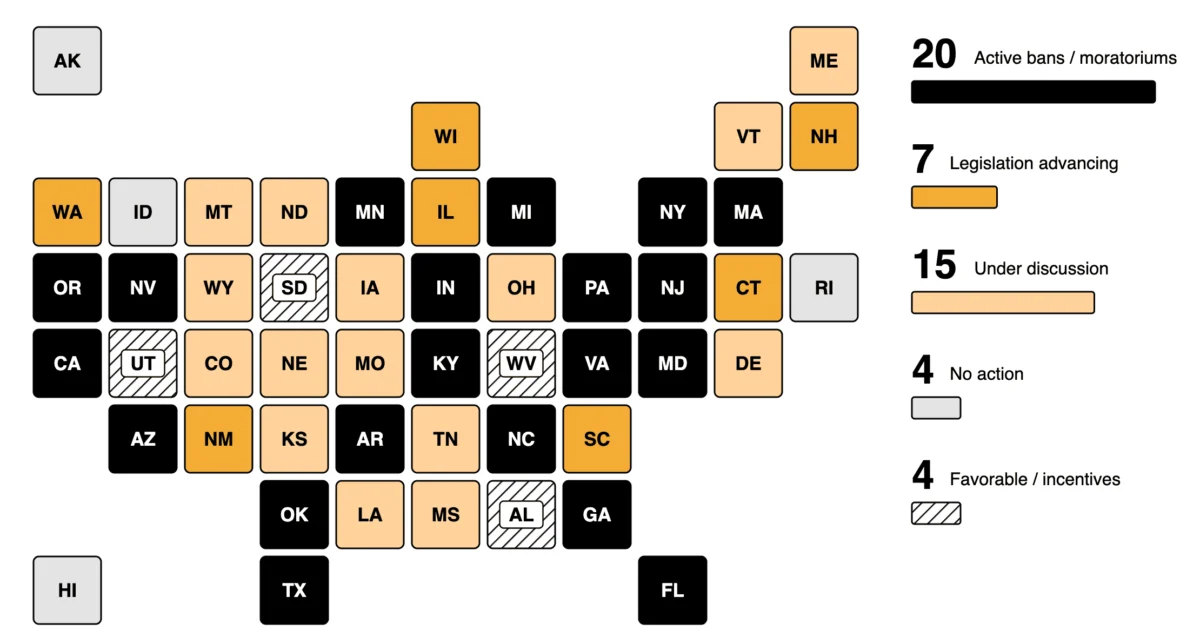
By late 2026, approximately 379 jurisdictions across the United States had enacted formal moratoriums or outright bans on data center construction. The political landscape shifted rapidly as municipal governments sought to regain control over local resources:
- August 2025: The Tucson City Council unanimously rejected Amazon’s proposed "Project Blue" facility following intense public pushback regarding regional water security.
- December 2025: The Chandler, Arizona city council voted 7–0 against a proposed artificial intelligence data center amid mounting concerns over local aquifer depletion.
- June 2026: The Charlotte City Council enacted a 150-day moratorium on new data center approvals after a municipal survey revealed a 78% disapproval rating among residents.
- August 2026: The Indianapolis City Council voted 23–1 to advance a formal pause on new data center construction, extending the restriction through 2027 while regulatory frameworks are reviewed.
- September 2026: Texas Governor Greg Abbott ordered a comprehensive state audit of all data center grid connection requests, subsequently halting new state-level permits until the evaluation is completed.
According to data compiled by the Brookings Institution, the political salience of the issue has transformed local zoning disputes into prominent talking points in state and federal elections, with candidates across the political spectrum running campaign advertisements opposing poorly regulated data center developments.
Economic Realities: Rising Capacity Costs and the Ratepayer Debate
At the core of the financial dispute is the mechanism by which wholesale electricity is priced and distributed. In the 13-state region served by PJM Interconnection—the nation’s largest grid operator—capacity auctions dictate the rates power plants receive to guarantee energy availability during peak demand periods.

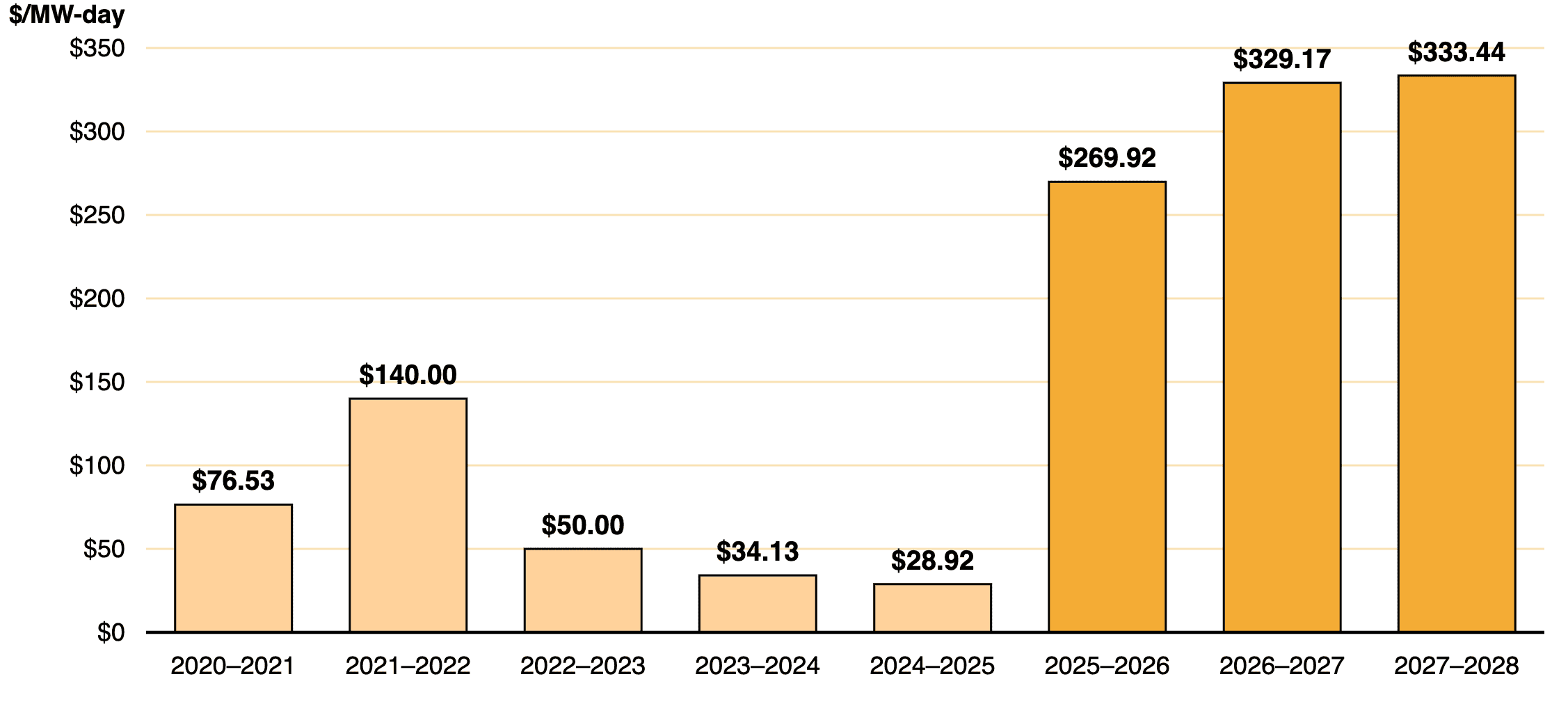
The financial impact of surging demand has been stark. PJM’s capacity clearing prices escalated dramatically, moving from $28.92 per megawatt-day for the 2024–2025 delivery year to $269.92 for 2025–2026. Subsequent auctions hit the established market price cap, reaching $329.17 and $333.44. PJM’s independent market monitor attributed 63% of the 2025–2026 price surge—equating to approximately $9.3 billion—directly to the influx of new data center load.
This wholesale market shock has begun translating into retail rate pressures. Residential electricity prices in Virginia rose by roughly 13% over a 12-month period, according to U.S. Energy Information Administration (EIA) data. A January 2026 survey conducted by the Global Strategy Group and the Chesapeake Climate Action Network Action Fund found that nearly three-quarters of Virginia voters placed the blame for escalating utility bills squarely on the proliferation of local data centers. Furthermore, a peer-reviewed modeling study published in May 2026 by researchers from North Carolina State University and Carnegie Mellon University projected that wholesale electricity prices could rise between 6% and 29% nationally by 2030, with spikes reaching up to 57% in regions experiencing the heaviest data center concentration.
Conversely, technology sector advocates and utility industry studies contend that large, continuous industrial consumers often help stabilize and eventually lower baseline operational costs. Research published by the Electric Power Research Institute (EPRI) analyzing data from 2015 to 2024 concluded that historical increases in data center capacity correlated with a 3.5% reduction in average retail prices, as predictable, high-volume loads allowed utilities to distribute fixed infrastructure costs across a broader revenue base. Additionally, an Amazon-funded analysis by consulting firm E3 asserted that the company’s direct utility payments met or exceeded the actual cost of serving its facilities, generating an average net surplus of approximately $3.4 million per site.
Academic and policy analysts suggest the true financial impact may lie in the future. The Rutgers New Jersey State Policy Lab found no statistically significant correlation between localized data center density and retail electricity rate increases through 2024, but emphasized that historical price stability relied heavily on existing, unutilized grid capacity. As utilities are forced to build out new transmission and distribution lines to support specialized AI demands, the central policy question remains: who will ultimately finance the next wave of capital expenditures if projected demand fluctuates?
Water Resource Allocation and Environmental Pressures
Beyond electrical grid capacity, the intensive water requirements of modern cooling infrastructure have intensified regional resource competition, particularly in arid Western states facing long-term drought conditions. Water-cooled data centers can consume millions of gallons of water daily, placing significant strain on municipal supplies.
This consumption occurs against the backdrop of tightening federal water allotments. Arizona, for example, faces federally mandated reductions under Colorado River management plans, which require the state to reduce its usage by up to 30%. These environmental pressures have directly influenced local policy decisions. In Florida, Orange County officials proposed a one-year moratorium on new facilities, citing projections indicating a potential groundwater deficit of 96 million gallons per day by the year 2045.
While viral estimates have frequently claimed that individual AI queries consume substantial volumes of freshwater—such as early academic models suggesting roughly half a liter of water per 100-word prompt—industry updates have offered revised metrics. Google’s 2025 environmental reports estimated that a median text prompt utilizing its Gemini model consumes approximately 0.26 milliliters of water on-site, though environmental advocates note that this calculation excludes the substantial indirect water consumption associated with off-site thermoelectric power generation.
At the national level, the American Enterprise Institute notes that direct data center water consumption accounts for a small fraction of overall freshwater use. However, localized impacts can be severe. In Botetourt County, Virginia, a planned Google data center campus is projected to consume between two and eight million gallons of water daily. In response, local authorities have committed $300 million toward the development of an expanded regional water supply, partially offset by anticipated commercial tax revenues.
Evaluating Tax Revenue, Job Creation, and the Industrial Response
Proponents of data center development frequently emphasize the substantial fiscal benefits returned to host communities through property taxes and infrastructure investments. Northern Virginia’s data centers generated an estimated $1.3 billion in local property taxes in 2024, underpinning a broader local tax revenue base exceeding $2 billion, according to the Chamber of Progress.
Smaller municipalities have experienced even more dramatic fiscal transformations. In Quincy, Washington, a cluster of approximately 30 data centers accounts for roughly 57% of the total property tax base. This revenue stream has funded the construction of a $120 million high school, modernized emergency services facilities, and a collaborative $30 million water reuse project developed alongside Microsoft. Similarly, legislative audits in Virginia ranked state-level data center tax exemptions as highly productive economic incentives, generating significant personal income growth relative to forgone state revenues.
However, independent economic analyses indicate that the permanent employment footprint of these facilities is relatively modest. A comprehensive study by the Brookings Institution tracking approximately 1,500 data center facilities found that the arrival of a major installation typically generates between 100 and 200 permanent operational jobs over a decade, with negligible impact on surrounding wage growth. While construction phases yield substantial short-term employment, those positions conclude once physical building is complete.
Recognizing the modest direct job creation relative to high infrastructure demands, state legislatures have increasingly reevaluated incentive structures. During 2026 legislative sessions, states including Illinois, Massachusetts, Nebraska, Nevada, and Ohio paused or scaled back specialized tax breaks. Meanwhile, Virginia enacted a temporary electricity consumption tax of 1.1 cents per kilowatt-hour on data centers to help internalize the costs of grid modernization.
On-Site Power Generation and Air Quality Controversies
When utility interconnection delays threaten deployment timelines, some technology enterprises have turned to unconventional on-site power solutions to accelerate operations. The most prominent example unfolded in Memphis, Tennessee, where xAI deployed dozens of trailer-mounted methane gas turbines to power its Colossus supercomputer installations without waiting for traditional transmission upgrades.
The deployment drew intense scrutiny from local residents and environmental advocacy groups, who noted that the temporary power generation units were operating in industrial-burdened neighborhoods such as Boxtown. Legal challenges led by the Southern Environmental Law Center (SELC) and Earthjustice argued that the unpermitted stationary turbines violated the federal Clean Air Act. Although the U.S. Environmental Protection Agency (EPA) issued clarifying guidance confirming that large-scale temporary turbines require formal stationary source air permits, the U.S. Department of Justice intervened in the legal proceedings in mid-2026, citing national economic and energy security considerations.
Independent air quality analyses yielded mixed conclusions: while satellite data analyzed by university researchers identified localized elevations in nitrogen dioxide concentrations surrounding the site, broader regional models indicated minimal long-term degradation. Nevertheless, the Memphis case highlighted a growing tension between the rapid pace of artificial intelligence development and established environmental review processes designed to protect public health.
Conclusion: Structuring Policy for Sustainable Infrastructure
The ongoing conflict over the expansion of artificial intelligence data centers demonstrates that the costs and benefits of technological innovation are fundamentally misaligned. The financial, environmental, and infrastructure burdens—ranging from elevated capacity charges and municipal water strain to local air quality management—are predominantly local and immediate. Conversely, the economic returns and strategic advantages of advanced computing capacity are distributed regionally or nationally and realized over a longer time horizon.
As state legislatures, utility regulators, and municipal governments continue to draft updated policy frameworks, the central challenge remains designing market rules that ensure fair cost allocation. Whether addressing minimum financial commitment thresholds for large utility customers or reforming zoning transparency requirements, policymakers are increasingly focused on a singular, foundational question: if projected computational demand fluctuates or fails to materialize, who ultimately pays for the next generation of the electrical grid?