In the fast-paced landscape of modern digital commerce and market research, the ability to collect, process, and analyze real-time web data has become a core operational requirement. Enterprises across sectors—from e-commerce giants and supply chain logistics providers to financial analysts and academic researchers—rely heavily on continuous streams of external data. Tasks such as monitoring competitor pricing shifts, updating dynamic product rankings, tracking supplier inventories, and aggregating industry directories are vital for maintaining a competitive edge.
However, executing these operations at scale has historically been plagued by prohibitive technical friction. Traditional web scraping solutions, whether custom-coded Python scripts or brittle visual extraction tools, struggle profoundly with modern, highly dynamic web architectures. Websites laden with complex JavaScript rendering, regional paywalls, intricate multi-step filtering mechanisms, anti-bot security protocols, and human-verification roadblocks frequently break conventional data extraction pipelines.
Addressing these pervasive industry challenges, the no-code artificial intelligence web scraping platform BrowserAct has emerged to redefine how organizations interact with complex web ecosystems. By blending advanced autonomous AI exploration with reusable, parameter-driven automation bots, the platform seeks to eliminate the high maintenance overhead and surging operational costs that have long hindered recurring web data collection.
The Technical Evolution of Web Data Extraction: From Static Scripts to Autonomous Agents
To understand the significance of platforms like BrowserAct, it is essential to examine the evolutionary trajectory of web data collection tools over the past two decades. In the early eras of the internet, static HyperText Markup Language (HTML) pages made scraping relatively straightforward. Developers could write simple scripts utilizing libraries like BeautifulSoup or Scrapy to parse tags and pull structured tables or text blocks.
As web development matured into highly dynamic, client-side rendered applications powered by frameworks such as React, Vue, and Angular, those simple scripts began to fail. Modern web pages frequently load content asynchronously via APIs after the initial document object model (DOM) has rendered. Consequently, traditional tools require headless browsers, complex proxy rotations, and painstaking manual configuration of Document Object Model (DOM) selectors. Whenever a target website undergoes a structural redesign—even something as minor as changing a CSS class name—the underlying extraction scripts inevitably break, forcing engineering teams into continuous, reactive maintenance cycles.
In recent years, the advent of generative artificial intelligence and large language models (LLMs) introduced a new paradigm: ad-hoc AI web scraping agents. These agents allow users to express data collection goals in natural language—for instance, instructing an agent to search for wireless keyboards, filter by a four-star rating or higher, and extract specific pricing and availability metrics. The AI dynamically explores the target site, navigates through pagination, and retrieves the desired data without requiring predefined selectors.
Yet, a critical operational inefficiency emerged within this generative approach: lack of reusability. While an autonomous AI agent excels at one-off research tasks, running that same agent repeatedly—such as daily or weekly—requires the model to re-evaluate the website structure, plan actions, and reason through navigation paths afresh every single time. This redundant cognitive processing consumes significant computational tokens and time, making operating costs unpredictable and scaling difficult for enterprises requiring high-frequency data pipelines.
Bridging the Gap: The BrowserAct Architectural Approach
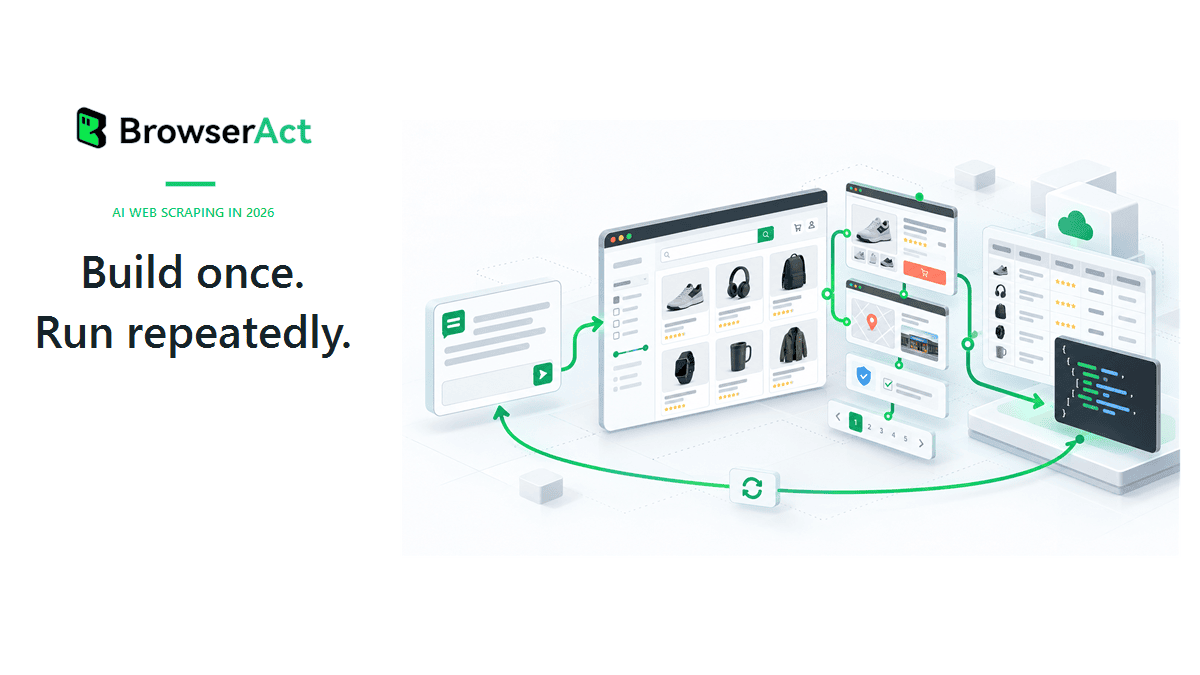
BrowserAct was engineered to resolve this specific architectural bottleneck by marrying the intuitive flexibility of natural language AI with the cost-efficiency and reliability of traditional automation. Rather than relying on fresh AI reasoning for every recurring run, BrowserAct utilizes a "build once, run repeatedly" framework.
When a user initiates a data collection task on the platform, they can either select from a comprehensive library of over 400 prebuilt templates—covering high-demand platforms like Amazon, LinkedIn, and major job boards—or construct a custom scraper using plain, natural language instructions.
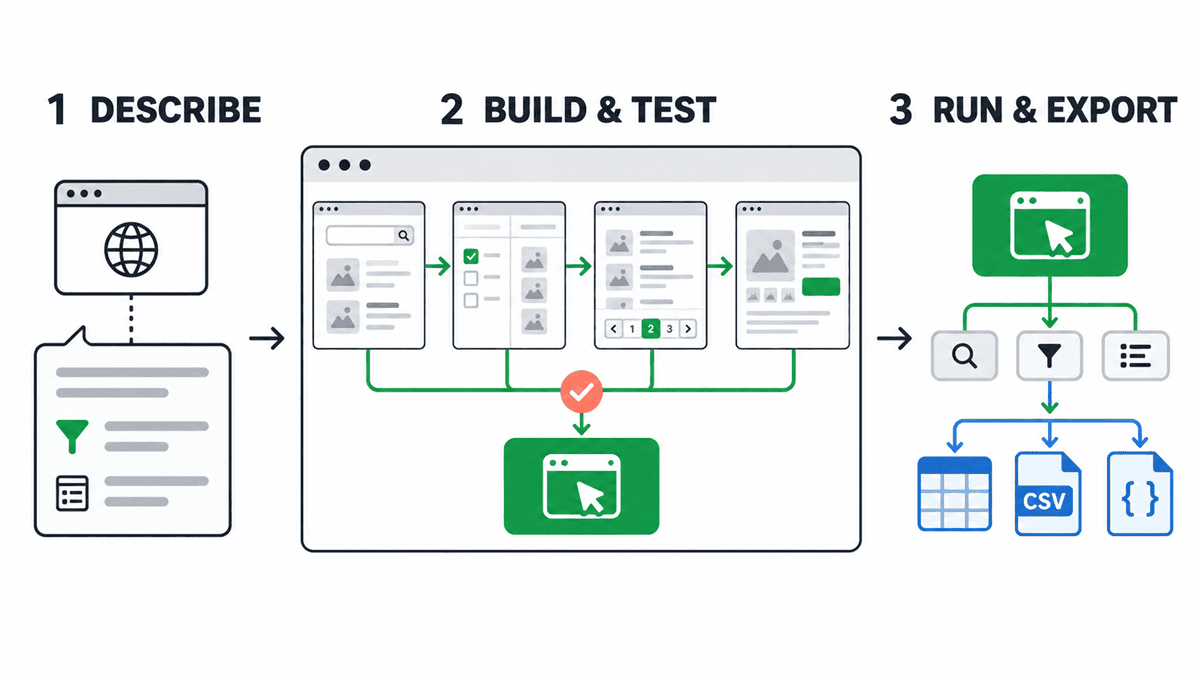
The platform operates through a structured three-step lifecycle:
- Task Definition: The user specifies the target website, necessary filtering parameters, and the exact data fields required.
- Intelligent Exploration: BrowserAct’s underlying AI engine explores live web pages, successfully handles dynamic filters, navigates pagination loops, and validates the extraction path. Once tested, this validated path is codified into a permanent, reusable Bot.
- Scalable Execution: Subsequent data collection runs utilize this saved logic rather than re-exploring the site. Users can easily update parameters such as keywords, target categories, or geographic regions to pull fresh data efficiently.
According to platform metrics, this hybrid methodology drastically reduces token consumption and operational latency. While the initial exploration and bot generation phase consumes standard AI credits, routine scheduled runs execute using the saved extraction script. Published custom bots require a minimal credit expenditure per run (typically 30 to 50 credits), making high-frequency, automated data gathering financially predictable for enterprise budgets.
Overcoming Infrastructure and Anti-Bot Barriers
Beyond the challenge of dynamic page structures, professional web scraping operations face substantial hurdles regarding network security and infrastructure management. Modern web servers increasingly deploy sophisticated bot-mitigation technologies, including Cloudflare challenges, fingerprint analysis, CAPTCHAs, and rate-limiting blocks based on IP geolocation.
Building internal infrastructure to bypass these barriers demands specialized cybersecurity and DevOps talent. Organizations must manage sprawling pools of residential, datacenter, and dynamic rotating proxies, implement stealth browser fingerprinting to mimic human user behavior, and configure automatic retries upon encountering HTTP 429 (Too Many Requests) or 403 (Forbidden) error codes.
BrowserAct abstracts this complex infrastructure layer entirely away from the end user. The platform leverages a managed cloud browser environment equipped with advanced stealth fingerprinting, automated residential proxy rotation, and built-in handling for supported CAPTCHA and human-verification challenges. By delegating proxy management and browser orchestration to the cloud platform, organizations save countless hours of engineering overhead, allowing data teams to focus strictly on analysis rather than maintenance.
Furthermore, websites are living entities subject to frequent structural updates. When a target website alters its layout or security parameters and disrupts an active data pipeline, BrowserAct incorporates failure-logging mechanisms. Users can review error reports, optimize the bot configuration, test the revised pathway, and republish an updated version with minimal downtime.
Integration Ecosystem and Enterprise Use Cases
Data generated through web scrapers yields little organizational value if it remains siloed within a standalone application. To maximize utility, BrowserAct provides versatile data export options and robust integration capabilities. Users can instantly download extracted datasets in structured CSV or JSON formats. Alternatively, native API endpoints, webhooks, and pre-built connectors for integration platforms such as Make, n8n, and Zapier allow seamless data ingestion into corporate data warehouses, customer relationship management (CRM) systems, and business intelligence (BI) dashboards.
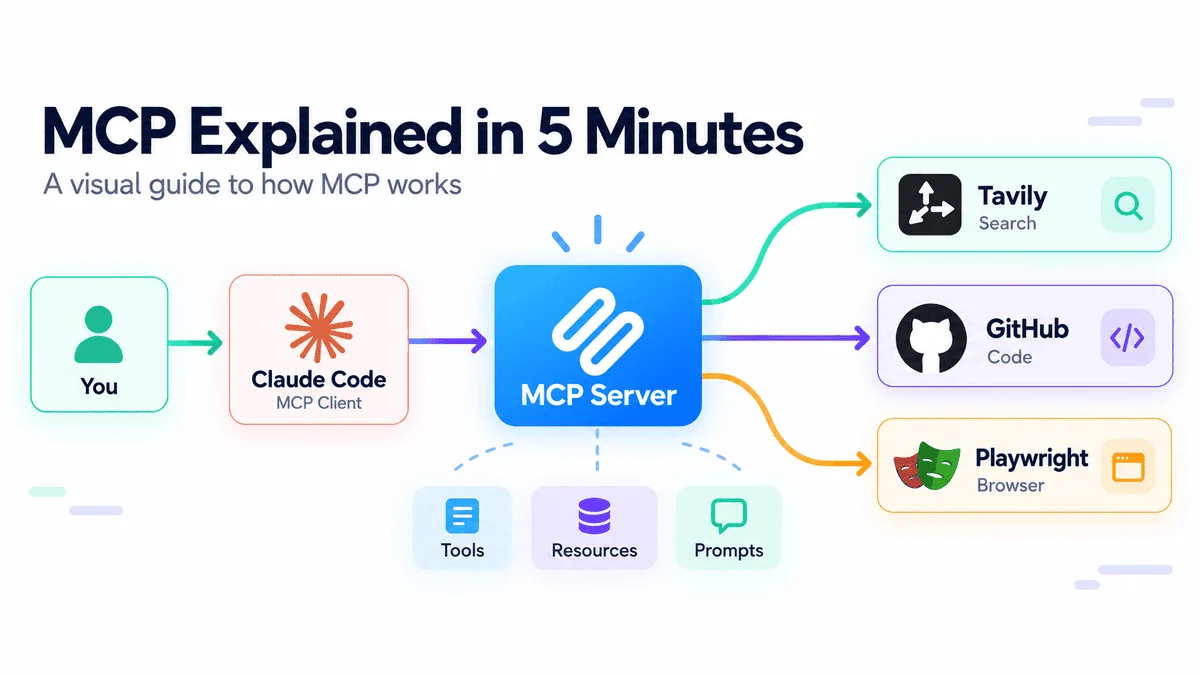
Moreover, for advanced AI and automation engineers, published BrowserAct bots can be configured directly as Model Context Protocol (MCP) tools. This allows compatible external AI clients and autonomous multi-agent systems connected to the corresponding server to trigger live web data retrieval dynamically as part of larger, multi-step automated workflows.
The practical applications span numerous industries:
- E-commerce and Retail: Brands and marketplace sellers utilize automated scrapers to monitor competitor pricing strategies, track real-time stock availability, analyze customer review sentiments, and observe dynamic product ranking fluctuations across various regional marketplaces.
- Financial Services and Market Research: Analysts aggregate alternative datasets, including industry-specific directory listings, supplier information, and employment trends, to feed predictive financial models and generate comprehensive market reports.
- Recruitment and Human Resources: Talent acquisition teams monitor job boards and professional networking platforms to analyze compensation trends, skill demand, and talent distribution across geographical regions.
Comparative Analysis of Data Collection Methodologies

When evaluating tools for recurring data collection, technical leadership must weigh upfront development costs against long-term maintenance overhead.
Custom-written scripts offer maximum flexibility but demand continuous engineering hours to maintain browser environments and fix broken selectors. Web scraping APIs provide convenient endpoints but often break down when confronted with complex, non-standard website navigation or deep pagination hierarchies. Visual scrapers reduce initial coding barriers through point-and-click interfaces, yet remain vulnerable to minor website interface updates. One-off AI agents offer rapid ad-hoc research capabilities but incur prohibitive computational costs and latency when deployed for high-frequency, recurring tasks.
BrowserAct positions itself at the intersection of these approaches by combining the zero-code accessibility of natural language generation with the execution stability and cost-efficiency of reusable cloud bots.
Market Availability and Introductory Incentives
BrowserAct operates on a flexible, tiered subscription model designed to accommodate varying data volume requirements, ranging from individual developers to large enterprise deployments. The platform offers a free entry-tier for new users, alongside a seven-day risk-free trial period for all paid monthly plans.
To mark the platform’s broader expansion, management has partnered with industry publications to introduce a targeted promotional incentive. New subscribers applying the exclusive promo code KDnuggets at checkout will receive a 50% discount on their first monthly subscription order, applicable up to a maximum value of $200 USD.
As enterprises face mounting pressure to harness real-time external data for AI training, market intelligence, and automated decision-making, tools that successfully bridge the gap between autonomous AI reasoning and reliable, scalable automation are poised to become standard infrastructure in the modern data stack. Platforms like BrowserAct signal a decisive shift toward intelligent, resilient, and maintenance-free web data collection for organizations of all sizes.