Computer vision has rapidly evolved beyond basic object detection and simple image classification tasks. By 2026, computer vision engineers operate at the intricate intersection of foundation models, spatial computing, and specialized embedded hardware, architecting sophisticated systems capable of perceiving, reasoning over, and reacting to the physical world in real time.
The global demand for technical professionals who can operate across this exhaustive full stack has experienced exponential growth. Modern industries—spanning autonomous vehicles, automated robotic warehouses, advanced medical imaging diagnostics, and immersive spatial computing hardware—share a fundamental dependency on engineering talent that understands not just model architecture, but the end-to-end data pipeline originating from physical sensors down to real-time production inference.
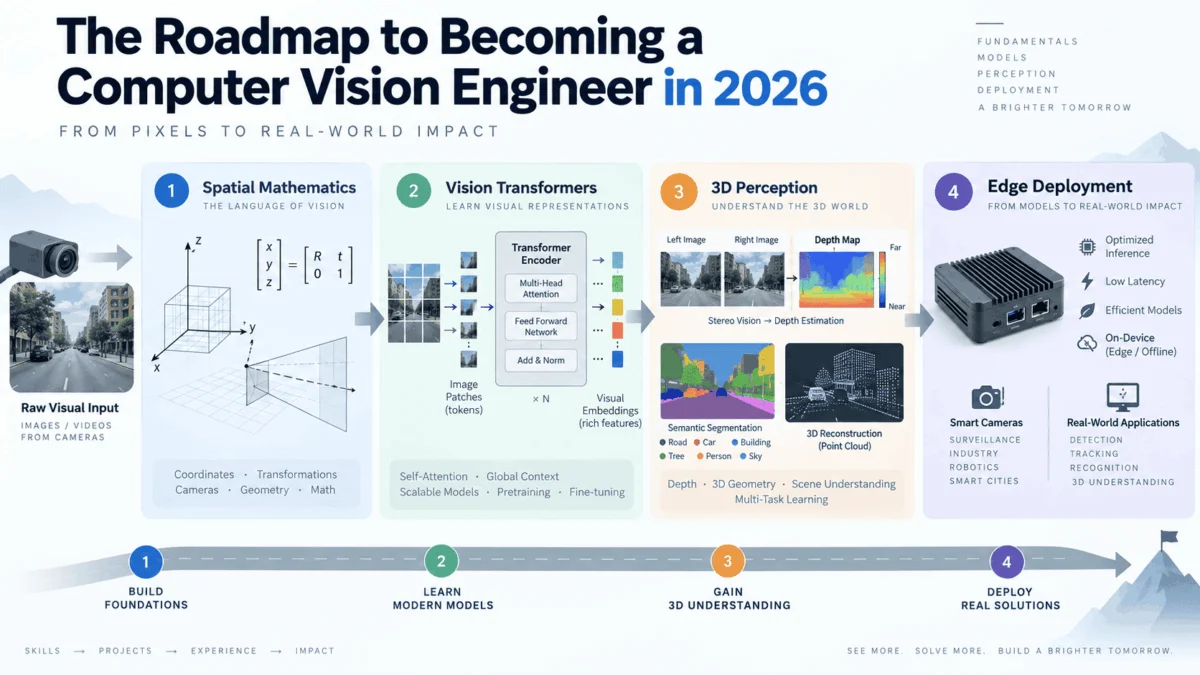
To meet this industry demand, technical educators and senior industry practitioners have established a comprehensive four-stage learning roadmap. This framework guides aspiring and transitioning engineers from foundational spatial mathematics and core vision primitives all the way to complex edge deployment and hardware-aware optimization.
Background and Context of the 2026 Engineering Shift
The computer vision landscape has undergone a radical paradigm shift over the past half-decade. Historically dominated by convolutional neural networks focused on isolated 2D image tasks, the field was revolutionized by the introduction of Vision Transformers (ViTs) and subsequent multi-modal foundation models. Industry analysts estimate that the global computer vision market will surpass multi-billion-dollar valuations by the late 2020s, heavily driven by the integration of artificial intelligence into industrial automation and consumer electronics.
This expansion has created a severe skills gap. Enterprises no longer merely seek software developers who can fine-tune open-source models; they require systems engineers who comprehend the underlying spatial geometry, possess the capability to deploy heavy models onto resource-constrained edge devices, and can maintain high-throughput video streaming pipelines under rigorous latency constraints.
Stage 1: Spatial Mathematics and Foundation Vision Primitives
Every robust computer vision system is, fundamentally, a mechanism for reasoning about spatial geometry. Before engaging with modern deep learning architectures, engineers must develop a functional mastery of the mathematical principles that govern visual reasoning.
Critical core concepts in this foundational stage include matrix transformations, coordinate frames, projective geometry, and multi-view geometry. Far from being merely academic exercises, these mathematical constructs dictate how an optical camera maps a three-dimensional physical environment onto a two-dimensional sensor array, how multiple camera angles reconstruct depth profiles, and how distinct coordinate systems synchronize across multi-sensor robotic rigs.
Implementation fluency typically begins with PyTorch for advanced tensor manipulation, which remains the dominant framework for both cutting-edge research and production environments. This is paired with sophisticated synthetic data augmentation libraries such as Albumentations, allowing developers to simulate challenging lighting conditions, geometric distortions, and occlusions without the overhead of capturing massive physical datasets.
Feature representation forms the third pillar of this initial phase. Engineers must discern the functional distinctions between traditional convolutional backbones—such as ResNet and EfficientNet—and modern attention-based architectures. Furthermore, contrastive representation learning, where models train by evaluating comparative similarities and differences between data examples, has established itself as an essential technique for generating useful embeddings prior to task-specific fine-tuning.
Stage 2: Vision Transformers and Multimodal Foundation Models
The large-scale transition from convolutional neural networks to transformer-based vision architectures has fundamentally rewritten industry requirements. Vision Transformers process images by dividing them into sequences of fixed-size patches, applying self-attention mechanisms across these patches rather than utilizing localized convolutional filters. Subsequent innovations, including Swin Transformers, introduced hierarchical windowed attention to make transformer methodologies practical for high-resolution visual inputs.
Concurrently, the emergence of vision-language models (VLMs)—exemplified by architectures like CLIP and SigLIP—has transformed visual recognition. Through contrastive training on massive web-scale datasets, these models learn joint embeddings across both image and text modalities, unlocking open-vocabulary understanding where systems can interpret visual scenes via natural language prompts instead of rigid, pre-defined class labels.
This capability underpins open-vocabulary detection models such as OWL-ViT and Grounding DINO, which empower systems to localize and identify any object described through text without requiring retraining on explicitly labeled target classes. Similarly, Meta’s Segment Anything Model 2 (SAM 2) delivers promptable, zero-shot segmentation across static imagery and complex video streams, producing high-end segmentation masks instantly upon receiving point, bounding box, or textual prompts.
Stage 3: 3D Vision, Neural Rendering, and Spatial Perception
As computer vision applications pivot toward advanced spatial reasoning, the technical competency requirements expand into three-dimensional data structures. This phase introduces the representations and algorithms necessary to reconstruct and interpret a 3D world from 2D inputs.
The primary 3D data representations include point clouds, voxel grids, and signed distance fields (SDFs). Each structure presents distinct trade-offs concerning memory consumption, computational complexity, and application suitability. Point clouds serve as the native output of LiDAR hardware and structure-from-motion pipelines, while voxel grids provide regular spatial structures at a higher memory cost. Signed distance fields represent geometry through continuous mathematical functions, facilitating differentiable rendering workflows.
Monocular depth estimation has similarly advanced through models like Depth Anything (v2), which computes accurate relative and metric depth maps from a single RGB image without auxiliary hardware sensors. In parallel, neural rendering techniques have matured rapidly; while Neural Radiance Fields (NeRFs) pioneered novel view synthesis, 3D Gaussian Splatting has largely overtaken NeRFs in real-time applications by offering significantly faster processing and memory efficiency on consumer-grade hardware.
For robotics and autonomous systems, spatial perception requires deep competency in Visual Odometry (VO) and Simultaneous Localization and Mapping (SLAM). These algorithms enable autonomous platforms to continuously estimate their spatial positioning and incrementally construct environmental maps using exclusively visual input data.
Stage 4: Inference Optimization and Edge Deployment
The final phase of the engineering lifecycle bridges high-level artificial intelligence with rigorous systems engineering. A model that demonstrates optimal performance on a high-powered GPU workstation does not inherently translate into a viable production asset. Deploying computer vision systems reliably onto constrained edge hardware at minimal latency, while avoiding catastrophic accuracy degradation, represents a distinct and highly valued engineering discipline.
Model compression relies on three core pillars: pruning redundant network parameters, distilling knowledge from massive teacher models into efficient student networks, and applying quantization techniques (such as converting FP32 weights to INT8 representations) to drastically reduce memory footprints.
Hardware execution frameworks provide the necessary middleware for deployment. NVIDIA TensorRT and ONNX Runtime serve as standard deployment pathways for optimized GPU and CPU environments, respectively. Intel’s OpenVINO toolkit facilitates integration across Intel CPUs, integrated graphics, and specialized vision processing units. For embedded architectures, engineers frequently utilize NVIDIA Jetson modules, Apple Silicon Neural Engines, and dedicated neural processing units integrated into modern edge hardware.
Managing high-throughput, multi-camera streaming introduces complex systems engineering challenges. Ingesting RTSP streams, synchronizing video frames across multiple sensors, managing batch processing, and sustaining performance thresholds above 30 frames per second under heavy operational load requires meticulous architectural design. Tools like NVIDIA DeepStream remain industry standards for GPU-accelerated video analytics pipelines.
Industry Implications and Broader Impact
The maturation of computer vision into a full-stack engineering discipline carries significant economic and industrial implications. As autonomous systems, smart manufacturing facilities, and spatial computing ecosystems scale globally, the bottleneck in technological advancement has shifted from algorithmic research to robust engineering execution.
Industry analysts emphasize that professionals capable of bridging theoretical spatial mathematics with low-level edge hardware optimization will command significant market value. By following a structured, milestone-driven learning progression—from raw tensor manipulation and geometric reasoning to transformer composition and quantized edge deployment—engineers can systematically navigate the complexities of modern computer vision and meet the rigorous demands of enterprise automation in 2026 and beyond.