The rapid expansion of the large language model (LLM) tooling ecosystem has fundamentally transformed how software engineers approach artificial intelligence integration. As enterprises rush to deploy generative AI solutions, development teams are consistently confronted with a pivotal architectural decision: whether to adopt comprehensive orchestration frameworks like LangChain and LlamaIndex, or to bypass third-party abstractions entirely in favor of building applications from the base APIs upward. While both frameworks promise to streamline development by abstracting complex infrastructure plumbing, neither offers a universal solution for every production environment.
To make an informed technological choice, development teams must systematically evaluate project maturity, architectural constraints, long-term maintenance overhead, and the specific functional requirements of their targeted deployment.
The Architectural Dilemma: Understanding LLM Orchestration
At their foundational core, large language models operate as stateless predictive text engines. Given a specific prompt, an LLM generates a probabilistic completion before resetting its context, retaining no native memory of past interactions. Consequently, transforming these isolated models into functional enterprise applications—such as multi-step autonomous agents, sophisticated retrieval-augmented generation (RAG) pipelines, or context-aware conversational assistants—requires an external orchestration layer.
This orchestration layer must actively manage dynamic context windows, route user intents to appropriate toolsets, retrieve relevant external knowledge from enterprise repositories, maintain conversational memory, and chain sequential logical operations together. Historically, developers bore the full responsibility of writing this integration plumbing by hand. Today, specialized frameworks and SDKs have emerged to shoulder this burden, allowing engineering teams to pivot their primary focus toward application logic and domain-specific value delivery.
Chronology and Evolution of the LLM Tooling Market
The generative AI tooling market has undergone an aggressive, highly compressed evolution since the public release of foundational LLMs in late 2022.
In the initial phase, spanning late 2022 through early 2023, developers relied almost exclusively on direct, raw API calls to providers like OpenAI. This approach quickly exposed severe limitations in handling contextual data over long interactions and integrating private corporate repositories with base models.
Recognizing this market friction, LangChain launched in late 2022 to provide a unified, general-purpose wrapper for chains, prompts, and external API integrations. Shortly thereafter, as enterprise demand for secure document querying surged, LlamaIndex (originally introduced as GPT Index) arrived on the scene to specialize exclusively in indexing and retrieval mechanisms for RAG architectures.
By 2024, both frameworks had matured significantly, securing massive open-source communities, venture capital backing, and widespread enterprise adoption. However, this rapid growth introduced notable technical debt, including frequent breaking API changes, bloated abstraction layers, and documentation lag. As a direct result, a prominent counter-movement has taken shape among senior engineering organizations throughout 2024 and 2025, favoring minimalist, scratch-built architectures that utilize raw provider APIs alongside native vector database SDKs.
LangChain: Broad Capabilities and Integration Ecosystem
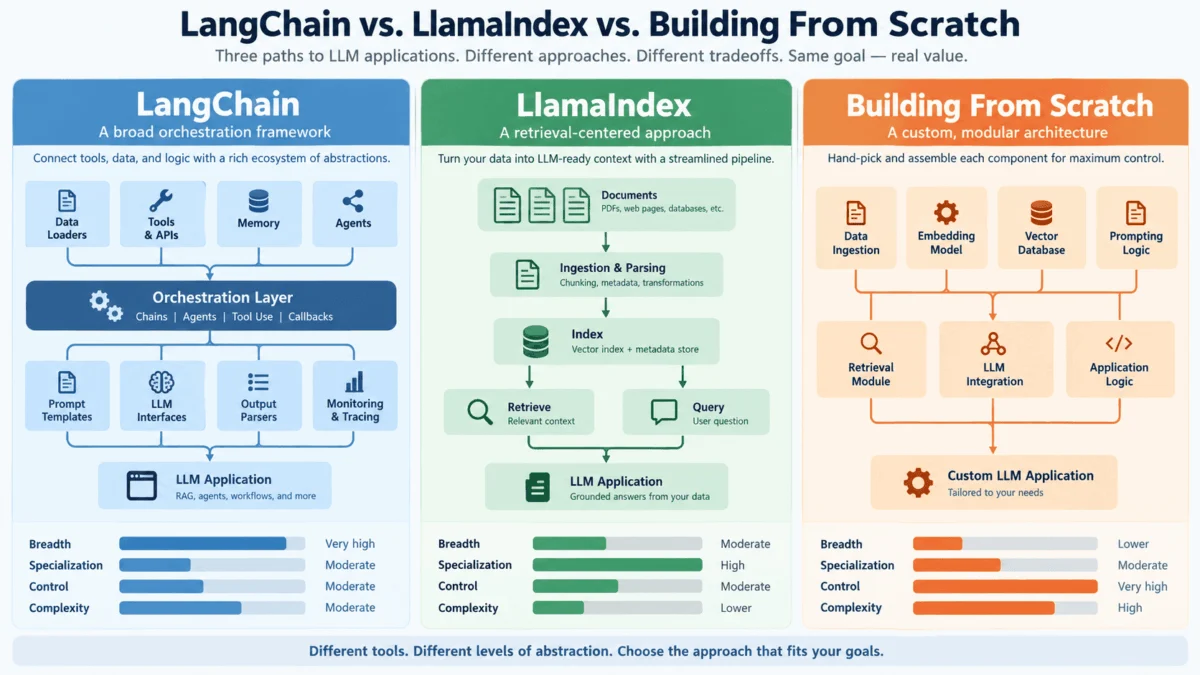
LangChain established its dominant market position by offering an exceptionally wide surface area designed to cover nearly every conceivable generative AI use case. Its core architectural strength lies in its expansive integration library, which seamlessly connects LLMs to hundreds of third-party data providers, vector stores, web search utilities, and enterprise APIs.
Operational Strengths
For organizations tasked with building complex, multi-step agentic workflows where an LLM must dynamically select tools, evaluate intermediate outputs, and execute iterative loops, LangChain provides out-of-the-box abstractions that drastically accelerate initial prototyping. Teams that need to rapidly test proof-of-concepts integrating disparate data silos frequently find LangChain’s pre-built wrappers indispensable.
Technical Friction and Drawbacks
Despite its versatility, LangChain’s vast surface area introduces substantial abstraction overhead. When execution pipelines fail in production, developers often find themselves tracing errors across multiple layers of deeply wrapped classes. Furthermore, the framework’s rapid iteration cycle has historically resulted in deprecated syntax and documentation that struggles to stay synchronized with the latest software releases. For mission-critical enterprise systems demanding absolute stability and predictable execution paths, this continuous framework churn presents a quantifiable operational risk.
LlamaIndex: Specialized Precision for Retrieval-Augmented Generation
Originally branded as GPT Index, LlamaIndex adopted a much more focused and opinionated philosophy, tailoring its architecture specifically to the challenges of retrieval-augmented generation (RAG).
Operational Strengths
LlamaIndex excels in scenarios where the primary objective is extracting precise information from large corpora of enterprise documents and supplying it as grounded context to an LLM. Its data connectors, hierarchical indexing strategies, and advanced query engines are purpose-built to handle complex document structures. Additionally, LlamaIndex has invested heavily in evaluation tooling, enabling developers to quantitatively assess retrieval accuracy and context relevancy before deploying applications into user-facing environments.
Technical Friction and Drawbacks
Conversely, LlamaIndex’s narrow focus can become restrictive when a project expands beyond basic document retrieval. Applications requiring intricate, stateful agent behaviors, dynamic multi-tool orchestration, or non-retrieval workflows often force developers into an adversarial relationship with the framework’s core assumptions. Much like LangChain, its deeply nested abstractions can obscure the underlying mechanics of API requests, complicating advanced performance optimization.
Building From Scratch: Direct Control and Architectural Clarity
The alternative to adopting a heavy third-party framework is building directly against the base infrastructure APIs provided by model creators such as OpenAI, Anthropic, and Google, while utilizing native client libraries for vector databases like Pinecone, Weaviate, and Qdrant.
Operational Strengths
Constructing an LLM application from scratch grants developers absolute visibility and granular control over every execution step. There are no hidden retry loops, unexpected abstraction wrappers, or opaque prompt templates intercepting requests. When performance bottlenecks or unexpected behaviors materialize in production, engineers can isolate and resolve the root cause directly within their own codebase.
Furthermore, this hands-on methodology forces architectural discipline. By implementing only the specific data chunking, vector similarity search, and context management logic required for the immediate use case, teams naturally avoid the over-engineering traps frequently encouraged by expansive frameworks.
Technical Friction and Drawbacks
Building from scratch demands a higher upfront engineering investment. Development teams must write and maintain their own orchestration boilerplate, handle rate-limiting logic manually, and possess a thorough foundational understanding of vector mathematics, embedding space dynamics, and context window limitations. For early-stage startups or exploratory innovation teams operating under strict time-to-market constraints, this initial development overhead can delay vital product validation.
Strategic Implications and Decision Framework
Industry analysts and technical leaders suggest that selecting the appropriate LLM development path requires a cold, objective assessment of three core variables: project lifecycle stage, team engineering expertise, and functional application scope.
- Early Exploration and Prototyping: When the primary objective is rapidly testing market viability or validating whether an LLM can solve a specific business problem, frameworks are generally preferred. LangChain suits exploratory projects with ambiguous requirements, while LlamaIndex is ideal if document retrieval is explicitly central to the product vision.
- Production-Grade Retrieval Systems: For enterprise applications centered entirely around secure, high-accuracy document search and question-answering, LlamaIndex provides robust native abstractions and evaluation frameworks that significantly reduce time-to-market.
- Long-Term Scalability and Customization: For mature engineering organizations with strong foundational software architecture skills, building from scratch is increasingly viewed as the superior long-term investment. Total ownership of the codebase ensures unhindered flexibility, streamlined debugging, and superior cost-performance optimization as scaling demands intensify.
Ultimately, technological choices in the generative AI domain are rarely permanent. A prevalent industry pattern involves prototyping core concepts within a framework like LangChain to rapidly understand system requirements, followed by a deliberate migration toward a clean, scratch-built architecture for the production release. By aligning technological selection with rigorous problem analysis rather than prevailing ecosystem trends, enterprise development teams can build resilient, maintainable, and high-performing artificial intelligence systems.