Anthropic’s release of Claude Haiku 5.5 on October 7, 2026, marks a significant milestone in the evolution of lightweight artificial intelligence models. Positioned by the artificial intelligence safety and research company as its most economical, rapid, and capable small-scale model to date, Haiku 5.5 addresses long-standing enterprise demands for high-throughput, cost-effective automation. Available globally across the primary Claude Platform, Amazon Web Services (AWS), Google Cloud, and Microsoft Azure, the model arrives with a sharply reduced pricing structure and substantially expanded technical parameters compared to its predecessor, the Claude Haiku 4.5.
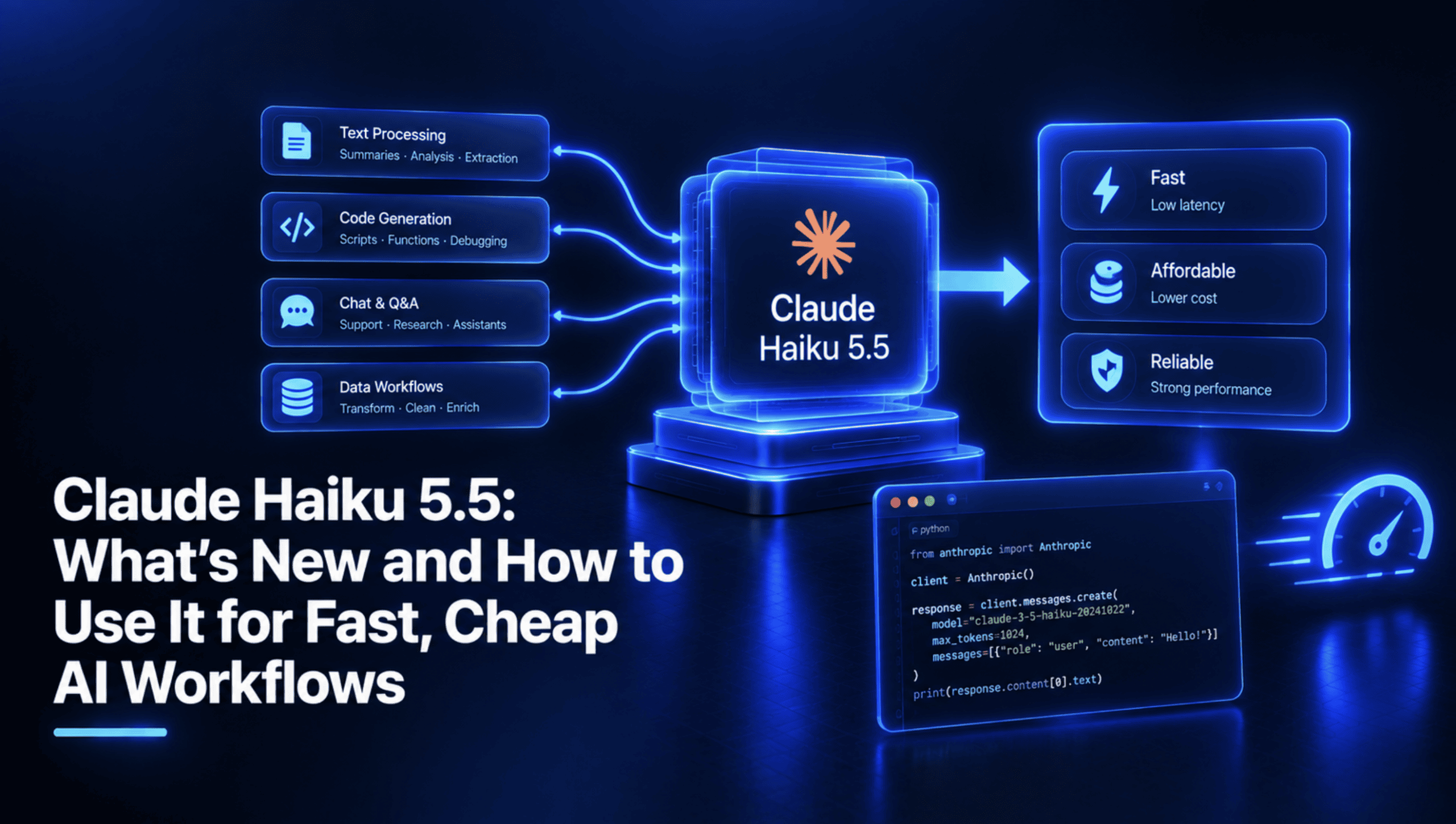
The introduction of Claude Haiku 5.5 follows a competitive wave of enterprise-focused model updates designed to handle heavy computational loads without incurring the prohibitive expenses associated with frontier-class models like Claude Opus or Sonnet. According to technical documentation released by Anthropic, Haiku 5.5 is specifically engineered for high-volume, cost-sensitive operations such as automated data compaction, document summarization, database querying, large-scale text classification, and as a lightweight sub-agent operating in tandem with larger orchestration models.
Evolution of the Haiku Lineup: Architectural and Technical Enhancements
When compared directly with its predecessor, Claude Haiku 4.5, the 5.5 iteration introduces transformative upgrades across nearly every benchmarked metric. Most notably, the context window has been quadrupled, expanding from 200,000 tokens to an expansive 1 million tokens. Similarly, the maximum output capability has doubled from 64,000 tokens to 128,000 tokens, allowing the model to generate substantially longer and more comprehensive structured responses.
Perhaps the most prominent architectural shift is the introduction of adaptive thinking controls with variable effort settings—a first for the Haiku product line. While previous iterations relied strictly on manual thinking budget allocations, Haiku 5.5 incorporates dynamic reasoning mechanisms that adjust computational depth based on prompt complexity. Furthermore, the model operates on an updated tokenizer. While list prices reflect aggressive reductions—dropping from $1.00 to $0.10 per million input tokens and from $5.00 to $0.50 per million output tokens for prompts up to 100,000 tokens—the revised tokenizer results in roughly 30% more token consumption for equivalent text lengths. Factoring in tokenization adjustments and requests exceeding 100,000 tokens, Anthropic estimates average net customer savings at approximately 75%.
Performance benchmarks provided by Anthropic illustrate substantial gains across multiple domains. On the GDPval-AA benchmark for knowledge work, Haiku 5.5 scores 1,620, marking a dramatic leap from the 735 scored by Haiku 4.5. In computer-use evaluations utilizing the OSWorld 2.1 offline subset, the model achieved a 72.4% success rate compared to 15.7% previously. Furthermore, on Humanity’s Last Exam without tools, Haiku 5.5 scored 45.9%, up from 10.2%, and registered 39.2% on Terminal-Bench 4.0 for agentic coding.
Chronology and Deployment Timeline
The release schedule for Anthropic’s model family establishes strict deprecation and adoption timelines that enterprise developers must navigate. Claude Haiku 5.5 became generally available on October 7, 2026. Concurrently, Anthropic updated its model deprecation schedules, setting the earliest retirement date for the legacy Claude Haiku 4.5. According to platform documentation, the transition window requires development teams to audit and refactor existing codebases to accommodate breaking changes inherent to the 5.5 architecture.
Migration from Haiku 4.5 to Haiku 5.5 introduces three distinct breaking changes that can disrupt legacy implementations. First, transmitting sampling parameters such as temperature, top_p, or top_k now results in an application programming interface error, as the model enforces deterministic or adaptive decoding configurations. Second, concluding message arrays with an assistant prefill string is no longer supported and triggers an error response. Third, manual thinking configurations utilizing explicit budget_tokens are rejected.
Additionally, developers must account for behavioral shifts. Adaptive thinking is enabled by default, meaning responses frequently initiate with internal reasoning blocks that count toward the max_tokens limitation. Security protocols have also been tightened; Anthropic’s safety classifiers now incorporate stricter cybersecurity safeguards that automatically block requests associated with penetration testing, and applications must be programmed to explicitly handle stop_reason: "refusal" responses. The earliest scheduled retirement date for Haiku 5.5 is currently fixed for October 7, 2027, providing organizations with a stable one-year operational window.
Industry Reception and Enterprise Integration
Early enterprise adopters have reported substantial performance and efficiency gains following integration tests. Financial intelligence platform AlphaSense noted that Haiku 5.5 outperformed its predecessor on complex document question-answering workflows, registering a success score of 0.84 compared to 0.76 while processing approximately 8 million queries per week. Similarly, software development platform Cognition reported deploying Haiku 5.5 as a responsive sidekick model within Devin Fusion architectures, paired with Claude Opus 5.5 serving as the primary reasoning lead.
Collaborative cloud partners have integrated the model into their respective managed machine learning ecosystems simultaneously with Anthropic’s native release. Enterprises utilizing Amazon Web Services, Google Cloud Platform, and Microsoft Azure can access Haiku 5.5 directly through native managed endpoints, though developers utilizing Amazon Bedrock should note that structured JSON output formatting is currently unsupported natively on that specific infrastructure, requiring alternative prompt-engineering validation strategies.
Practical Implementation: Building Fast, Cost-Effective Workflows
Implementing Claude Haiku 5.5 in production environments requires leveraging updated software development kits, such as the official Python SDK version compatible with the output_config parameter. Below is an architectural blueprint demonstrating how to construct high-speed classification, structured data extraction, and multi-agent coordination workflows.
# haiku_tasks.py
"""Fast, cheap Claude Haiku 5.5 calls: classification and extraction with JSON outputs."""
import json
import anthropic

MODEL = "claude-haiku-5-5"
client = anthropic.Anthropic()

PRICES =
    "claude-haiku-5-5": (0.10, 0.50),
    "claude-sonnet-5-5": (2.00, 10.00),
    "claude-opus-5-5": (4.00, 20.00),


CATEGORY_SCHEMA =
    "type": "object",
    "properties": "category": "type": "string", "enum": ["billing", "shipping", "technical", "other"],
    "required": ["category"],
    "additionalProperties": False,


INVOICE_SCHEMA =
    "type": "object",
    "properties":
        "vendor": "type": "string",
        "invoice_number": "type": "string",
        "total": "type": "number",
        "currency": "type": "string",
        "due_date": "type": "string", "description": "ISO date, YYYY-MM-DD",
    ,
    "required": ["vendor", "invoice_number", "total", "currency", "due_date"],
    "additionalProperties": False,


def cost_usd(model, usage):
    price_in, price_out = PRICES[model]
    return (usage.input_tokens * price_in + usage.output_tokens * price_out) / 1_000_000

def ask_json(schema, instruction, text, model=MODEL, effort="low"):
    reply = client.messages.create(
        model=model,
        max_tokens=1000,
        system=instruction,
        messages=["role": "user", "content": text],
        output_config="effort": effort, "format": "type": "json_schema", "schema": schema,
    )
    if reply.stop_reason in ("refusal", "max_tokens"):
        raise RuntimeError(f"No usable answer, stop reason: reply.stop_reason")
    answer = "".join(block.text for block in reply.content if block.type == "text")
    return json.loads(answer), reply.usage

def classify(text, model=MODEL):
    data, usage = ask_json(CATEGORY_SCHEMA, "Classify the customer message.", text, model)
    return data["category"], usage

def extract_invoice(text, model=MODEL):
    data, usage = ask_json(INVOICE_SCHEMA, "Extract the invoice fields from the text.", text, model)
    return data, usage
For advanced multi-agent orchestrations, developers can pair Haiku 5.5 worker nodes with a higher-tier planning model such as Claude Sonnet 5.5. This pattern minimizes overall token expenditure by delegating repetitive summarization and extraction tasks to parallel Haiku instances, aggregating the compressed notes, and delivering them to the primary model for final synthesis.
# subagents.py
"""A lead model delegates narrow jobs to parallel Haiku 5.5 workers, then writes the answer."""
import asyncio
import anthropic
from haiku_tasks import MODEL as WORKER, cost_usd

LEAD = "claude-sonnet-5-5"
client = anthropic.AsyncAnthropic()

def text_of(reply):
    return "".join(block.text for block in reply.content if block.type == "text")

async def summarize(name, document, limit):
    async with limit:
        reply = await client.messages.create(
            model=WORKER,
            max_tokens=1500,
            system="Summarize the document in two sentences. Keep names, dates and amounts exact.",
            messages=["role": "user", "content": document],
            output_config="effort": "low",
        )
    return name, text_of(reply), cost_usd(WORKER, reply.usage)

async def answer(documents, question):
    limit = asyncio.Semaphore(8)
    notes = await asyncio.gather(*(summarize(n, d, limit) for n, d in documents.items()))
    worker_cost = sum(cost for _, _, cost in notes)

    brief = "n".join(f"[name] summary" for name, summary, _ in notes)
    reply = await client.messages.create(
        model=LEAD,
        max_tokens=2000,
        system="You are the lead analyst. Answer using only the worker notes.",
        messages=["role": "user", "content": f"Question: questionnnWorker notes:nbrief"],
        output_config="effort": "medium",
    )
    return text_of(reply), worker_cost, cost_usd(LEAD, reply.usage)
Comparative Economic Analysis and Strategic Implications
A financial evaluation of published list prices underscores the economic viability of migrating high-volume pipelines to Haiku 5.5. For a standard classification workload comprising 300 input tokens and 30 output tokens per request, comparative operational costs scale dramatically across Anthropic’s model tiers:
| Model Tier | Input/Output Cost per Million Tokens | Estimated Cost per 1,000 API Calls |
|---|---|---|
| Claude Haiku 5.5 | $0.10 / $0.50 | $0.045 |
| Claude Sonnet 5.5 | $2.00 / $10.00 | $0.900 |
| Claude Opus 5.5 | $4.00 / $20.00 | $1.800 |
These figures demonstrate that routing high-frequency classification tasks through Haiku 5.5 rather than Sonnet 5.5 yields a 95% reduction in direct API execution costs, while comparison against Opus 5.5 achieves a 97.5% reduction.
Despite these economic advantages, industry analysts emphasize that model selection must align strictly with task complexity. While Haiku 5.5 excels in bounded informational extraction, classification, structured routing, and parallel data preprocessing, complex architectural reasoning, advanced multi-file software engineering, and nuanced multi-step agentic execution continue to necessitate frontier models like Sonnet 5.5 or Opus 5.5.
Ultimately, Claude Haiku 5.5 provides engineering organizations with a robust, highly scalable instrument for high-throughput AI applications. By restructuring pipelines around parallelized sub-agent frameworks and taking advantage of expanded context windows and adaptive thinking capabilities, development teams can optimize both operational latency and financial expenditures across enterprise deployments.