For over a decade, Lynn Montgomery-Haga lived in a state of physical imprisonment. Her world, once defined by the autonomy of a professional accounting career and independent living, had shrunk to the confines of a wheelchair and the terror of sudden, bone-crushing muscle spasms. Diagnosed with Stiff Person Syndrome (SPS), a rare and debilitating autoimmune disorder, Montgomery-Haga found herself struggling to complete the most basic daily tasks—walking 25 feet across a hallway was a monumental, often impossible challenge. However, a groundbreaking clinical trial utilizing experimental CAR T cell therapy has recently restored her mobility, marking a potential turning point in the treatment of autoimmune diseases.
SPS is characterized by the body’s immune system turning against itself, specifically targeting proteins in the nervous system that regulate muscle tone. The result is a progressive, involuntary locking of the muscles that can lead to falls, fractures, and chronic pain. As public awareness of the condition grew following high-profile disclosures by figures such as Celine Dion, the medical community intensified its search for therapies that address the underlying pathology rather than merely suppressing symptoms.

The Chronology of a Medical Breakthrough
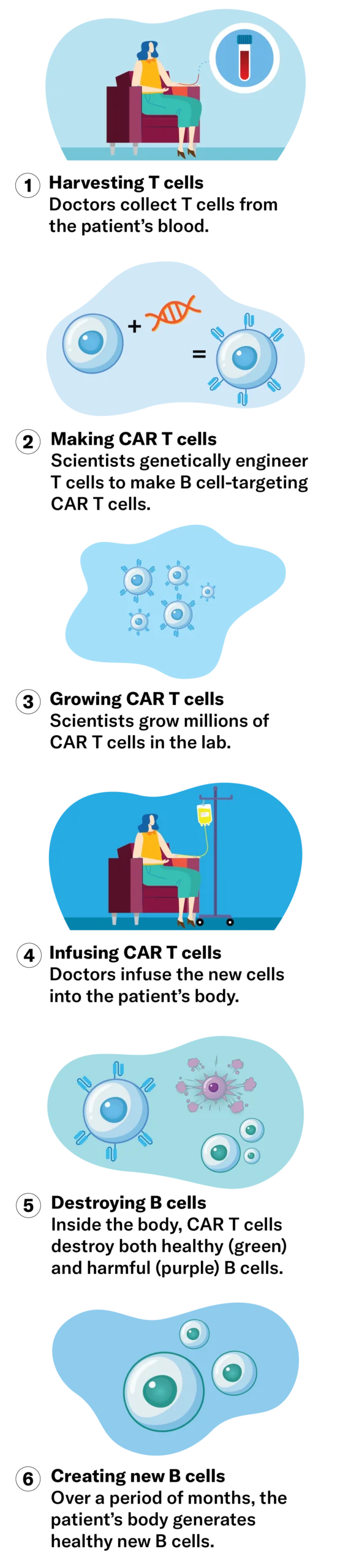
The journey toward this therapeutic milestone began with the repurposing of chimeric antigen receptor (CAR) T cell therapy. Initially developed in the early 2010s to combat hematologic malignancies like leukemia and lymphoma, the treatment involves extracting a patient’s T cells—the "soldiers" of the immune system—and genetically engineering them in a laboratory to recognize and neutralize specific targets. Once re-infused into the patient, these cells hunt down and eliminate the harmful agents driving the disease.
The transition from oncology to immunology was spurred by observations in cancer patients who, after receiving CAR T therapy, showed unexpected remission of their co-occurring autoimmune conditions. In 2021, researchers at Friedrich-Alexander-Universität Erlangen-Nürnberg in Germany provided the first definitive evidence of this potential when they successfully treated a 20-year-old patient with severe lupus. By depleting the patient’s B cells—the factories responsible for producing rogue antibodies—the team effectively performed an "immune reset." Following this success, clinical interest exploded. By 2024, the focus shifted to rare neurological conditions, including SPS, with trials led by firms like Kyverna Therapeutics.
Clinical Data and Patient Outcomes
The clinical trial that Montgomery-Haga participated in at the University of Colorado Anschutz Medical Campus has yielded compelling data. The study, involving 12 participants who previously relied on walking aids, showed that a significant majority were able to move independently after the intervention. One-year follow-up data released in September 2026 confirmed that these improvements were not fleeting; many patients reached walking speeds comparable to healthy adults and, crucially, were able to discontinue the use of chronic immunosuppressive medications.

For Montgomery-Haga, the results were transformative. Where she once lived in fear of sudden muscle rigidity that could cause her to collapse while cooking or walking, she now exhibits a smooth, confident gait. Her recovery has allowed her to return to domestic activities—gardening, vacuuming, and living without the constant anxiety of a "stiffening" event. On a subjective scale of health and functionality, she reports a marked improvement, moving from a near-zero baseline to a seven, with continued progress noted in her physical therapy assessments.
Expert Perspectives and Medical Caution
Despite the optimism surrounding these results, leading immunologists maintain a measured approach. Dr. Carl June, a pioneer of CAR T therapy at the University of Pennsylvania, notes that while the results are revolutionary, the medical community must remain cautious. "It is far too early to declare a definitive cure," Dr. June stated. He emphasizes that the long-term safety profile of these therapies in autoimmune populations is not yet fully understood. Unlike cancer patients, who may face different risk-benefit calculations, autoimmune patients require therapies that offer a high degree of safety over a lifetime.
The caution is underscored by recent setbacks in the field. In mid-2026, pharmaceutical companies such as Novartis and Bristol Myers Squibb paused clinical trials for their own CAR T autoimmune candidates following reports of patient deaths and severe neurological complications. These incidents have highlighted the complexity of manufacturing these living drugs. Experts like Dr. Marc Scherlinger of Strasbourg University Hospital have warned against the danger of "overselling" the treatment, noting that the biological variability between patients means that a therapy successful for one might present unforeseen hazards for another.

Implications for Future Autoimmune Care
If the U.S. Food and Drug Administration (FDA) grants approval to therapies like Kyverna’s miv-cel, it would represent a historic shift in how medicine addresses autoimmune dysfunction. Currently, patients with conditions like lupus, rheumatoid arthritis, multiple sclerosis, and myasthenia gravis rely on a cocktail of off-label drugs, including muscle relaxants, anti-seizure medications, and Botox, all of which manage symptoms without altering the course of the disease.
The potential for CAR T therapy to cross the blood-brain barrier is perhaps the most significant implication for neurological conditions. By accessing the central nervous system directly, these engineered cells could potentially halt the smoldering inflammation that causes the cognitive "brain fog" and physical degradation associated with MS and SPS. However, researchers such as Dr. Rebecca Farber of Columbia University point out a key limitation: while the therapy can stop the progression of a disease, it is not currently expected to reverse existing tissue damage.
The Road to 2027 and Beyond
Kyverna Therapeutics is currently moving toward an FDA submission, with the hope that miv-cel could become available to the public by 2027. If approved, it would be the first FDA-sanctioned CAR T therapy for an autoimmune condition. The regulatory path will likely involve rigorous scrutiny of manufacturing consistency and long-term toxicity monitoring.

For the patient community, the success of these trials has ignited a new sense of agency. The Stiff Person Syndrome Research Foundation, led by CEO Tara Zier, serves as a hub for those navigating the diagnostic and treatment maze. While Zier notes that some patients remain hesitant to undergo such an intensive, potentially risky procedure, the sheer existence of a "potential cure" has changed the discourse surrounding the disease.
For Lynn Montgomery-Haga, the future is no longer a question of "if" but "when." The woman who once struggled to pick up a dropped piece of soap now plans international travel to Paris and Scotland. The narrative of her life has shifted from one of resignation to one of reclamation. As she recently remarked, after years of watching others live their lives from the sidelines, she has finally reached a point where she can participate in the world again.
As the medical community continues to refine the delivery and safety of these cellular therapies, the focus is shifting toward "off-the-shelf" solutions that would eliminate the need for costly, time-consuming personalized engineering. If these advancements follow the current trajectory, the decade-long struggle of patients like Montgomery-Haga may soon be viewed as a relic of a time before the "immune reset" became a standard tool in the physician’s arsenal. The success of this experimental therapy in managing the symptoms of stiff person syndrome serves as a proof-of-concept, suggesting that the era of treating autoimmune diseases at the cellular factory level has truly arrived.