The fundamental nature of pressure is often taught through the lens of collective behavior—a macroscopic average of trillions of molecular impacts against a surface, such as the air sustaining the structure of an inflated balloon. However, beneath this statistical blanket lies a chaotic, discrete reality of individual particle interactions. In a groundbreaking experiment detailed in the October 23 issue of Physical Review Letters, researchers at Yale University have successfully captured the infinitesimal "touch" of individual atoms, marking a milestone in our ability to measure force at the quantum-classical boundary.
By employing a sophisticated optical levitation technique, the research team, led by physicist Yu-Han Tseng, observed a glass nanosphere—barely 100 nanometers in diameter—as it responded to the kinetic energy of single gas atoms. This achievement represents a departure from traditional sensing methods, which rely on cumulative pressure readings, and opens a new chapter in vacuum metrology and planetary science.
The Mechanism of Optical Levitation
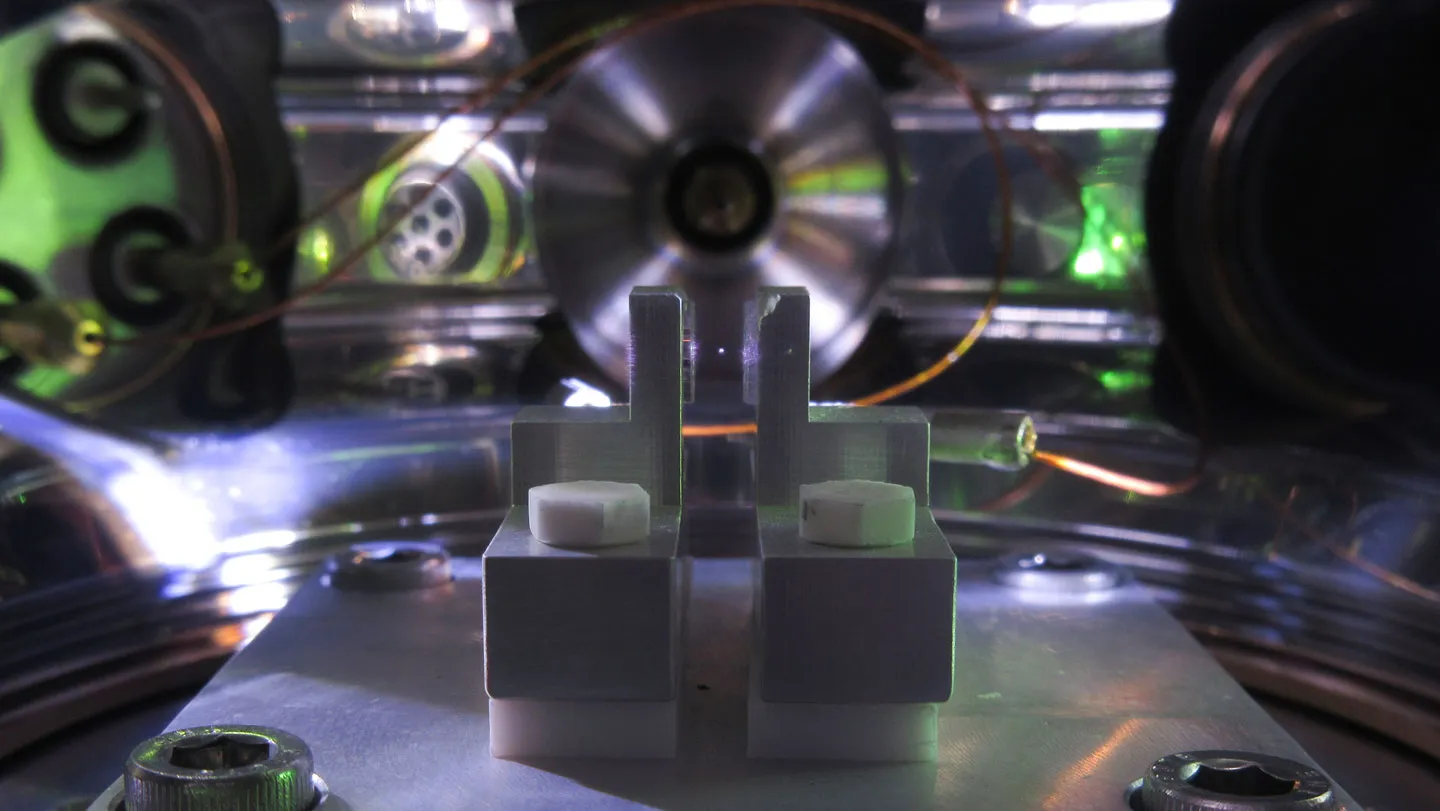
To observe the impact of a single atom, the researchers had to eliminate the noise of the macroscopic world. The experiment utilized a highly controlled vacuum chamber, an environment so sparse that the motion of the suspended sphere was almost entirely decoupled from environmental interference.
The core of the apparatus involves a tightly focused laser beam that acts as an optical tweezer. This beam traps a glass nanosphere, which weighs approximately one quadrillionth of a gram. Despite the nanosphere being 10 million times more massive than the individual gas particles it encounters, its extreme isolation allows it to react to the minute momentum transfer of a single collision.
When a gas atom—specifically krypton, xenon, or the molecule sulfur hexafluoride—strikes the sphere, the sphere experiences a displacement. By monitoring the laser light scattered by the nanosphere, the team could track these movements with extraordinary precision. The recorded impulses were as slight as a billionth of a Newton acting for a duration of one ten-trillionth of a second. This level of sensitivity transforms the nanosphere into a biological-scale "drumhead" that resonates with the kinetic rhythm of the surrounding gas.
Chronology of the Research
The journey toward this achievement began with the theoretical challenge of cooling nanoparticles to their quantum ground state. In previous work, the Yale Wright Lab had demonstrated that a levitated particle could be brought to a state of near-zero motion, effectively stripping away thermal noise.
- Phase One (Conceptualization): Researchers hypothesized that if a nanoparticle could be sufficiently isolated, its vibrational motion would act as a pristine sensor for external momentum transfer.
- Phase Two (Isolation): Development of the high-vacuum environment, where traditional gas pressure is virtually non-existent, allowed for the identification of singular, distinct events rather than a constant, blurred pressure signal.
- Phase Three (Data Collection): Over several months, the team introduced controlled, trace amounts of heavy gases. The increase in collision frequency was observed to scale linearly with the pressure within the chamber, validating the system as a reliable barometer.
- Phase Four (Validation): The researchers confirmed that the signature of the motion differed based on the species of the gas, proving that the system could not only measure pressure but also analyze gas composition.
Technical Implications and Sensing Capabilities
The implications of this technology extend far beyond the laboratory. Traditional pressure sensors, such as ionization gauges or capacitance manometers, struggle to maintain accuracy in extremely low-pressure environments. As pressures drop into the ultra-high vacuum range—commonly found in deep-space simulation chambers or semiconductor manufacturing—standard sensors become limited by their own electronic noise or the thermal degassing of their internal components.
The Yale team’s optical levitation system offers a "primary standard" approach. Because the force of a single atomic collision is fundamentally governed by the laws of classical mechanics—specifically the transfer of momentum—the sensor can be calibrated through first principles.
"This could enable a very good way to sense pressure," says Yu-Han Tseng. By analyzing the frequency and magnitude of the nanosphere’s "jiggles," scientists can determine the precise density and atomic mass of the gas surrounding it. This capability to distinguish between different gas species adds a layer of chemical analysis to what was previously only a physical measurement tool.
Broader Scientific Impact
The ability to detect individual molecular collisions at the nanoscale has significant ramifications for fields ranging from quantum thermodynamics to planetary exploration.
Planetary Science:
One of the most compelling applications is the potential for off-world atmospheric analysis. Current missions to planets or moons with thin atmospheres often rely on heavy, power-intensive spectrometers. A miniature, laser-levitated sensor could theoretically operate in the tenuous atmospheres of bodies like Mars or Titan, providing real-time data on atmospheric composition and pressure fluctuations with minimal energy consumption.
Quantum Metrology:
In the realm of quantum physics, understanding how a macroscopic object (like the 100-nanometer sphere) interacts with a quantum-scale particle (the gas atom) is vital for the development of quantum sensors. These devices could potentially detect gravitational waves or dark matter candidates that might exert similar, albeit even weaker, forces on sensitive test masses.
Industrial Manufacturing:
In the semiconductor industry, where atomic-layer deposition requires absolute control over vacuum environments, this technology could provide a new generation of high-precision gauges. By monitoring the "collision frequency" of residual gases, manufacturers could achieve cleaner, more consistent processes, potentially increasing the yield of advanced microprocessors.
Expert Reaction and Future Outlook
While the current experiment represents a significant technical success, the path to commercial or field deployment involves scaling the hardware. Currently, the requirement for a stable laser setup and a vacuum chamber limits the portability of the sensor. However, the trajectory of "lab-on-a-chip" technology suggests that optical levitation systems could eventually be miniaturized into integrated photonics packages.
Peer review in the physics community has noted that the experiment successfully bridged the gap between microscopic stochastic behavior and macroscopic measurement. By turning the nanosphere into a real-time monitor of atomic collisions, the Yale team has provided a new tool for probing the invisible, chaotic landscape of gas-phase dynamics.
As the research progresses, the focus will likely shift toward refining the sensitivity of the nanosphere’s motion detection, potentially moving into the regime of quantum sensing where the particle’s wave-like nature—not just its mass—must be accounted for. For now, the successful detection of the "gentlest caress" of a single atom serves as a testament to the precision of modern experimental physics and the ongoing quest to quantify the smallest interactions in our universe.