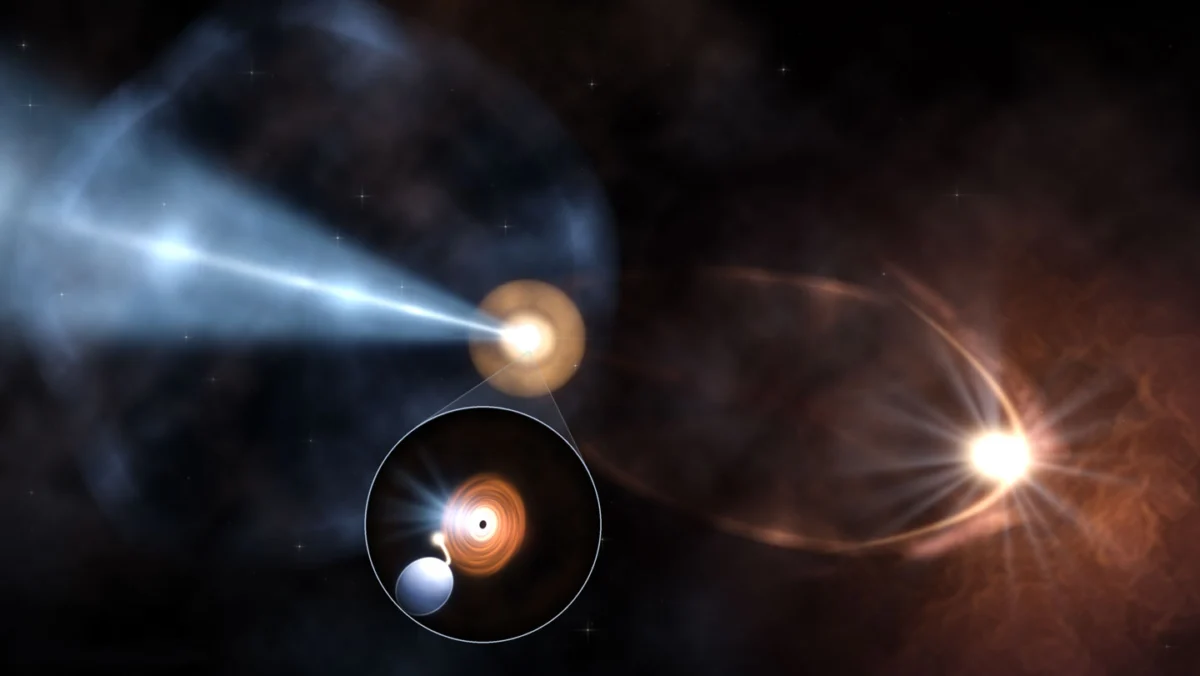
The hunt for a "microblazar"—a scaled-down version of the supermassive black holes that power the most luminous beacons in the universe—has finally concluded within the borders of our own Milky Way. For over three decades, astrophysicists have hypothesized that if massive quasars could launch jets of high-energy material toward Earth, their smaller counterparts, consisting of stellar-mass black holes devouring neighboring stars, should theoretically be capable of the same feat. Now, researchers have identified an object known as IRAS 18293–0941, which appears to be the first confirmed microblazar, providing a unique laboratory for observing cosmic phenomena that would otherwise take millennia to unfold.
A Quest Spanning Three Decades
The search for these elusive objects began in the early 1990s, shortly after the mechanics of microquasars—binary systems containing a compact object and a donor star—became a staple of high-energy astrophysics. While microquasars were well-documented, the specific subset known as "microblazars" required a precise geometric alignment: the jet of relativistic particles emitted by the black hole had to be oriented almost directly toward Earth.
For astrophysicists Pedro Luque-Escamilla of the University of Jaén in Spain and his collaborator Josep Martí, the journey to this discovery spanned two decades of systematic catalog scouring. The primary challenge was the "false positive" problem. In the past, researchers identified various candidates, only for follow-up observations to reveal that these objects were actually full-sized, extragalactic blazars—massive, distant black holes—rather than the compact, nearby systems they were hunting.
The breakthrough came through a meticulous cross-referencing process. By re-examining the 1983 infrared catalog produced by the Dutch-American Infrared Astronomical Satellite (IRAS), the team isolated IRAS 18293–0941. When they correlated the infrared data with modern radio telescope readings, they detected a distinct, asymmetric emission pattern. This "one-sided" brightness is the quintessential fingerprint of a blazar-like orientation, where the relativistic Doppler boosting effect significantly enhances the luminosity of the jet pointing toward the observer.
The Mechanism: A Cosmic Engine in Fast-Forward
To understand the significance of the microblazar, one must compare it to the supermassive blazars that anchor distant galaxies. In a standard blazar, the central black hole is millions or even billions of times the mass of the sun. The accretion process—the swirling of gas and dust into the event horizon—is massive and slow. Changes in the brightness or jet structure of these giants can take centuries to manifest.
In contrast, a microblazar operates on a human-observable timescale. Because the black hole is significantly smaller, the "accretion disk" is tighter and the orbital period of the donor star is shorter. As Luque-Escamilla notes, processes that require thousands of years in a supermassive blazar occur in a matter of days or weeks in a microblazar. This effectively turns the object into a "cosmic movie" played at high speed, allowing astronomers to observe the birth, evolution, and potential death of high-energy jets in real-time.
Multi-Wavelength Validation
The confirmation of IRAS 18293–0941 as a genuine galactic microblazar required an unprecedented integration of data. Unlike previous claims that relied on single-spectrum observations, the research team employed a multi-wavelength approach. By synthesizing data from three distinct observatories—spanning radio, infrared, and X-ray spectra—the team was able to triangulate the object’s distance and confirm its position within the Milky Way.
Dr. Alexandra Tetarenko, an astrophysicist at the University of Lethbridge who reviewed the findings, emphasized the methodological rigor of the study. "The authors took a truly multi-wavelength approach, making use of all different types of astrophysical data from many telescopes," Tetarenko observed. "This is not only what distinguishes this work from past claims on other microblazar candidates but also makes it far more convincing." The consensus among the broader astrophysical community is that the integration of diverse observational data sets has set a new standard for identifying compact high-energy sources.
Solving the Mystery of High-Energy Particles
Beyond the classification of the object itself, the discovery of IRAS 18293–0941 may solve a significant mystery regarding ultrahigh-energy cosmic rays. For years, scientists have detected particles with energies reaching levels 100 times higher than those produced by the Large Hadron Collider. The origin of these particles, and the mechanism that "juices" them to such extremes, has been a subject of intense debate.
The proximity of IRAS 18293–0941 to a known "hotspot" of ultrahigh-energy particles suggests a causal link. The researchers hypothesize that while one jet from the microblazar points toward Earth, the opposing jet—which is otherwise invisible—slams into a dense molecular cloud. This collision acts as a natural, large-scale particle accelerator, stripping away electrons and boosting atomic nuclei to near-light speeds. If this hypothesis holds, it suggests that microblazars are not just curiosities; they are significant contributors to the cosmic ray population of the Milky Way.
Implications and Future Research
The identification of this microblazar opens several new avenues for research:
- Particle Acceleration Models: By studying the interaction between the invisible jet and the molecular cloud, researchers can test theories of shock acceleration that are impossible to simulate in Earth-based facilities.
- Stellar Evolution: Monitoring the donor star in the system will provide data on how stellar-mass black holes interact with their companions, specifically regarding mass transfer rates and the formation of accretion disks.
- Galactic Energy Budgets: Understanding how much energy microblazars inject into the interstellar medium will help astronomers better model the energetic feedback loops within the galaxy.
The team is already coordinating with global observatory networks to secure additional "time-domain" observations. The goal is to capture the system during a period of high variability, which would provide a clearer look at the dynamics of the jet-disk coupling.
A New Era of High-Energy Astronomy
The discovery marks a transition in how we view the Milky Way. For decades, the galaxy was considered a relatively quiet environment compared to the violent, active galactic nuclei found at the edge of the observable universe. The existence of a microblazar confirms that the same high-energy physics governing the most powerful objects in the cosmos are at work in our own galactic backyard.
As scientists continue to monitor IRAS 18293–0941, the focus will shift from identification to characterization. Every flicker of radiation and every change in jet intensity serves as a data point in a broader investigation into the fundamental laws of gravity and electromagnetism. In the words of Luque-Escamilla, this object is more than just a discovery; it is a "supreme cosmic engine" that has finally been brought into view, offering a rare, intimate look at the mechanics of the universe.
While the data currently supports the team’s findings, the scientific process dictates that further scrutiny is necessary. Upcoming surveys from next-generation radio arrays are expected to provide even higher resolution imagery of the jet structure, which will either confirm the current model of particle acceleration or lead to a deeper understanding of how these compact systems shape their environments. For now, the discovery stands as a testament to the power of persistence and the utility of historical archival data in the modern era of high-tech astrophysics.