Scientists at the University of Cambridge have achieved a landmark breakthrough in quantum physics and material science, discovering that electrons can be propelled across solar materials at speeds approaching the fundamental limits of nature. This discovery, published in the journal Nature Communications on March 5, 2026, fundamentally challenges long-accepted dogmas regarding the operation of solar energy systems and suggests a radical new "rulebook" for designing the next generation of light-harvesting technologies. By observing charge separation occurring within a staggering 18 femtoseconds—less than 20 quadrillionths of a second—the research team has demonstrated that molecular vibrations, previously viewed as a source of energy loss, can actually function as "molecular catapults" to drive electrons with unprecedented efficiency.
The 18-Femtosecond Breakthrough: Mapping the Limits of Time
To understand the scale of this discovery, one must first grasp the infinitesimal nature of the femtosecond. A single femtosecond is one quadrillionth of a second. To put this in a cosmic perspective, one second contains roughly eight times more femtoseconds than there are hours in the 13.8 billion years since the Big Bang. At this scale, the traditional laws of classical physics give way to quantum mechanical behaviors, where the distinction between particles and waves becomes blurred.
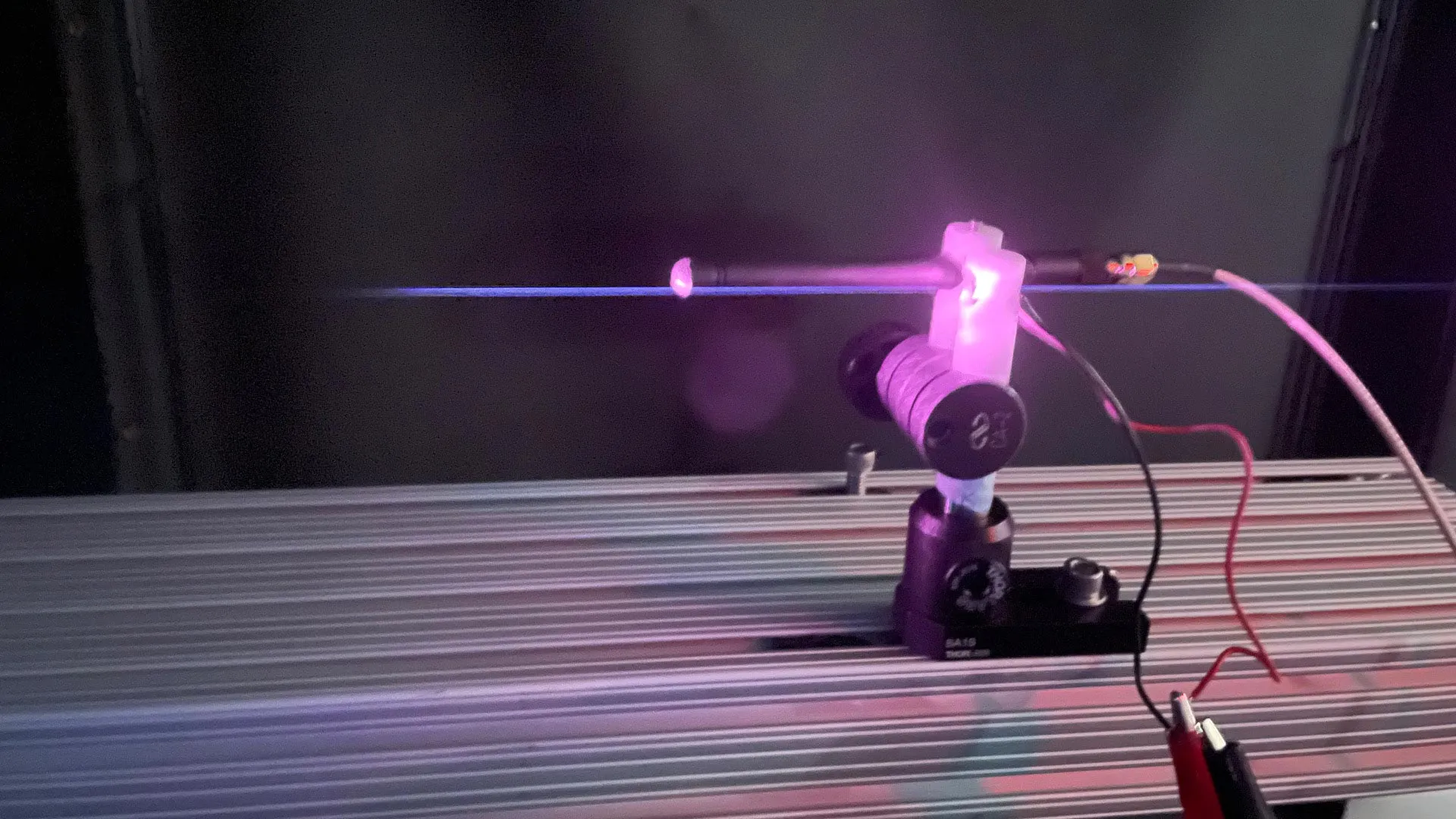
The Cambridge team, led by researchers at the Cavendish Laboratory and St John’s College, utilized advanced ultrafast laser spectroscopy to monitor the movement of electrons. They observed that electric charges separated during the span of a single molecular vibration. This speed is effectively the same pace at which atoms move within a molecule. Dr. Pratyush Ghosh, a Research Fellow at St John’s College and the study’s lead author, noted that the system was watching electrons migrate on the exact same "clock" as the atoms themselves.
This observation is significant because it matches the natural rhythm of atomic motion, reaching a state of "ballistic" motion. In traditional solar materials, electrons often move through a process of "hopping" or "drifting" randomly, which is inherently slower and prone to energy loss. The Cambridge findings reveal a coherent burst of movement where the vibration of the molecule actively pushes the electron across the interface between materials.
Challenging the Conventional Design Rulebook
For decades, the development of organic solar cells and other light-harvesting devices has been guided by a specific set of design principles. Conventional theory suggested that for ultrafast charge transfer to occur, there must be a significant energy difference (driving force) between the donor material (which absorbs light) and the acceptor material (which receives the electron). Furthermore, it was believed that strong electronic coupling—a high degree of interaction between the molecules—was a prerequisite for speed.
However, these requirements come with a significant trade-off. Large energy differences often result in a loss of voltage, which reduces the overall efficiency of the solar cell. To test the limits of this theory, the Cambridge researchers intentionally designed a "worst-case scenario" system. They paired a polymer donor with a non-fullerene acceptor (NFA) characterized by almost no energy difference and exceptionally weak electronic interaction.
"By conventional design rules, this system should have been slow," Dr. Ghosh explained. "We deliberately designed a system that, according to conventional theory, should not have transferred charge this fast. That is what makes the result so striking."
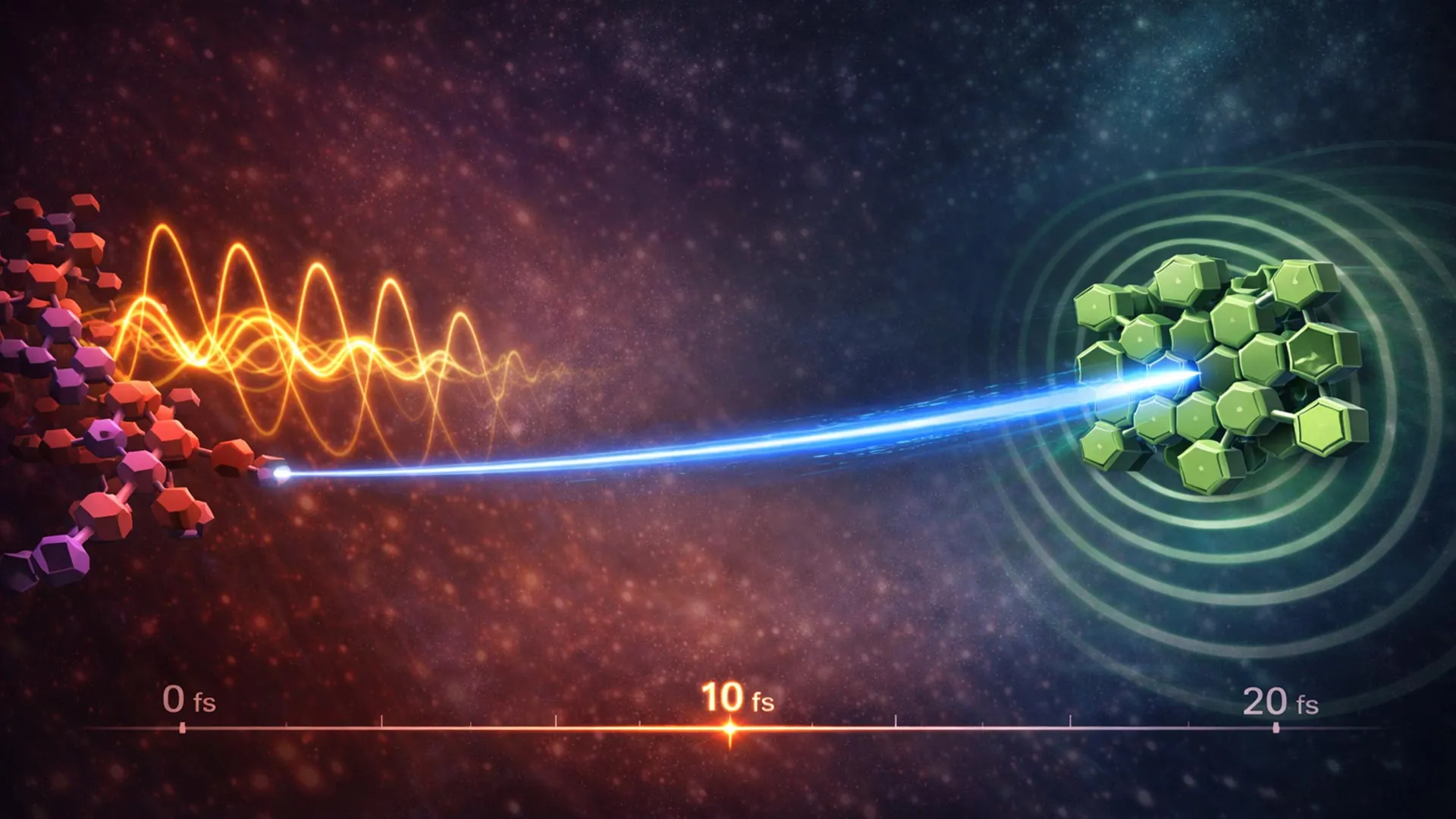
Instead of the predicted sluggish performance, the electron crossed the interface in 18 femtoseconds. This result suggests that the "static" electronic structure of a material—how its energy levels are arranged when it is still—is not the only factor determining performance. Instead, the dynamic behavior of the molecules—how they shake and vibrate—plays a dominant role.
The Mechanism: From Diffusion to Molecular Catapults
The heart of the discovery lies in the role of excitons and molecular vibrations. In carbon-based (organic) solar materials, when sunlight strikes the surface, it creates an "exciton"—a tightly bound pair consisting of an electron and a "hole" (the positive charge left behind). For a solar cell to generate electricity, this exciton must be ripped apart so the electron can flow through a circuit.
In many systems, this separation is a struggle against the internal "glue" of the exciton. The Cambridge study found that when the polymer absorbs light, it begins to vibrate at specific, high-frequency patterns. These vibrations mix different electronic states, effectively creating a bridge for the electron to cross.
The researchers described this as a "molecular catapult." Rather than drifting through the material like a person navigating a crowded room, the electron is launched across the boundary in one coherent, directional motion. Once the electron arrives at the acceptor molecule, it triggers a new, distinctive vibration. This "fingerprint" vibration was detected by the researchers, providing clear evidence of how cleanly and rapidly the transfer occurred. This phenomenon is rarely observed in organic materials, as the signal is usually lost in the "noise" of random molecular movement.
Global Collaboration and Experimental Precision
The study was a massive undertaking involving a multidisciplinary team from the University of Cambridge’s Cavendish Laboratory and the Yusuf Hamied Department of Chemistry. Dr. Rakesh Arul, another St John’s College Research Fellow, played a key role in the experimental execution.
The research was not confined to the UK; it involved a global network of collaborators from Italy, Sweden, the United States, Poland, and Belgium. This international cooperation was necessary to combine expertise in synthetic chemistry, ultrafast laser physics, and theoretical modeling.
The primary tool used was transient absorption spectroscopy, a technique that uses "pump" and "probe" laser pulses. The first pulse (the pump) excites the material, mimicking the impact of sunlight. The second pulse (the probe) acts as a high-speed camera, capturing snapshots of the electron’s position at femtosecond intervals. By analyzing the changes in the light absorbed by the material over time, the team could reconstruct the electron’s journey with sub-atomic precision.
Implications for the Future of Green Energy
The implications of this discovery reach far beyond the laboratory. Organic photovoltaics (OPVs) are a promising alternative to traditional silicon-based solar panels because they are lightweight, flexible, and can be manufactured using low-cost printing techniques. However, they have historically lagged behind silicon in terms of efficiency.
By unlocking the "vibrational rulebook," engineers can now design materials that utilize molecular motion rather than trying to suppress it. Professor Akshay Rao, a Professor of Physics at the Cavendish Laboratory and co-author of the study, emphasized the shift in perspective: "Instead of trying to suppress molecular motion, we can now design materials that use it—turning vibrations from a limitation into a tool."
This "vibration-assisted" design could lead to several technological advancements:
- High-Efficiency Organic Solar Cells: By minimizing the energy difference required for charge separation, scientists can create cells that maintain higher voltages, significantly boosting the power conversion efficiency (PCE) of organic solar panels.
- Advanced Photocatalysis: The process of using light to drive chemical reactions—such as splitting water to produce clean hydrogen fuel—relies on the same ultrafast charge separation. This discovery could pave the way for more efficient hydrogen production, a key component of the global transition to net-zero emissions.
- Enhanced Photodetectors: Devices used in medical imaging, fiber-optic communications, and night-vision technology could benefit from the increased speed and sensitivity offered by ballistic electron transfer.
- Bio-inspired Technologies: Similar ultrafast processes occur during natural photosynthesis in plants. By understanding how nature uses vibrations to move energy so efficiently, scientists may be able to create "artificial leaves" that outperform natural systems.
Analysis: A Paradigm Shift in Material Science
This research marks a transition from "static" material science to "dynamic" quantum engineering. For years, the focus of the semiconductor industry has been on the arrangement of atoms and the purity of crystals. While those factors remain important, the Cambridge study highlights that the rhythm of the material is just as vital as its structure.
From a commercial standpoint, this could shorten the development cycle for new solar materials. If researchers know which specific vibrational frequencies act as catapults, they can use computational modeling to screen thousands of potential molecules before ever synthesizing them in a lab. This "rational design" approach replaces the trial-and-error methods that have characterized much of organic electronics over the last two decades.
Furthermore, the discovery addresses one of the primary causes of energy loss in solar cells: non-radiative recombination. This occurs when an electron and a hole recombine before they can be harvested as electricity, usually losing their energy as heat. By separating the charges in 18 femtoseconds—faster than the typical recombination timeframe—the "catapult" mechanism ensures that almost every photon absorbed is converted into useful charge.
Conclusion
The findings published by the University of Cambridge represent a pivotal moment in the study of light-matter interactions. By proving that electrons can move at the speed of atomic vibrations even in systems designed for "weak" interaction, the team has dismantled a major barrier in solar energy theory.
As the world seeks more efficient ways to harvest the 173,000 terawatts of solar energy that strike the Earth continuously, the ability to manipulate the quantum "rhythm" of molecules offers a new and potent strategy. The transition from fighting molecular vibrations to harnessing them as catapults may well be the catalyst needed to bring low-cost, high-efficiency organic solar technology to the global market. The "rulebook" has indeed been rewritten, and the future of solar energy appears to be moving faster than ever imagined.