The field of synthetic chemistry, often described as the architecture of the microscopic world, is undergoing a fundamental transformation as researchers at the École Polytechnique Fédérale de Lausanne (EPFL) introduce a pioneering framework that marries the strategic depth of human reasoning with the processing power of artificial intelligence. Led by Professor Philippe Schwaller, the research team has unveiled Synthegy, a method that utilizes large language models (LLMs) not merely as generative engines, but as sophisticated evaluators capable of guiding complex chemical synthesis and reaction mechanism discovery. This development, recently detailed in the journal Matter, addresses a decades-old bottleneck in the pharmaceutical and materials science industries: the disconnect between computational brute force and the nuanced, strategic judgment of experienced chemists.
The Evolution of Synthetic Strategy and the Retrosynthetic Challenge
To understand the significance of Synthegy, one must first grasp the immense complexity inherent in molecular construction. For over a century, the creation of new compounds—whether for life-saving oncology drugs, advanced polymers, or sustainable fertilizers—has relied on a process known as retrosynthesis. Formulated in its modern sense by Nobel laureate E.J. Corey in the 1960s, retrosynthesis requires a chemist to look at a complex target molecule and work backward, step-by-step, to identify simpler, commercially available starting materials.
This "backwards" mapping is fraught with strategic pitfalls. A single molecule might have thousands of potential synthetic routes. Choosing the most efficient one requires a chemist to consider various factors: the compatibility of different functional groups, the cost of reagents, the environmental impact of solvents, and the necessity of "protecting groups"—temporary modifications used to prevent sensitive parts of a molecule from reacting prematurely. While computational tools have existed for decades to assist in this process, they have traditionally functioned as rigid databases or "black box" algorithms. These systems often suggest pathways that are chemically valid on paper but practically unfeasible or strategically nonsensical to a human expert.
The primary hurdle has been the "search space." The number of possible chemical reactions is estimated to exceed the number of atoms in the known universe. While traditional algorithms can scan millions of these possibilities, they lack the "intuition" to prioritize a route that avoids a difficult purification step or one that builds a complex ring structure early in the process to ensure stability.
Synthegy: A Paradigm Shift in Human-AI Collaboration
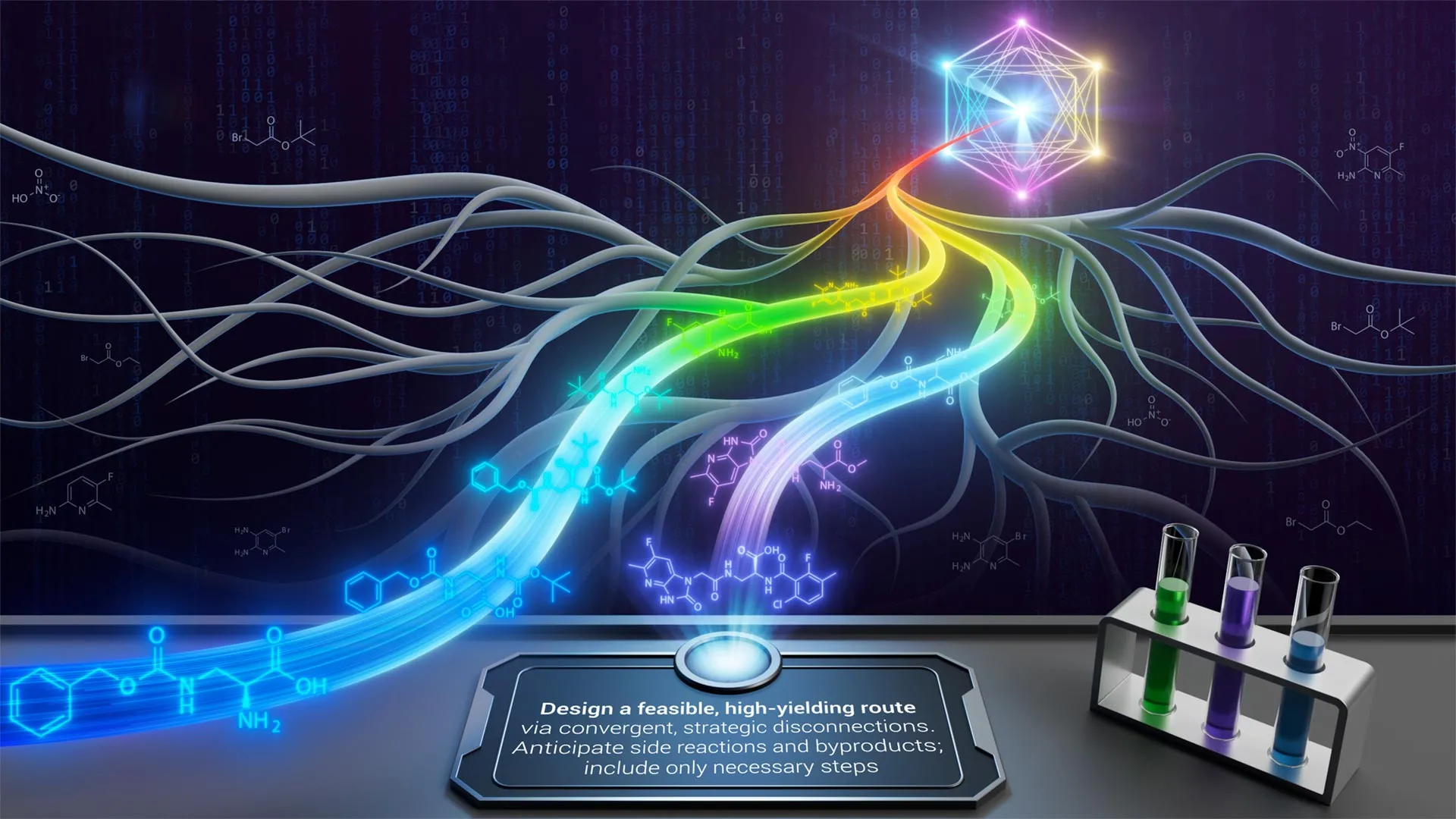
The EPFL team, spearheaded by first author Andres M. Bran, recognized that the missing link in computational chemistry was not more data, but better reasoning. Synthegy represents a departure from previous AI applications in chemistry, which often attempted to have models "predict" a reaction outcome directly. Instead, Synthegy uses LLMs—the same class of technology behind ChatGPT—as a "reasoning layer" that sits atop traditional search algorithms.
In this framework, the LLM acts as a bridge between the chemist’s natural language intent and the computer’s mathematical search. A chemist can now provide high-level strategic instructions in plain English, such as "Avoid using protecting groups on the nitrogen atom" or "Prioritize routes that utilize a Diels-Alder cyclization in the early stages." Synthegy then takes the vast output of traditional retrosynthesis software and uses the LLM to score, filter, and explain each potential pathway based on those specific instructions.
This "natural language interface" is more than just a convenience; it is a fundamental shift in how scientists interact with data. By allowing chemists to "talk" to the synthesis planning process, the system enables a rapid iterative cycle. If a suggested route is too expensive or requires toxic catalysts, the chemist can simply tell the model to adjust its parameters and re-evaluate the options in seconds.
Chronology of Development and the Rise of LLMs in Science
The development of Synthegy follows a timeline of rapid acceleration in AI-driven science. In the late 2010s, the introduction of Transformer-based models revolutionized natural language processing. By 2020 and 2021, researchers began applying these models to "chemical languages" like SMILES (Simplified Molecular Input Line Entry System), treating molecular structures like sentences and reactions like grammar.
However, these early chemical LLMs often suffered from "hallucinations"—suggesting reactions that violated the laws of physics or chemistry. The EPFL team’s work, which began in earnest over the last two years, sought to solve this by moving away from pure generation. By late 2023, the team had successfully integrated the reasoning capabilities of GPT-4 and other large models with established chemical search trees, leading to the formalization of the Synthegy framework. This timeline reflects a broader shift in the scientific community from using AI as a standalone "oracle" to using it as a collaborative "co-pilot."
Data-Driven Validation: Bridging the Gap Between AI and Expert Judgment
To prove the efficacy of Synthegy, the researchers conducted a rigorous, double-blind study involving 36 professional chemists. This validation process was designed to see if the AI’s "judgment" aligned with that of human experts—the gold standard in synthetic planning.
The participants were presented with 368 different chemical evaluations. They were asked to rank synthetic pathways and reaction mechanisms without knowing whether the evaluations were generated by a human or by Synthegy. The results were striking: the chemists’ assessments agreed with the AI’s rankings 71.2% of the time on average.
Furthermore, the study revealed a clear correlation between the size of the underlying language model and its chemical "intelligence." Larger models, which have been trained on more diverse datasets including scientific literature, demonstrated a superior ability to identify subtle strategic nuances, such as the strategic placement of a functional group to facilitate a later reaction. Smaller, more localized models were found to be significantly less effective, often missing the broader "strategic picture" of a multi-step synthesis.
The data also showed that Synthegy was particularly adept at flagging unnecessary steps. In modern drug synthesis, efficiency is measured not just by yield, but by "step economy"—the fewer the steps, the lower the cost and waste. Synthegy’s ability to prioritize efficient solutions that match a chemist’s specific goals represents a significant advancement over previous "best-first" search algorithms that often prioritized high-yield individual steps over the efficiency of the entire sequence.
Deep Dive: Applying AI to Reaction Mechanisms
Beyond retrosynthesis, Synthegy is breaking new ground in the study of reaction mechanisms. A reaction mechanism is a step-by-step description of how a chemical transformation occurs, focusing on the movement of electrons. Understanding mechanisms is the "holy grail" of chemistry because it allows scientists to not only observe what happens but to understand why it happens, enabling the design of entirely new reactions.
Traditional computational tools for mechanism exploration, such as quantum chemical calculations, are extremely resource-intensive and often provide too many possible pathways for a human to analyze. Synthegy approaches this by breaking down a reaction into its fundamental "electron pushes." The LLM then evaluates these individual steps, steering the search toward pathways that "make sense" according to established chemical principles.
The flexibility of the framework allows researchers to incorporate expert hypotheses into the search. For example, if a researcher suspects that a specific solvent molecule is involved in the transition state, they can provide this information as text. Synthegy then incorporates this constraint into its evaluation, allowing for a more realistic and targeted exploration of the chemical space.
Broader Implications for Industry and Research
The implications of the Synthegy framework extend far beyond the laboratory at EPFL. In the pharmaceutical industry, where the average cost to bring a new drug to market exceeds $2 billion and takes over a decade, any tool that can shave months off the synthesis planning stage is invaluable. By streamlining the path from a molecular "idea" to a physical sample, Synthegy could significantly accelerate the early stages of drug discovery.
Moreover, the tool has profound implications for the "democratization" of high-level chemistry. By providing a natural language interface, Synthegy makes advanced computational tools accessible to experimentalists who may not have expertise in coding or complex algorithmic theory. This allows a broader range of scientists to engage with sophisticated synthetic strategies.
From a sustainability perspective, the ability to rapidly identify more efficient, "greener" synthetic routes is crucial. As the chemical industry faces increasing pressure to reduce its carbon footprint and eliminate toxic waste, tools that can prioritize "atom-economical" pathways—those that incorporate as many of the starting materials as possible into the final product—will be essential.
Future Outlook: A Unified Interface for Chemistry
As the EPFL team continues to refine Synthegy, the goal is to create a truly unified interface for chemical research. Andres M. Bran emphasizes that the connection between synthesis planning and mechanisms is the next great frontier. By using mechanisms to discover new reactions, and then using those reactions to synthesize complex new molecules, Synthegy creates a closed-loop system of discovery.
The future of chemistry likely lies in this hybrid model: human chemists providing the creative spark and high-level strategy, while AI systems like Synthegy handle the heavy lifting of scanning possibilities and ensuring strategic alignment. As language models continue to evolve, their "reasoning" will only become more refined, potentially leading to a future where the most complex molecules on earth can be mapped out as easily as a traveler plans a route on a digital map.
The work of Schwaller and his team serves as a definitive proof of concept that AI is not here to replace the chemist, but to empower them. In the intricate dance of atoms and electrons, Synthegy provides the music, allowing the chemist to lead the way toward the next generation of scientific breakthroughs.