The proliferation of artificial intelligence integrations across software development has fundamentally shifted how developers evaluate and consume third-party packages. A well-received open-source AI wrapper often functions seamlessly within an author’s curated demo notebook, yet struggles when deployed into diverse production environments. Within days of adoption, teams frequently encounter structural failures: a missing API key yields an unhelpful, raw exception rather than a clear diagnostic message; the installation of a lightweight text-classification feature inadvertently pulls in gigabytes of deep learning dependencies; and automated test suites flake because they evaluate the stochastic language output of a model rather than the deterministic logic of the library itself.
These challenges rarely stem from poor coding standards. Instead, they highlight a category mismatch in contemporary software engineering. Traditional Python packaging methodologies were largely architected for utilities that interface with relational databases, parse static configuration files, or handle predictable HTTP requests. AI libraries, by contrast, contend with a fundamentally different taxonomy of failure modes: outputs that fail to conform to strict programmatic schemas, runtime dependencies measured in gigabytes, and third-party large language model (LLM) APIs that experience outages, rate limits, and latency spikes rarely encountered in standard REST integrations.
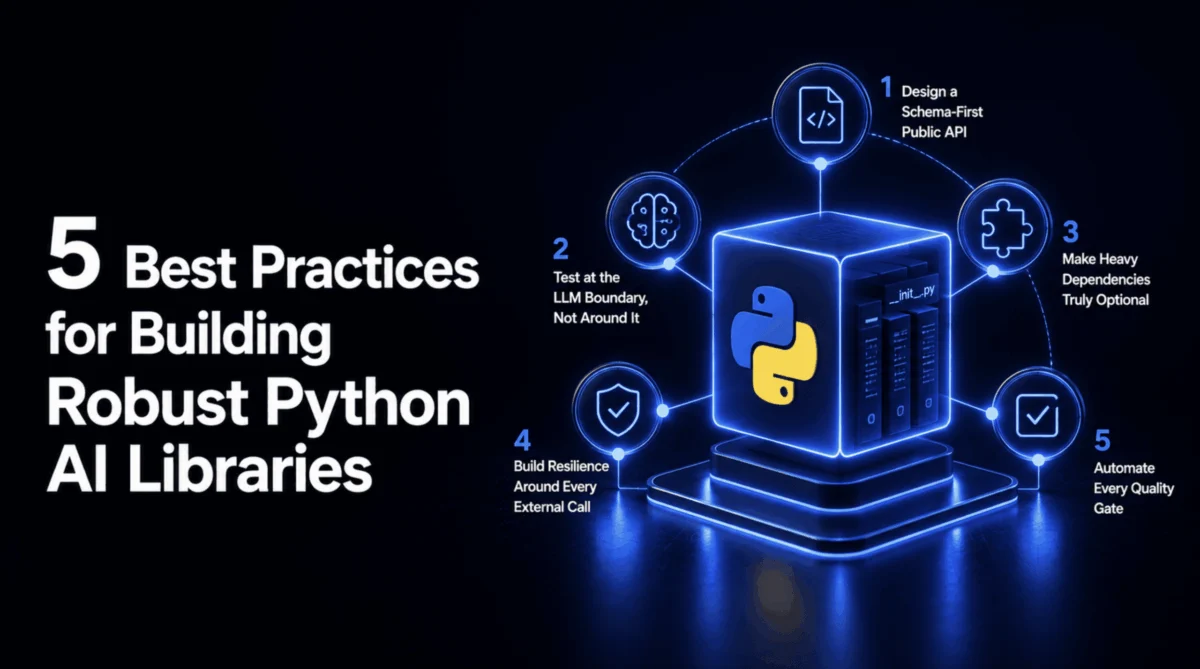
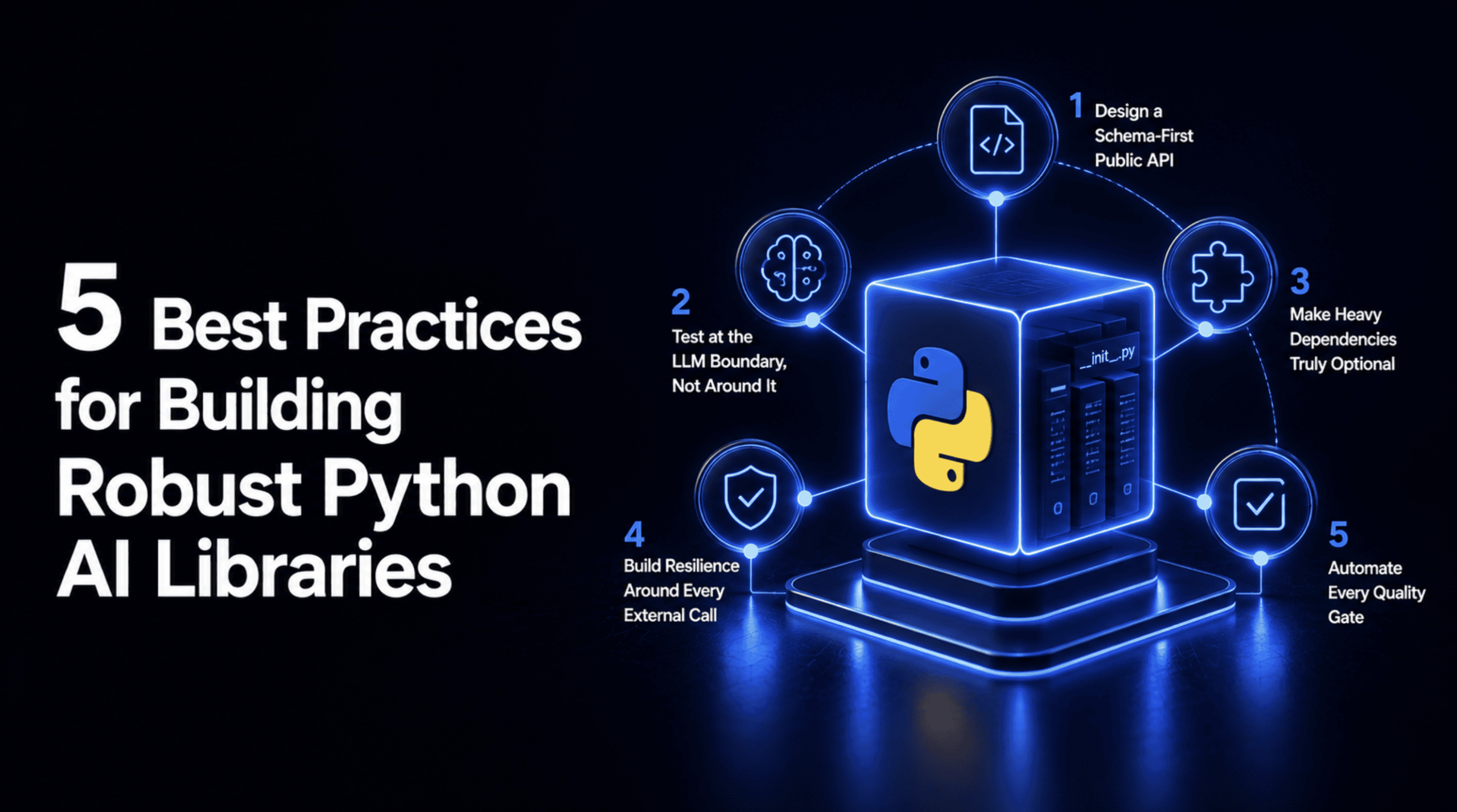
Navigating these obstacles requires a specialized approach to Python AI Software Development Kit (SDK) design. Building a production-ready package that survives outside a controlled demo environment demands deliberate architectural choices. Below are five foundational practices, illustrated through concrete code patterns and industry standards, that separate transient prototypes from robust, enterprise-grade AI libraries.
The Architectural Bar for Modern AI SDKs
Before establishing development workflows, engineering teams must define what constitutes a genuinely robust Python AI package. According to guidelines set forth by the Python Packaging User Guide and contemporary software construction standards, reliable packages share several immutable traits.
Foremost among these is complete type coverage, reinforced by a pyproject.toml-first project structure adhering to PEP 621 specifications, which supersedes fragmented legacy configuration files. Furthermore, robust packages employ explicit input and output validation at the public application programming interface (API) boundary to mitigate the inherent unpredictability of generative models. They also implement rigorous dependency isolation, ensuring that consuming a specific feature does not force a multi-gigabyte installation footprint, while baking resilience directly into external communication channels from the initial commit. Finally, comprehensive Continuous Integration (CI) pipelines automatically enforce these constraints, eliminating reliance on manual code reviews.
Industry-standard repositories offer valuable structural blueprints. OpenAI’s official Python SDK demonstrates clean top-level namespace exposure and rigorous dual-type checking using both pyright and mypy. Instructor and PydanticAI exemplify schema-validated structured output design, treating type safety as a core architectural philosophy rather than an afterthought. Meanwhile, LiteLLM establishes a unified interface across dozens of disparate model providers without leaking provider-specific implementation details, and Hugging Face Transformers remains the benchmark for modular dependency management at scale.
Core Practices for Production-Ready AI Packaging
1. Designing a Schema-First Public API
The primary rule of AI library design is simple: never allow a raw string or an untyped dictionary sourced directly from an LLM response to cross the public boundary of your library. Model calls routinely return malformed JSON, omit required keys, or alter data types unexpectedly. If unvalidated output propagates through a codebase, downstream applications fail unpredictably far from the source of the error.
To mitigate this, developers should leverage libraries like Pydantic to enforce strict data contracts.
from pydantic import BaseModel, ValidationError
from openai import OpenAI

client = OpenAI()

class ExtractedInvoice(BaseModel):
    vendor: str
    total: float
    due_date: str

class SchemaValidationError(Exception):
    """Raised when a model's response doesn't match the expected schema."""

def extract_invoice(raw_text: str) -> ExtractedInvoice:
    """Extract structured invoice fields from raw text. Returns a
    validated ExtractedInvoice, never a raw dict or string."""
    response = client.chat.completions.create(
        model="gpt-4o",
        messages=[
            "role": "system", "content": "Extract invoice fields as JSON: vendor, total, due_date.",
            "role": "user", "content": raw_text,
        ],
        response_format="type": "json_object",
    )
    raw_json = response.choices[0].message.content

    try:
        return ExtractedInvoice.model_validate_json(raw_json)
    except ValidationError as e:
        raise SchemaValidationError(
            f"Model returned data that doesn't match ExtractedInvoice: e"
        ) from e
By enforcing response_format="type": "json_object", the client constrains the provider to return syntactically valid JSON, preempting parsing failures. Furthermore, catching Pydantic’s internal ValidationError and re-raising it as a domain-specific SchemaValidationError encapsulates internal implementation details, presenting consumers with a clean, actionable error interface.
2. Testing at the Large Language Model Boundary
Automated testing for AI applications introduces unique complexities due to the non-deterministic nature of generative models. Asserting tests against the literal prose returned by an LLM guarantees test suites will flake.
The solution is to isolate tests precisely at the boundary where the library communicates with the provider API. By mocking the network client, developers can verify both the parsing logic and the structure of the outgoing prompt without invoking a live, stochastic model.
from unittest.mock import patch, MagicMock
import pytest
from mylib.invoices import extract_invoice, SchemaValidationError

def _mock_response(content: str) -> MagicMock:
    mock = MagicMock()
    mock.choices = [MagicMock(message=MagicMock(content=content))]
    return mock

@patch("mylib.invoices.client")
def test_extract_invoice_parses_valid_response(mock_client):
    mock_client.chat.completions.create.return_value = _mock_response(
        '"vendor": "Acme Corp", "total": 452.10, "due_date": "2026-09-01"'
    )

    result = extract_invoice("some raw invoice text")

    assert result.vendor == "Acme Corp"
    assert result.total == 452.10

    sent_messages = mock_client.chat.completions.create.call_args.kwargs["messages"]
    assert "Extract invoice fields as JSON" in sent_messages[0]["content"]

@patch("mylib.invoices.client")
def test_extract_invoice_raises_on_malformed_output(mock_client):
    mock_client.chat.completions.create.return_value = _mock_response(
        '"vendor": "Acme Corp"'
    )

    with pytest.raises(SchemaValidationError):
        extract_invoice("some raw invoice text")
This testing pattern ensures execution speed, eliminates API costs during test runs, and guarantees deterministic test outcomes within CI pipelines.
3. Making Heavy Dependencies Truly Optional
AI development frequently requires massive underlying frameworks, such as PyTorch or Hugging Face Transformers, which can easily exceed several gigabytes. Forcing every consumer to download these dependencies regardless of their use case creates unnecessary friction.
Modern Python packaging solves this through optional dependencies and lazy imports:
[project]
name = "mylib"
dependencies = [
    "pydantic>=2.0",
    "httpx>=0.27",
]

[project.optional-dependencies]
openai = ["openai>=1.0"]
local = ["torch>=2.0", "transformers>=4.40"]
all = ["mylib[openai,local]"]
def _require(module_name: str, extra_name: str):
try:
return __import__(module_name)
except ImportError as e:
raise ImportError(
f"'module_name' is required for this feature. "
f"Install it with: pip install 'mylib[extra_name]'"
) from e
def load_local_model(model_name: str):
torch = _require("torch", "local")
transformers = _require("transformers", "local")
return transformers.AutoModel.from_pretrained(model_name)By decoupling core utilities from heavy inference runtimes and supplying instructive exception messages upon import failure, libraries remain lightweight and adaptable.
4. Building Resilience Around External Calls
Third-party AI providers experience transient network partitions, rate limits, and server-side errors. Unhandled exceptions transform routine infrastructure hiccups into application-wide outages.
Implementing targeted retry logic with exponential backoff protects client applications from unstable provider uptime:
import logging
import httpx
from tenacity import (
    retry,
    stop_after_attempt,
    wait_exponential,
    retry_if_exception_type,
    before_sleep_log,
)

logger = logging.getLogger("mylib")

class ProviderUnavailableError(Exception):
    """Raised when a provider call fails after all retries are exhausted."""

@retry(
    stop=stop_after_attempt(3),
    wait=wait_exponential(multiplier=1, min=1, max=10),
    retry=retry_if_exception_type((httpx.TimeoutException, httpx.HTTPStatusError)),
    before_sleep=before_sleep_log(logger, logging.WARNING),
    reraise=True,
)
def _call_provider(client, **kwargs):
    return client.chat.completions.create(timeout=15.0, **kwargs)
This configuration restricts automatic retries exclusively to transient network events while explicitly avoiding retries on authentication or client-side validation failures, preventing wasted computational cycles and runaway billing loops.
5. Automating Quality Gates via Continuous Integration
Adhering to architectural standards requires automated enforcement. Modern development workflows utilize toolchains such as uv for dependency management, ruff for linting and formatting, mypy for static type verification, and pytest for test execution.
name: CI

on:
  push:
    branches: [main]
  pull_request:

jobs:
  quality:
    runs-on: ubuntu-latest
    steps:
      - uses: actions/checkout@v4
      - uses: astral-sh/setup-uv@v3
      - run: uv sync --all-extras --dev
      - run: uv run ruff check .
      - run: uv run ruff format --check .
      - run: uv run mypy src/
      - run: uv run pytest --cov=mylib --cov-report=term-missing tests/
By embedding these validation checks into automated pull-request workflows, maintainers ensure that code style consistency, type safety, and test coverage remain uncompromised throughout the project lifecycle.
Broader Implications for AI Software Engineering
As organizations transition generative AI prototypes into mission-critical production systems, the maturity of supporting software libraries dictates overall architectural stability. Transitioning from ad-hoc scripting to rigorous, schema-validated, and modular SDK design addresses the unique operational hazards of machine learning integration.
Ultimately, the distinction between a fragile demonstration wrapper and a robust enterprise-grade AI library rests on its resilience under failure. Packages that anticipate stochastic model outputs, isolate heavy workloads, and enforce strict automated quality controls provide the dependability required for scalable, long-term software deployment.