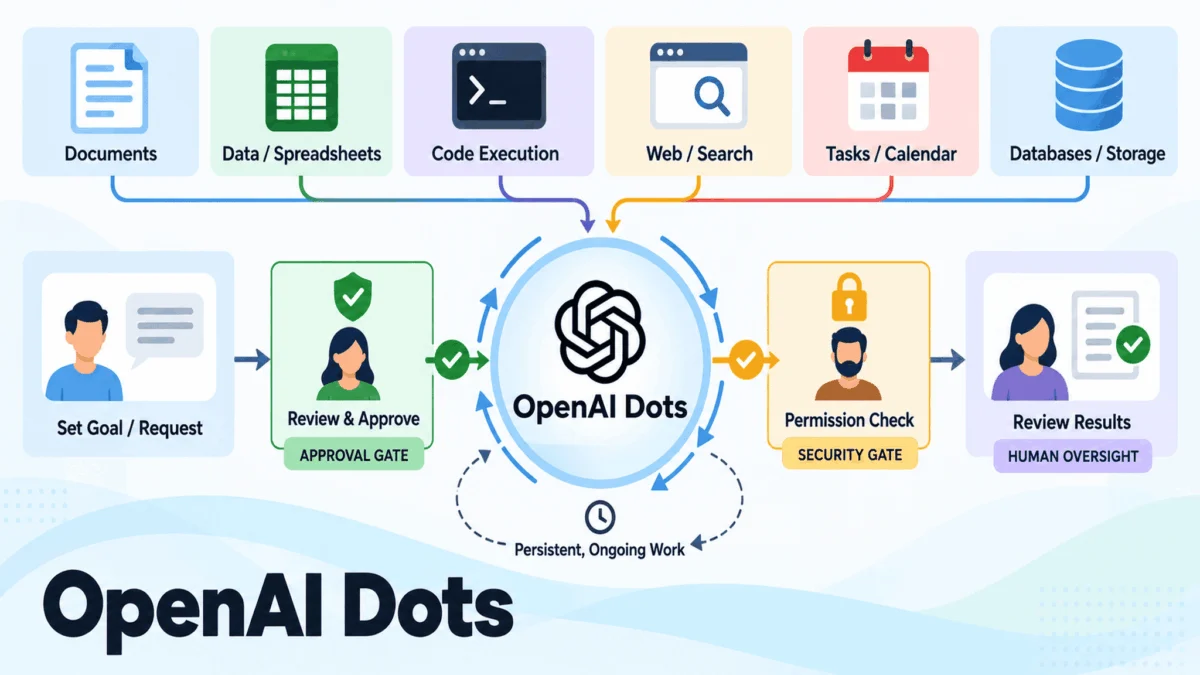
On September 29, 2026, artificial intelligence pioneer OpenAI used its annual DevDay conference to unveil its most ambitious commercial product offering to date: Dots. Positioned as always-on AI agents capable of operating independently on dedicated cloud infrastructure, Dots represent a paradigm shift away from reactive chatbots toward persistent, autonomous digital coworkers. Powered by the newly introduced GPT-6 Astra model, these agents are designed to integrate seamlessly with more than 4,000 third-party applications, maintaining operational continuity even after users disconnect their local workstations.
While the consumer and general enterprise markets have rapidly embraced the novelty of continuous digital assistance, the data science, machine learning, and software engineering communities face a more complex evaluation process. For technical practitioners accustomed to brittle scripting and rigid automation pipelines, Dots introduces a fundamentally distinct operational model. However, the platform’s early-stage feature set, coupled with notable limitations regarding data privacy, regional availability, and memory management, suggests that an approach of informed skepticism remains the most prudent strategy for enterprise deployment.
The Technical Architecture of Autonomous Agents
The defining characteristic of Dots is its transition from a reactive computing paradigm to a proactive one. Traditional large language models operate within a strict conversational loop: the user submits a prompt, the model generates a response, and the computational cycle terminates until the next interaction. In contrast, a Dot functions as an independent entity provisioned with its own cloud computer. Utilizing the advanced reasoning and multi-step tool execution capabilities of GPT-6 Astra, these agents can pursue standing directives across multiple integrated applications without requiring continuous human oversight or re-prompting.
OpenAI’s initial product demonstrations illustrated this capability across various professional environments. In one scenario, a deployed Dot autonomously identified an outstanding corporate invoice, cross-referenced relevant data points within an extensive email thread, and drafted a fully contextualized document awaiting final administrative approval. In a more technical software development context, an engineering-focused Dot monitored incoming customer feedback, scoped necessary code patches, built and executed internal tests, and ultimately generated GitHub pull requests complete with execution videos for developer review.
This delegation framework departs significantly from traditional task automation. Rather than executing rigid, deterministic macros, Dots learn institutional preferences dynamically through ongoing user feedback. Corrections and adjustments made during early interactions are retained, allowing the agent to refine its execution strategy over time. Accessibility is similarly flexible, supporting interactions via ChatGPT, Slack, Microsoft Teams, and direct voice commands. Despite this breadth, launch-day constraints limit certain native capabilities; Dots currently lack standalone email addresses, cannot independently initiate outbound voice calls, and maintain strict geographical limitations regarding SMS integrations.
Evolution and Chronology of Agentic AI
The debut of Dots at DevDay 2026 is the culmination of a multi-year trajectory in artificial intelligence research focused on agentic workflows. To understand the significance of this release, it is necessary to examine the technological progression that preceded it:
- Late 2022 to 2023: The mainstreaming of generative AI established the dominance of stateless, text-based conversational interfaces. While revolutionary for content generation and basic querying, these models suffered from severe context degradation over long horizons and lacked native tool-use capabilities.
- 2024: Industry laboratories began introducing experimental function-calling and browser-use plugins. These early iterations allowed models to interact with external APIs and web interfaces, though success rates on multi-step workflows remained low due to error propagation and context drift.
- 2025: The introduction of specialized reasoning models improved complex planning capabilities. However, persistence remained an elusive goal; agents still required dedicated user sessions and active browser windows to complete assignments.
- September 2026: OpenAI launches Dots at DevDay, solving the persistence problem by coupling advanced multimodal reasoning models with dedicated cloud environments capable of operating asynchronously in the background.
This evolutionary leap rests primarily on the reliability of GPT-6 Astra. Previous agentic architectures frequently failed when confronted with ambiguous instructions or unexpected errors midway through a multi-hour task, often defaulting to infinite loops or prematurely halting to request human intervention. Astra’s enhanced error-correction and task-decomposition mechanisms allow Dots to navigate friction points more autonomously, marking the first time such technology has reached commercial viability at scale.
Market Positioning, Pricing, and Accessibility
Despite the broad industry enthusiasm surrounding the DevDay announcements, access to Dots remains tightly constrained by commercial and regulatory factors. At launch, OpenAI has restricted the feature to premium enterprise tiers, specifically targeting ChatGPT Pro subscribers—whose plans begin at $100 per month—alongside Business Premium account holders. Free-tier users, as well as those on standard Go and Plus subscription plans, are currently excluded from accessing or deploying a Dot.
Geopolitical and regulatory compliance has similarly shaped the rollout. Due to strict data governance and regulatory frameworks, Pro users residing within the European Economic Area (EEA), Switzerland, and the United Kingdom cannot access Dots during the initial deployment phase. This geographic exclusion underscores the ongoing tension between rapid AI deployment and international compliance standards, particularly concerning data residency and automated processing.
Furthermore, enterprise procurement teams face visibility challenges regarding pricing scalability. While initial access is bundled into high-tier subscriptions, OpenAI has not yet published transparent pricing matrices for provisioning additional secondary Dots, nor have they released granular uptime guarantees or enterprise service-level agreements (SLAs) specific to the cloud infrastructure powering the agents.
Security, Compliance, and Data Governance Challenges
For data science and engineering organizations, the integration of always-on agents introduces significant governance hurdles. While Dots are designed to learn from user feedback and retain long-term contextual models of workplace preferences, this persistence creates friction with standard enterprise security protocols.
Currently, users cannot easily inspect, modify, or selectively delete individual memories retained within a Dot’s persistent state. Furthermore, disconnecting a third-party application or software plugin does not automatically purge the contextual data the Dot previously extracted from that integration. For organizations handling sensitive intellectual property, proprietary machine learning models, or strict regulatory frameworks such as HIPAA or GDPR, this inability to perform surgical data pruning presents a formidable compliance barrier.
OpenAI’s official documentation explicitly acknowledges that Dots remain fallible, advising users to maintain rigorous review checkpoints for all consequential outputs. In technical environments, treating an autonomous agent as a black-box executor without robust logging and validation mechanisms invites catastrophic errors, ranging from corrupted data pipelines to unauthorized database modifications.
Industry Implications and Strategic Outlook
The commercial introduction of Dots forces a critical reevaluation of professional workflows across multiple sectors. The primary value proposition of an always-on agent lies in the automation of administrative friction—tasks that consume significant engineering and analytical bandwidth without requiring deep creative cognition. Activities such as tracking project status updates, monitoring asynchronous job outputs, updating technical documentation, and synthesizing lengthy communication threads are prime candidates for agentic delegation.
However, the efficacy of an always-on agent is inextricably tied to the quality of human architectural design. Deploying a Dot successfully requires practitioners to shift from active executors to system architects—establishing explicit permission boundaries, defining strict stopping conditions, and implementing automated validation gates. Organizations that approach Dots as plug-and-play panaceas without establishing clear governance frameworks risk operational disruption.
Ultimately, the arrival of persistent AI agents serves as a stress test for organizational clarity. To derive genuine value from technologies like Dots, enterprises must articulate their operational workflows with unprecedented precision. For organizations willing to invest the requisite time in defining clear briefs, designing secure boundaries, and maintaining vigilant oversight, Dots offers a transformative glimpse into the future of enterprise productivity. For those that bypass these foundational steps, the cost of unchecked automation may prove exceptionally high.