The human nervous system is defined by a peculiar asymmetry: the left hemisphere of the brain governs the right side of the body, while the right hemisphere oversees the left. This "contralateral" organization has long perplexed anatomists, as it requires complex neural crossings that seem, at first glance, to be a logistical inefficiency. However, new research conducted by Dr. Martin Wessendorf of the University of Minnesota and cognitive neuroscientist Daniel Wang suggests that this architecture is not a random quirk of anatomy. Instead, it is an evolutionary inheritance, a "neural legacy" that traces its origins back over 500 million years to the earliest vertebrates.
Published in the journal Frontiers in Neuroanatomy, the study posits that the crossed-wiring of our motor and sensory systems was not initially designed for limb control, but was instead an architectural byproduct of an ancient, highly conserved visual system. By examining neural circuits in tetrapods—four-limbed animals including mammals, birds, reptiles, and amphibians—the researchers have mapped a timeline of development that suggests the brain’s current structural layout was "locked in" long before the emergence of complex terrestrial life.
The Primacy of the Visual System
To understand why the brain connects to the opposite side of the body, one must first look at the eyes. When light enters the eye, it is inverted by the lens, projecting the right side of the visual field onto the left side of the retina, and vice versa. This spatial reversal necessitates that the brain flip the information back to create a coherent representation of the world.
At the optic chiasm—the point where the two optic nerves meet and cross—visual information is bifurcated. Data from the right visual field is routed to the left hemisphere, and data from the left field is routed to the right. This routing is directed toward the optic tectum (known as the superior colliculus in mammals), an ancient midbrain structure present in every vertebrate species. Because the optic tectum is responsible for rapid, reflex-based responses to environmental stimuli—such as a sudden movement or a loud noise—it served as a foundational "processing hub" for early vertebrates.
The researchers argue that because this visual circuit was the first to establish a crossed architecture, later-evolving sensory and motor pathways likely "tethered" themselves to this existing map. By piggybacking on the established circuitry of the optic tectum, newer evolutionary developments were able to save energy and biological resources, effectively adopting a "plug-and-play" strategy rather than reinventing the neural architecture from scratch.
Chronology of an Evolutionary Inheritance
The timeline of this development is vast. The researchers identify the Cambrian Period, roughly 538 to 486 million years ago, as the likely genesis of this crossed-wiring system. During this era, primitive jawless fish—the ancestors of all vertebrates—developed the optic chiasm and the optic tectum.
The progression of these neural pathways follows a distinct evolutionary trajectory:
- Cambrian Period (500+ Million Years Ago): The emergence of the optic chiasm and optic tectum in early jawless fish establishes the fundamental "crossed" map for visual processing.
- Early Devonian Period (Approx. 400 Million Years Ago): The spinothalamic tract, responsible for pain and temperature sensations, begins to cross the midline within the spinal cord. Evidence of this is found in early cartilaginous fish like sharks and rays.
- Carboniferous Period (Approx. 300 Million Years Ago): The dorsal column pathway, which carries refined sensory data like vibration and touch, emerges in the common ancestor of tetrapods.
- The Rise of Mammals (200 Million Years Ago to Present): The refinement of the corticospinal tract, which allows for sophisticated fine motor control, develops as a modification of earlier sensory regulation circuits.
Mapping the Sensory and Motor Circuits
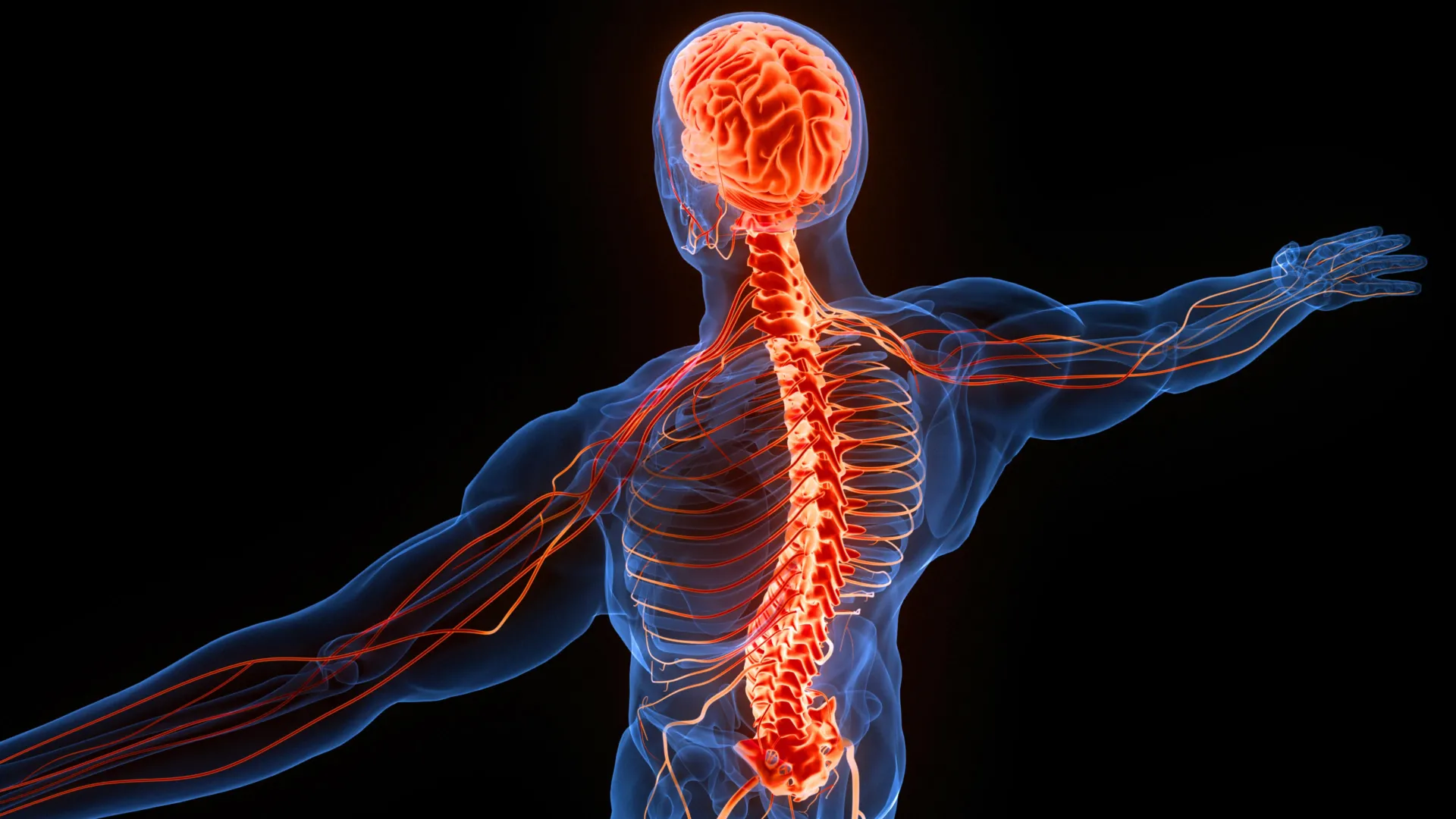
The study identifies two primary sensory pathways that confirm this crossed-wiring: the dorsal column pathway and the spinothalamic tract. The dorsal column pathway is a classic example of neural efficiency; it carries information about touch and body position up through the spinal cord, crossing over to the opposite side only once it reaches the brainstem. This pathway is a defining feature of all tetrapods, indicating that once the crossing was established in terrestrial ancestors, it became a fixed biological standard.
The spinothalamic tract, which handles pain and itching, crosses the midline at the spinal cord level. Its existence in both modern mammals and ancient cartilaginous fish suggests that this specific form of contralateral connectivity is among the oldest in the vertebrate lineage.
In terms of movement, the tectospinal and rubrospinal pathways illustrate how the brain translates these maps into action. The tectospinal pathway is directly linked to the optic tectum; it allows an animal to instinctively turn its head toward a sudden stimulus. The rubrospinal pathway, originating in the red nucleus of the midbrain, provides a more nuanced control of limbs. Both pathways exhibit the same crossed-wiring, confirming that the "opposite-side control" model is consistent across both sensory input and motor output.
The Corticospinal Tract and Human Fine Motor Skills
Perhaps the most significant aspect of the study is its analysis of the corticospinal tract, which is responsible for the fine motor movements of human fingers. Unlike the more ancient pathways, the corticospinal tract is a product of the cerebral cortex—the six-layered structure unique to mammals.
The researchers suggest that in early mammals, this tract was primarily used for regulating sensory input. Over time, evolution repurposed this pathway to govern skeletal muscle movement. This is a critical insight: humans did not evolve a completely new neural system for dexterous tasks like writing or playing a musical instrument. Instead, we adapted a preexisting sensory-regulatory circuit, effectively "upcycling" a neural pathway that had been crossed for millions of years. This explains why our motor control remains tied to the contralateral hemisphere—it is bound by the structural constraints of the systems that preceded it.
Implications and Scientific Analysis
The hypothesis presented by Wessendorf and Wang challenges the "adaptationist" view of evolution, which often assumes that if a biological structure exists, it must have provided a direct, unique survival advantage. The authors argue that the crossed-wiring of the brain may not be "better" than a straight-wired system; rather, it is a byproduct of historical contingency. Once the brain’s "operating system" was built on the crossed visual map of the Cambrian Period, it became significantly more efficient for subsequent pathways to follow that established template than to evolve a novel, uncrossed configuration.
The implications for neuroscience are profound. If the brain’s fundamental wiring is dictated by the constraints of 500-million-year-old sensory structures, then many neurological disorders—and our understanding of neural recovery—must be viewed through the lens of evolutionary history. When neural pathways are damaged, the brain’s ability to "re-route" signals is limited by these ancient, non-negotiable architectural maps.
Furthermore, this study provides a new roadmap for paleoneurobiology. By analyzing fossilized skulls of early vertebrates, scientists may be able to identify the exact point at which the optic chiasm evolved, providing physical evidence to support the timeline proposed by Wessendorf and Wang.
Conclusion
The "crossed-brain" phenomenon is a testament to the conservatism of evolution. While the human brain is capable of extraordinary feats of language, abstract thought, and delicate physical precision, these functions operate within a structural framework established in the shallow seas of the Cambrian Period. The internal map of our nervous system is a living archive, preserving the visual and motor strategies of our earliest ancestors. In the grand scheme of biology, our ability to use our hands and perceive our surroundings is inextricably linked to the visual reflexes of creatures that navigated a vastly different world half a billion years ago. The brain, it seems, is not merely a modern machine, but a complex, layered testament to a half-billion-year-old evolutionary blueprint.