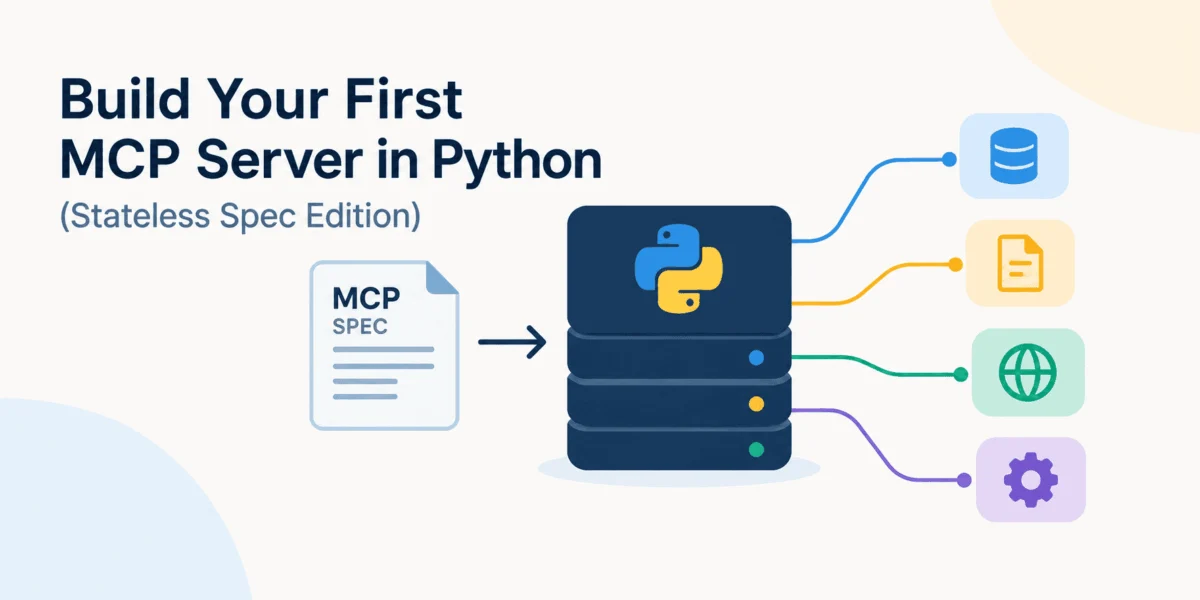
The landscape of artificial intelligence infrastructure experienced a pivotal evolution with the architectural overhaul of the Model Context Protocol (MCP). Spearheaded by foundational updates introduced in the mid-2026 specification, the core of the protocol transitioned from a stateful, session-dependent framework to a fully stateless request-response model. This structural shift fundamentally alters how modern large language model (LLM) clients interact with backend systems, eliminating the mandatory protocol handshake and the reliance on session identifiers such as Mcp-Session-Id for standard requests. Consequently, developers can deploy, manage, and scale MCP servers behind conventional enterprise-grade HTTP load balancers and infrastructure without the historical friction of sticky routing.
Concurrent with this architectural milestone, the official Python SDK transitioned to version 2 as its primary stable distribution line. This release introduced the high-level MCPServer application programming interface, designed to streamline the exposure of foundational protocol primitives—tools, resources, and prompts—using standard, idiomatic Python functions and native type hints. As organizations increasingly adopt agentic workflows and retrieval-augmented generation (RAG) pipelines, the ability to rapidly construct, inspect, and deploy robust MCP servers has become a critical competency for machine learning engineers and backend architects alike.
Background Context and Evolution of the Model Context Protocol
The Model Context Protocol was originally conceived to standardize the integration layer between AI models, client applications, and external data sources or execution environments. In its earliest iterations, the protocol relied heavily on stateful connection handling. Clients were required to establish a dedicated protocol session with a server prior to executing any commands. This design, while suitable for localized development environments and tightly coupled desktop clients, introduced significant operational overhead in distributed, cloud-native deployments. Maintaining session continuity across multiple microservice replicas demanded specialized infrastructure, including sticky sessions and centralized state management stores.
Recognizing these scalability bottlenecks, the protocol maintainers revised the specification on July 28, 2026. The updated standard decoupled individual requests from persistent connection states. Under the current specification, every incoming request contains all necessary contextual parameters required for processing, aligning MCP with standard stateless HTTP paradigms. This evolution addresses the long-standing enterprise requirement for horizontal scalability, allowing server fleets to handle requests across disparate worker nodes dynamically and reliably.
Architecting a Stateless Developer Knowledge-Base Server
To demonstrate the capabilities of the v2 Python SDK and the stateless protocol specification, developers can construct a modular developer support knowledge-base server. This practical application exposes three distinct MCP primitives: a tool for searching internal documentation, a resource for listing available articles, and a prompt template for generating standardized customer support replies.
The implementation requires minimal boilerplate. Utilizing modern Python packaging tools such as Astral’s uv or standard pip, developers can initialize a project environment supporting Python 3.10 or newer. By installing the mcp[cli] package, engineers gain immediate access to the command-line interface and the integrated MCP Inspector development utility.
mkdir first-mcp-server
cd first-mcp-server
uv init
uv add "mcp[cli]"
The resulting project architecture remains remarkably lean, typically consisting of a dedicated server script and a corresponding client verification script, devoid of complex framework dependencies.
Implementing Server Primitives via Python Type Hints
The core strength of the v2 Python SDK lies in its ability to introspect standard Python code to generate valid MCP schemas automatically. By leveraging native type hints and docstrings, developers avoid the manual authoring of verbose JSON schemas or explicit tool manifests.
Consider the implementation of an interactive search tool within server.py:
from mcp.server import MCPServer

mcp = MCPServer(
    "Developer Support KB",
    instructions=(
        "Use the knowledge-base tools to answer support questions. "
        "Prefer retrieved KB information over guessing."
    ),
)

ARTICLES = [

        "id": "python-env",
        "title": "Creating a Python virtual environment",
        "body": (
            "Create a virtual environment with `python -m venv .venv`, "
            "then activate it before installing dependencies."
        ),
    ,

        "id": "reset-password",
        "title": "Resetting your password",
        "body": (
            "Open Account Settings, choose Security, and select "
            "Reset Password. A verification email will be sent."
        ),
    ,

        "id": "api-rate-limit",
        "title": "Understanding API rate limits",
        "body": (
            "API rate limits restrict the number of requests allowed "
            "within a time window. Clients should retry using "
            "exponential backoff after receiving a rate-limit response."
        ),
    ,
]

@mcp.tool()
def search_kb(
    query: str,
    limit: int = 3,
) -> list[dict[str, str]]:
    """Search the support knowledge base."""
    query = query.lower()
    matches = []
    for article in ARTICLES:
        searchable_text = (
            article["title"] + " " + article["body"]
        ).lower()
        if query in searchable_text:
            matches.append(article)
    return matches[:limit]

@mcp.resource("kb://articles")
def list_articles() -> str:
    """Return the available knowledge-base articles."""
    return "n".join(
        f"article['id']: article['title']"
        for article in ARTICLES
    )

@mcp.prompt()
def draft_support_reply(
    customer_message: str,
) -> str:
    """Create a support-response prompt."""
    return f"""
You are a technical support assistant.

Write a concise and helpful response to this customer message:

customer_message

Use the support knowledge base when relevant.
Do not invent product policies.
""".strip()

if __name__ == "__main__":
    mcp.run("streamable-http")
In this architecture, the search_kb function functions as an action-oriented tool analogous to an HTTP POST request, where the model dynamically determines execution parameters based on user queries. Conversely, resources such as kb://articles operate similarly to GET requests, exposing readable data structures that host applications can inject directly into the model’s context window without active model invocation. Prompt templates provide standardized scaffolding for user interactions, ensuring consistent output generation across disparate sessions.
Local Inspection and Validation Workflows
The official Python SDK provides an integrated development workflow through the MCP Inspector utility. By executing the development command within the terminal environment:
uv run mcp dev server.pyDevelopers are provided with a web-based graphical interface connected to their local server instance. This environment enables real-time inspection of available tools, resource schemas, and prompt definitions. Engineers can execute test payloads—such as querying rate-limiting documentation—to verify schema compliance and payload handling prior to production deployment.
For production-grade HTTP deployments, the server can be executed directly via Python or integrated into standard ASGI web frameworks. Utilizing the built-in Streamable HTTP transport layer:
uv run python server.pyExposes the endpoint at http://127.0.0.1:8000/mcp by default. For enterprises requiring integration with robust web frameworks like FastAPI or Starlette, the server instance can export a standard ASGI application via mcp.streamable_http_app(), enabling seamless deployment behind production ASGI servers such as Uvicorn:
app = mcp.streamable_http_app()uvicorn server:app --workers 4Handling Application State in a Stateless Protocol Environment
A common point of confusion among engineers transitioning to the updated specification is the distinction between protocol-level state and application-level state. While the MCP protocol core is strictly stateless, enterprise applications frequently require session persistence, shopping carts, or authenticated user contexts.
The protocol maintainers recommend an explicit-handle design pattern to manage state at the application tier. Rather than relying on hidden protocol identifiers managed by the transport layer, applications expose explicit parameters that travel with the request. For instance, a stateful interaction such as shopping basket management is handled by passing explicit identifiers like basket_id directly through tool arguments. This architectural separation ensures that the underlying transport remains completely stateless, permitting horizontal scaling and load balancing without session affinity constraints, while the application logic retains full transactional integrity.
Broader Industry Implications and Future Outlook
The transition to a stateless Model Context Protocol specification marks a mature maturation phase for AI application development infrastructure. By removing the technical debt associated with persistent protocol sessions, the developer ecosystem can more easily integrate AI agents into existing microservice architectures, enterprise service meshes, and cloud-native Kubernetes clusters.
The synergy between the v2 Python SDK and the updated protocol specification lowers the barrier to entry for developers seeking to build customized, secure, and performant AI tooling. As organizations increasingly deploy multi-agent systems and specialized retrieval engines, the standardization of stateless context exchange ensures that AI infrastructure can scale reliably alongside traditional web applications, paving the way for wider enterprise adoption of generative AI technologies.