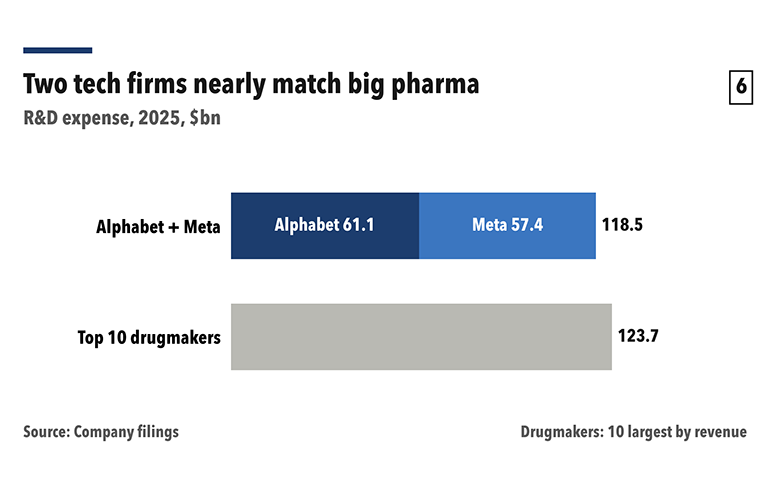
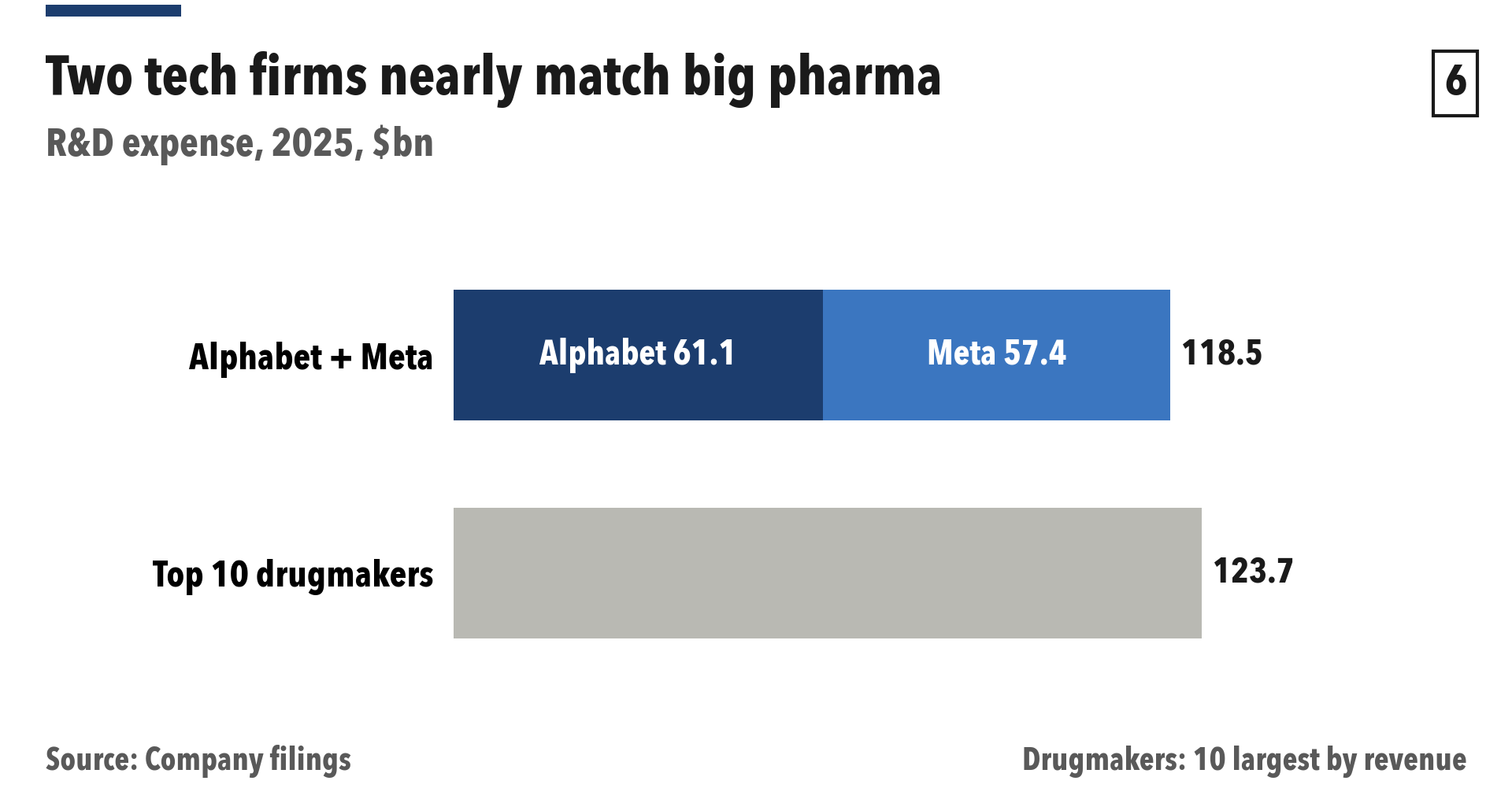
The landscape of global research and development is undergoing a seismic shift as the financial muscle of Big Tech begins to rival, and in some metrics surpass, the traditional dominance of the pharmaceutical industry. In 2025, Google parent Alphabet and Meta reported a combined $118.5 billion in R&D expenditure. This figure sits in striking proximity to the $123.7 billion collective investment of the 10 largest drugmakers by revenue—a group that includes industry titans such as Johnson & Johnson, Roche, Merck, and Bristol Myers Squibb.
This convergence of capital marks more than just a fiscal milestone; it signals the end of an era where drug discovery was the exclusive domain of life sciences firms. Today, the most significant breakthroughs in molecular design, protein folding, and clinical trial optimization are increasingly being engineered in the server farms of Silicon Valley.
A Decadal Reversal of Fortunes
To understand the magnitude of this transition, one must look back at the fiscal landscape of 2013. At that time, the research priorities of Big Tech and Big Pharma were distinct, with limited overlap. In 2013, Merck & Co. reported an R&D expenditure of $7.5 billion, a figure that narrowly exceeded Google’s investment of $7.1 billion. The parity suggested two parallel tracks of innovation.
By 2025, those tracks have not only converged but have been drastically realigned. Alphabet’s R&D spend has ballooned to $61.1 billion, representing a massive scaling of its computational infrastructure and AI-driven life sciences initiatives. In contrast, Merck’s R&D spend stood at $15.8 billion. While pharma companies have continued to increase their budgets, their growth rate is dwarfed by the exponential spending of the technology giants, who are now pouring tens of billions into the underlying infrastructure of the next biological revolution.
The Infrastructure of the AI-Driven Lab
The current era of drug discovery is defined by the integration of high-performance computing (HPC) directly into the pharmaceutical pipeline. This is no longer merely about outsourcing data storage to the cloud; it is about bringing the "AI Factory" on-premises.
Eli Lilly has been at the forefront of this physical integration. In February 2026, the company brought its "LillyPod" supercomputer online in Indianapolis. Developed in partnership with NVIDIA, the system was assembled in just four months. The facility now runs NVIDIA’s 550-billion-parameter Nemotron 3 Ultra model locally, providing researchers with virtually unlimited token capacity for simulation and analysis. According to Chief AI Officer Thomas Fuchs, the system has already successfully co-designed a small-molecule candidate featuring a novel chemical fragment—a feat that would have taken traditional wet-lab processes years to validate.
The partnership between hardware providers and drugmakers has become the standard. In January, Lilly and NVIDIA deepened their collaboration with a $1 billion, five-year commitment to a Bay Area co-innovation lab. Similarly, Roche announced in March that it had expanded its local compute capacity by installing 2,176 Blackwell GPUs on-site, bringing its total operational capacity above 3,500 GPUs. Bristol Myers Squibb is following suit, currently developing its second major NVIDIA-based supercomputer, building upon the operational success of its first DGX SuperPOD, which has been in use for nearly three years.
The Rise of Frontier AI Labs in Biology
While tech giants provide the compute, Frontier AI labs are moving rapidly to capture the "intelligence" layer of the pharmaceutical value chain. Anthropic, a leader in large language models, has transitioned from a software provider to a potential competitor.
The company has established a dedicated wet lab in the San Francisco Bay Area. While the company maintains that the lab is not exclusively for drug discovery, the move into physical biology is a clear signal of intent. In June 2026, Anthropic announced it would leverage its models to lead preclinical programs in disease areas that have historically been neglected by Big Pharma due to low profit margins. This strategy is bolstered by its partnership with Basecamp Research, utilizing EDEN biological models to accelerate antibiotic discovery and vaccine design.
The acquisition of Coefficient Bio, a New York-based startup founded by former Genentech computational biologists, for approximately $400 million, further underscores Anthropic’s commitment. By appointing Novartis CEO Vas Narasimhan to its board, Anthropic has effectively bridged the gap between silicon-based intelligence and the clinical rigors of the pharmaceutical industry.
Enterprise Adoption: Claude and GPT as Research Partners
The adoption of generative AI at the enterprise level is now pervasive across the life sciences sector. Large language models (LLMs) are being integrated into the core workflows of global drug companies, from early-stage discovery to manufacturing and commercialization.
Genmab initiated the trend in January 2026, announcing the development of custom agents powered by Anthropic’s Claude to expedite clinical development. Bristol Myers Squibb has since scaled this effort, deploying Claude Enterprise to over 30,000 employees. The platform serves as a shared intelligence hub, facilitating cross-departmental communication and complex data synthesis.
Novo Nordisk, perhaps the most aggressive adopter of this year, has pursued a "multi-vendor" strategy. In April, the company signed a major enterprise partnership with OpenAI, followed by an AWS agreement in August, and finally, a collaboration with Anthropic in September. Novo is currently testing Claude Science—a specialized research workbench—to streamline its R&D workflows.
Simultaneously, OpenAI has launched GPT-Rosalind, a purpose-built life sciences model designed for high-stakes research environments. Early adopters include Amgen and Moderna, firms that view such models as critical to maintaining their competitive edge in vaccine and biologic development.
The Role of Isomorphic Labs
Alphabet’s own dedicated drug-discovery arm, Isomorphic Labs, continues to serve as the benchmark for AI-native medicine. With a $2.1 billion funding round completed in May, the company has secured the resources necessary to pursue a long-term vision of de novo drug design.
Isomorphic Labs has successfully integrated into the existing ecosystem through strategic collaborations with Johnson & Johnson, Lilly, and Novartis. While the company has opted to defer its clinical-stage milestones to the end of 2026 to ensure the maturity of its models, its presence has forced traditional pharma to reconsider the viability of their own internal, non-AI-integrated pipelines.
Implications for the Future of Healthcare
The implications of this convergence are profound. For the pharmaceutical industry, the reliance on Big Tech for compute, model training, and analytical support represents a fundamental shift in control. The traditional "gatekeeper" status of the drugmaker is being challenged by tech firms that possess more data, more compute, and, in many cases, more advanced AI research capabilities.
However, this is not a zero-sum game. The current trajectory suggests a symbiotic future:
- Accelerated Timelines: The integration of AI agents and supercomputing is expected to reduce the time-to-clinic for new drug candidates by years, potentially lowering the astronomical costs of clinical trials.
- Economic Rebalancing: As tech companies increase their R&D spending, the "cost of entry" for innovative drug discovery is rising. Smaller biotech firms may struggle to keep pace without partnering with one of the major tech-pharma alliances.
- Regulatory Challenges: As AI-designed candidates move into clinical trials, regulatory bodies like the FDA will face new challenges in validating the "black box" logic behind the drug development process.
The data indicates that the 2025-2026 period will be remembered as the point of no return. The separation between software and medicine has evaporated. As the R&D budgets of Meta and Alphabet continue to swell, they are effectively subsidizing the future of global health, turning the pharmaceutical industry into a high-tech sector where success is measured as much by parameter counts as by clinical outcomes. The era of the "AI-Pharma hybrid" is not coming—it is already here.