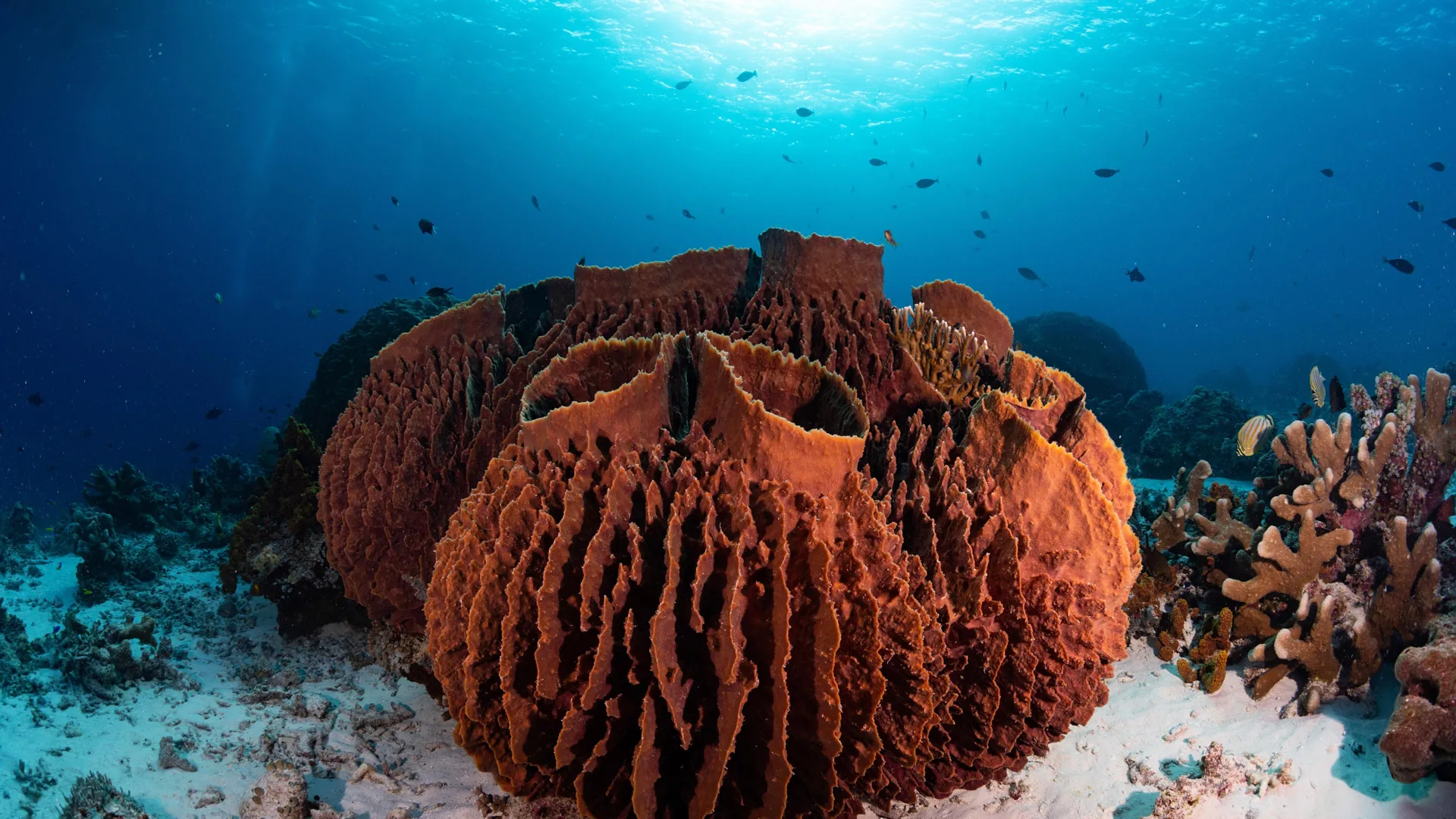
Researchers at MIT have uncovered compelling new chemical clues embedded within exceptionally ancient rocks, strongly suggesting that some of the very first animals to inhabit Earth were likely the ancestors of modern sea sponges. This groundbreaking discovery, published in the prestigious journal Proceedings of the National Academy of Sciences, offers a significant leap forward in our understanding of early animal evolution, pushing the timeline for complex life back further than previously confirmed.
Unearthing Ancient Molecular Signatures
The scientific team, led by Dr. Lubna Shawar, a former Crosby Postdoctoral Fellow at MIT’s Department of Earth, Atmospheric and Planetary Sciences (EAPS) and now a research scientist at Caltech, analyzed sedimentary rocks exceeding 541 million years in age. These rocks, dating back to the Ediacaran Period (approximately 635 to 541 million years ago), just before the dramatic diversification of animal life known as the Cambrian Explosion, yielded what are known as "chemical fossils." These are not fossilized remains of entire organisms, but rather the preserved molecular fingerprints—biological molecules—that were once part of living entities. Over vast geological timescales, these molecules were buried, transformed by heat and pressure, and locked within the rock strata, acting as enduring witnesses to ancient biological activity.
The core of this investigation lies in the identification and analysis of specific molecules belonging to the sterane group. Steranes are remarkably stable remnants of sterols, which are essential lipid molecules found in the cell membranes of complex life forms, including animals. Cholesterol, a well-known sterol, is a prime example. By meticulously dissecting the intricate chemical structures of these ancient steranes, the researchers were able to link them to a particular lineage of sponges: demosponges. Today, demosponges represent the most diverse and widespread group of sea sponges, inhabiting oceans across the globe in a vast array of forms, sizes, and colors. They are characterized by their soft bodies and their role as filter feeders, drawing sustenance from the water column. The implications are profound: the ancient relatives of these modern sponges were likely similar—soft-bodied marine organisms, existing in the primordial oceans.
Professor Roger Summons, the Schlumberger Professor of Geobiology Emeritus in MIT’s EAPS department and a senior author on the study, elaborated on the nature of these early life forms. "We don’t know exactly what these organisms would have looked like back then, but they absolutely would have lived in the ocean, they would have been soft-bodied, and we presume they didn’t have a silica skeleton," Professor Summons stated. This distinction is significant, as many modern sponges possess intricate skeletons made of silica spicules. The absence of evidence for such structures in these early chemical fossils further supports the idea of a simpler, softer-bodied ancestral form.
Revisiting and Reinforcing a Landmark Discovery
This latest research represents a crucial refinement and strengthening of findings first published by the same research group in 2009. In that earlier study, the scientists examined rocks from an outcrop in Oman, also from the Ediacaran Period. They detected an unusually high concentration of steranes derived from 30-carbon (C30) sterols. At the time, these rare steroid molecules were tentatively linked to ancient sea sponges. The initial findings in 2009 suggested that sponges may have predated the Cambrian explosion, potentially ranking among the planet’s earliest animal phyla.
However, these initial conclusions were met with some scientific skepticism. Alternative hypotheses were proposed, suggesting that the C30 steranes might have originated from other types of organisms or, more controversially, could have been formed through non-biological geological processes, challenging their status as definitive biomarkers of life. The current study directly addresses these doubts by introducing a second, highly specific chemical signature that significantly bolsters the sponge hypothesis.
The Significance of Rare Sterols in the Search for Early Life
The researchers employed a multi-faceted approach, examining Ediacaran-age rocks sourced from drill cores and outcrops in geographically diverse locations including Oman, western India, and Siberia. Their focus remained on steranes, the geologically stable derivatives of sterols. Sterols are fundamental components of cell membranes in all eukaryotes—organisms characterized by having a nucleus and other membrane-bound organelles, a group that encompasses plants, animals, fungi, and protists. As Professor Summons explained, "You’re not a eukaryote if you don’t have sterols or comparable membrane lipids."
The core structure of all sterols consists of four interconnected carbon rings. However, the specific modifications to this core structure, such as the addition of carbon side chains and other chemical groups, are dictated by an organism’s genetic makeup. Human cholesterol, for instance, has a 27-carbon backbone (C27), while sterols commonly found in plants typically have 29 carbons (C29).
"It’s very unusual to find a sterol with 30 carbons," noted Dr. Shawar. The earlier 2009 research had identified a C30 sterol linked to a specific enzyme, encoded by a gene that is known to be common in demosponges. This enzyme plays a crucial role in the synthesis of these unusual sterols. In their new analysis, the team made a critical realization: the same gene responsible for producing C30 sterols could also yield an even rarer variant, a 31-carbon sterol (C31).
Upon re-examining their meticulously collected rock samples, the researchers discovered the presence of abundant C31 steranes, co-occurring with the previously identified C30 forms. "These special steranes were there all along," Dr. Shawar remarked. "It took asking the right questions to seek them out and to really understand their meaning and from where they come." The concurrent detection of both C30 and C31 steranes, molecules with a strong genetic link to demosponges, significantly strengthens the argument for their biological origin from these early animal ancestors.
Rigorous Laboratory Validation of Biological Origin
To unequivocally confirm the biological source of these ancient steranes, the research team embarked on a series of rigorous laboratory experiments. They began by studying living demosponges, confirming that some modern species indeed produce C31 sterols, the direct biological precursors to the C31 steranes found preserved in the ancient rocks.
Following this, the scientists synthesized eight different C31 sterols in the laboratory. These synthesized molecules served as precise reference standards. The crucial step involved subjecting these synthesized sterols to conditions designed to mimic the geological processes of burial, heat, and pressure that would have occurred over millions of years. The goal was to observe how these molecules would transform under such conditions and then compare the resulting products with the C31 steranes extracted from the ancient rock samples.
The results were highly informative. Only two of the eight synthesized C31 sterols yielded transformation products that precisely matched the C31 steranes found in the Ediacaran rocks. The absence of transformation products from the other six synthesized sterols strongly indicated that the molecules found in the rocks were not the result of random, non-biological chemical reactions occurring in the natural environment. This differential transformation pattern provided a powerful constraint, effectively ruling out abiotic synthesis as the source of the detected steranes.
Convergence of Evidence: Rocks, Sponges, and Lab
The convergence of evidence from three distinct lines of inquiry—the chemical composition of ancient rocks, the biochemistry of modern sponges, and controlled laboratory experiments—provides a robust foundation for the study’s conclusion. The steranes identified in the rocks are overwhelmingly likely to have originated from living organisms, and those organisms were most plausibly the early ancestors of demosponges, which continue to exhibit the capacity to produce similar compounds today.
"It’s a combination of what’s in the rock, what’s in the sponge, and what you can make in a chemistry laboratory," Professor Summons emphasized. "You’ve got three supportive, mutually agreeing lines of evidence, pointing to these sponges being among the earliest animals on Earth." This integrated approach significantly enhances the confidence in the findings and addresses the earlier criticisms regarding the specificity of the biomarker.
Dr. Shawar further highlighted the methodological advancement: "In this study we show how to authenticate a biomarker, verifying that a signal truly comes from life rather than contamination or non-biological chemistry." This rigorous authentication process sets a new standard for identifying and interpreting ancient molecular fossils.
Expanding the Scope: Charting the Dawn of Animal Life
With the identification of C30 and C31 sterols as reliable chemical indicators of ancient sponges, the research team is poised to expand their search. They plan to analyze rocks from other geological formations and locations around the world to ascertain the distribution and temporal range of these early sponge ancestors. Thus far, the existing samples point to the presence of these sponge precursors during the Ediacaran Period. By gathering and analyzing more geological material, the scientists hope to pinpoint with greater precision the exact timing of the emergence of some of the planet’s very first animals.
This research was made possible through significant financial support from various institutions, including the MIT Crosby Fund, the Distinguished Postdoctoral Fellowship program, the Simons Foundation Collaboration on the Origins of Life, and the NASA Exobiology Program, underscoring the collaborative and well-funded nature of this important scientific endeavor. The implications of this discovery are far-reaching, offering a clearer glimpse into the enigmatic origins of animal life and the complex evolutionary pathways that shaped our planet’s biodiversity. It provides compelling evidence that the humble sea sponge, in its ancient, soft-bodied form, may have been a true pioneer, among the very first complex multicellular organisms to grace Earth’s oceans.