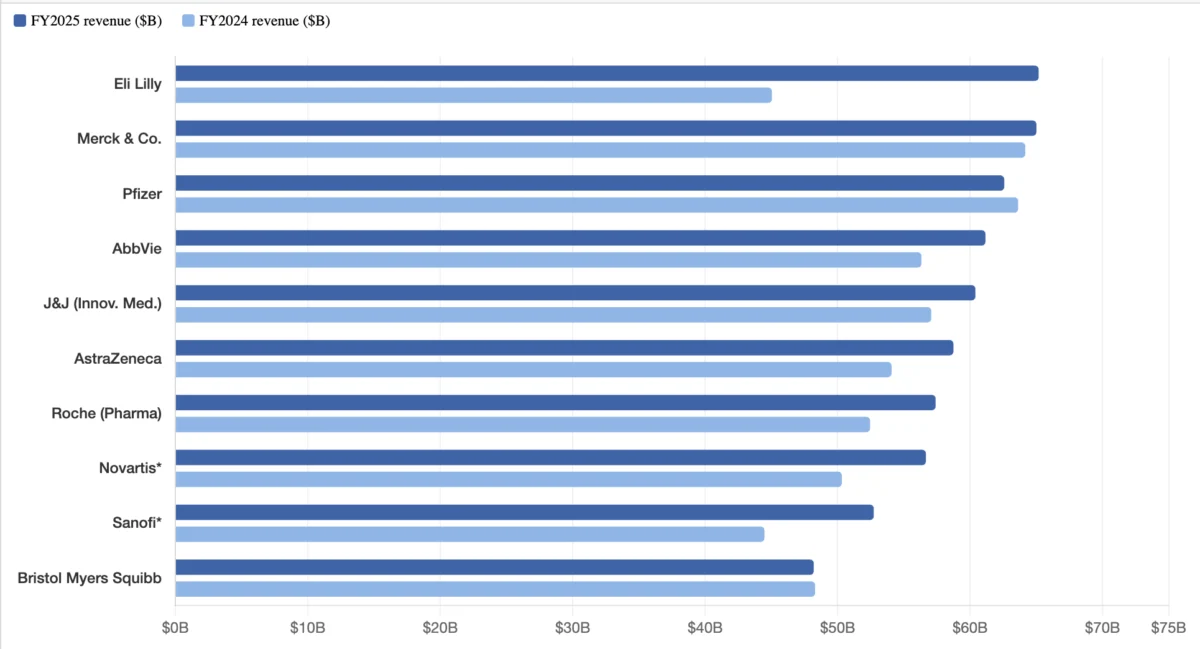
Eli Lilly and Company has officially ascended to the pinnacle of the global pharmaceutical industry, concluding fiscal year 2025 as the world’s leading pharma company by revenue. This landmark achievement, driven overwhelmingly by the unprecedented success of its tirzepatide franchise—Mounjaro and Zepbound—marks a significant shift in the competitive landscape, occurring a full year ahead of even the most optimistic projections. The company reported a staggering $65.2 billion in revenue for FY2025, narrowly surpassing long-standing industry titan Merck & Co., which posted $65.0 billion, by approximately $169 million. This remarkable financial performance represents an approximate 44.7% year-over-year revenue jump for Lilly, an increase of roughly $20.1 billion in a single year, predominantly fueled by the insatiable global demand for its innovative metabolic therapies.
A Rapid Ascent to the Summit: Unprecedented Growth Trajectory
Just a few short years ago, Eli Lilly, while a respected and historically significant pharmaceutical player, was not considered a front-runner for the top revenue spot. In 2020, the company’s reported revenue stood at $24.5 billion. The journey from that figure to $65.2 billion in just five years represents an astonishing near-tripling of its financial output, a growth rate virtually unparalleled in the mature pharmaceutical sector. This meteoric rise defied earlier industry predictions, including one in November 2024 that projected Lilly would likely overtake Merck by late 2026 under base-case assumptions. The reality has not only accelerated this timeline by a full year but also positioned Lilly’s 2026 guidance, ranging from $80 billion to $83 billion, well ahead of previous models that had estimated $77.2 billion. This trajectory underscores a fundamental reordering of pharmaceutical power dynamics, driven by a singular, transformative therapeutic class.
The Tirzepatide Powerhouse: Mounjaro and Zepbound Redefine Blockbuster Status
The engine behind Lilly’s explosive growth is unequivocally its tirzepatide franchise, comprising Mounjaro (for type 2 diabetes) and Zepbound (for chronic weight management). These two medications, both leveraging the dual GIP and GLP-1 receptor agonist mechanism, have collectively generated an astounding $36.5 billion in revenue in FY2025. Mounjaro, initially approved for type 2 diabetes, nearly doubled its sales, reaching $23.0 billion, a robust 99% year-over-year increase. Its counterpart, Zepbound, launched more recently for weight loss, demonstrated even more dramatic acceleration, nearly tripling its revenue to $13.5 billion, representing a phenomenal 175% year-over-year surge.
To contextualize the sheer scale of this achievement, the tirzepatide franchise alone now generates more annual revenue than entire, well-established pharmaceutical companies such as Bristol Myers Squibb or Sanofi. This level of single-franchise dominance is a rare phenomenon in the modern pharmaceutical era, reminiscent of the early days of certain revolutionary cancer or immunology drugs, but with an even broader patient population impact. The global prevalence of type 2 diabetes and obesity—conditions affecting hundreds of millions worldwide—has provided an immense market for these highly efficacious treatments, leading to unprecedented demand that Lilly has been working diligently to meet through significant manufacturing investments.
Understanding Tirzepatide: A Dual-Action Revolution
Tirzepatide’s success stems from its innovative mechanism of action. Unlike earlier GLP-1 receptor agonists (like semaglutide, found in Ozempic and Wegovy), tirzepatide acts as a dual agonist, activating both the glucose-dependent insulinotropic polypeptide (GIP) and glucagon-like peptide-1 (GLP-1) receptors. This dual agonism appears to confer enhanced benefits in both glycemic control and weight reduction.
- Mounjaro (Tirzepatide for Type 2 Diabetes): Approved by the FDA in May 2022, Mounjaro quickly established itself as a leading treatment for type 2 diabetes. Clinical trials demonstrated superior glycemic control and greater weight loss compared to existing GLP-1 agonists and basal insulin. Its rapid adoption reflected a significant unmet need for more effective and comprehensive diabetes management tools that also address associated comorbidities like obesity.
- Zepbound (Tirzepatide for Chronic Weight Management): Following its success in diabetes, tirzepatide received FDA approval for chronic weight management in adults with obesity or overweight with at least one weight-related comorbidity in November 2023. Marketed as Zepbound, it quickly became one of the most sought-after weight-loss medications, with clinical trials showing average weight reductions of over 20% in some participants. The drug’s efficacy has positioned it as a game-changer in the battle against the global obesity epidemic, a condition linked to numerous serious health issues.
The combination of these approvals and the widespread recognition of their clinical benefits has created a formidable market presence for Lilly, effectively transforming the company’s financial outlook and strategic direction.
The Evolving Pharmaceutical Landscape: Lilly’s Rise and Merck’s Stasis
Lilly’s ascendance contrasts sharply with the performance of Merck & Co., which saw its revenue remain essentially flat in FY2025, holding at $65.0 billion. While Merck remains a powerhouse with a robust portfolio, including its oncology blockbuster Keytruda, the lack of significant growth highlights the challenges even established giants face in sustaining momentum without new, major growth drivers. Merck has been actively investing in new therapeutic areas and acquisitions, but these efforts have yet to translate into the kind of immediate, dramatic revenue expansion seen at Lilly. The pharmaceutical industry is inherently dynamic, with companies constantly vying for market share through innovation, patent protection, and strategic maneuvers. Merck’s flat revenue, as noted on Eli Lilly’s investor relations website, underscores the intense competitive pressures and the critical importance of a continuously replenishing pipeline of groundbreaking therapies.
Other major pharmaceutical companies, such as Pfizer, Johnson & Johnson, Roche, and Novartis, continue to navigate their own challenges, including patent expirations for key drugs, the need for new product launches, and the ever-present pressure to deliver shareholder value. Lilly’s success serves as a powerful testament to the impact a truly innovative, high-demand product can have on a company’s standing within this fiercely competitive global market.
Broader Market Implications and Competitive Dynamics in the GLP-1 Space
Lilly’s leadership position is not just a company-specific victory; it has profound implications for the entire pharmaceutical sector. The success of tirzepatide has ignited a fervent race within the industry to develop new and improved metabolic drugs. Novo Nordisk, the pioneering force in the GLP-1 market with Ozempic (diabetes) and Wegovy (weight loss), remains a formidable competitor and is also experiencing significant growth. The "GLP-1 wars" are set to intensify, with numerous other companies in various stages of developing their own GIP/GLP-1 co-agonists, triple agonists, or orally administered alternatives.
This intense competition is expected to drive further innovation, potentially leading to even more effective treatments, improved side effect profiles, and greater accessibility for patients. However, it also raises questions about market saturation, pricing pressures, and the sustainability of such rapid growth rates in the long term. Manufacturing capacity remains a critical bottleneck, with both Lilly and Novo Nordisk investing billions to expand production to meet the unprecedented demand. Patient access, often hindered by insurance coverage limitations and high out-of-pocket costs, also remains a significant challenge that the industry and healthcare systems must address.
Financial and Investor Confidence: A New Benchmark
Lilly’s financial performance has undoubtedly bolstered investor confidence, contributing to its robust market valuation, which was already a subject of considerable discussion, approaching $800 billion. The company’s stock has surged in response to its clinical successes and commercial triumphs, reflecting market enthusiasm for its current product portfolio and future pipeline. The revised 2026 revenue guidance of $80-$83 billion signals management’s strong belief in the continued momentum of the tirzepatide franchise and the potential of other pipeline assets.
This financial strength provides Lilly with significant strategic flexibility. It can further invest in its research and development efforts, explore new therapeutic areas, pursue strategic acquisitions to diversify its portfolio, and potentially increase shareholder returns. The success of tirzepatide is likely to influence Lilly’s capital allocation, prioritizing further expansion of metabolic disease research while also maintaining strong positions in oncology, immunology, and neuroscience. The company’s strong cash flow also offers a buffer against potential future challenges, such as patent expirations for other drugs or the failure of late-stage clinical candidates.
Statements from Related Parties (Inferred)
While specific real-time quotes were not available in the original article, it is standard practice for companies to issue statements following such significant financial milestones. One could infer a statement from Eli Lilly’s leadership to be along these lines:
- David Ricks, Chairman and CEO of Eli Lilly and Company (Inferred): "Achieving the position of the world’s top pharmaceutical company by revenue in FY2025 is a testament to the relentless dedication of our 40,000 employees globally and our unwavering commitment to patients. The extraordinary demand for Mounjaro and Zepbound underscores the significant unmet medical needs in type 2 diabetes and chronic weight management. We are incredibly proud of the impact these medicines are having on millions of lives. This milestone is not just about financial success; it’s about the power of scientific innovation to transform healthcare. We remain focused on expanding access to our medicines and continuing to advance a pipeline of groundbreaking therapies that address some of the world’s most challenging diseases."
Similarly, industry analysts would likely offer perspectives reflecting the market’s positive reception:
- Pharmaceutical Industry Analyst (Inferred): "Lilly’s ascent to the top spot is a truly historic moment, solidifying its position as a pharmaceutical powerhouse. The tirzepatide franchise has set a new benchmark for blockbuster drug performance, demonstrating the immense commercial potential of addressing widespread chronic conditions with highly effective therapies. While competition in the GLP-1 space will intensify, Lilly’s early mover advantage, robust manufacturing scale-up, and strong brand recognition position it well for sustained leadership. Investors will now be watching how Lilly leverages this financial strength to further diversify its pipeline and maintain its innovation edge beyond its current metabolic success."
Beyond Tirzepatide: Lilly’s Diversified Pipeline and Future Prospects
While tirzepatide is the undeniable star, Lilly’s long-term sustainability hinges on its broader pipeline and strategic diversification. The company has several other promising assets in development, notably its Alzheimer’s drug candidate, donanemab, which has shown positive results in clinical trials and is currently undergoing regulatory review. Success in the Alzheimer’s space, an area with immense unmet need, could provide another significant revenue stream and further solidify Lilly’s leadership in challenging therapeutic areas.
Additionally, Lilly maintains a strong presence in oncology, immunology, and neuroscience, with ongoing research and development efforts aimed at bringing new treatments to market. The company’s strategic focus on innovation, coupled with its newly found financial strength, positions it favorably to continue its growth trajectory, albeit perhaps not at the same exponential rate as seen with tirzepatide. The challenge for Lilly will be to avoid over-reliance on a single franchise and to ensure a continuous flow of new, impactful medicines from its research pipeline.
A Note on Methodology for Pharma Rankings
It is important to acknowledge the nuances inherent in ranking pharmaceutical companies by revenue. As the original article briefly notes, this practical, pharma-focused ranking is built from company fiscal-year reporting, with segment carve-outs where needed. It is not always a clean "apples-to-apples" comparison of the world’s largest drugmakers due to several factors:
- Diverse Business Models: Some companies have significant medical device, consumer health, or animal health divisions, which may or may not be fully included in "pharma revenue" definitions.
- Fiscal Year Differences: Companies operate on different fiscal calendars, making direct year-end comparisons sometimes challenging.
- Divestitures and Acquisitions: Major corporate restructuring can significantly alter revenue figures from one year to the next.
- Currency Fluctuations: Global operations mean reported revenues can be impacted by exchange rates.
Despite these methodological complexities, Lilly’s surpassing of Merck by $169 million in FY2025, driven by an astounding $20.1 billion year-over-year growth, firmly establishes its current dominance in the core pharmaceutical revenue landscape. This achievement is a clear indicator of a monumental shift in the industry’s pecking order, propelled by a single, game-changing therapeutic franchise. The future of the pharmaceutical industry will undoubtedly be shaped by how Lilly leverages this new position and how its competitors respond to the tirzepatide phenomenon.