Thousands of years ago, a dramatic tableau unfolded within the dark recesses of a cave on the Caribbean island of Hispaniola. A giant barn owl, its silent flight a harbinger of death, carried its prey – a hutia, a large rodent native to the region – into the protective embrace of the cavern. The owl’s intention was singular: to nourish its young. The ensuing meal was swift, leaving behind only the skeletal remains of the unfortunate hutia scattered across the cave floor. Later, a creature of a different order, a burrowing bee, sought refuge and a place to establish its own legacy, drawn to the cave’s dark, undisturbed interior. It is a tale of predator and prey, of life and death, and ultimately, of an unexpected symbiotic relationship that would lie hidden for millennia, only to be unearthed by the keen eyes of modern science.
The narrative of who entered and who exited the cave is a riddle rooted in biological imperatives. The owl, a master of the nocturnal hunt, possessed the power of flight, allowing it to navigate the cave’s entrance and exit with ease. The hutia, a terrestrial mammal, would have been carried in, its fate sealed. The bee, a creature engineered for excavation and flight, could also readily depart. Therefore, the silent inhabitant left behind, the one whose story was only beginning to be written in stone, was the hutia. Its final resting place, however, would become the foundation for a new generation of life.
The Unseen Architects: Bees and the Art of Fossil Nesting
The initial interaction between the bee and the cave’s macabre bounty was one of practical necessity. The bee, driven by the instinct to reproduce, began its meticulous work, excavating a suitable chamber within the fine, clay-rich silt that had accumulated in the cave’s deeper, more sheltered zones. This silt, a testament to eons of geological processes and the slow trickle of surface materials, offered a promising substrate for nest construction. However, before reaching the desired depth, its efforts intersected with the fossilized remains of the hutia.
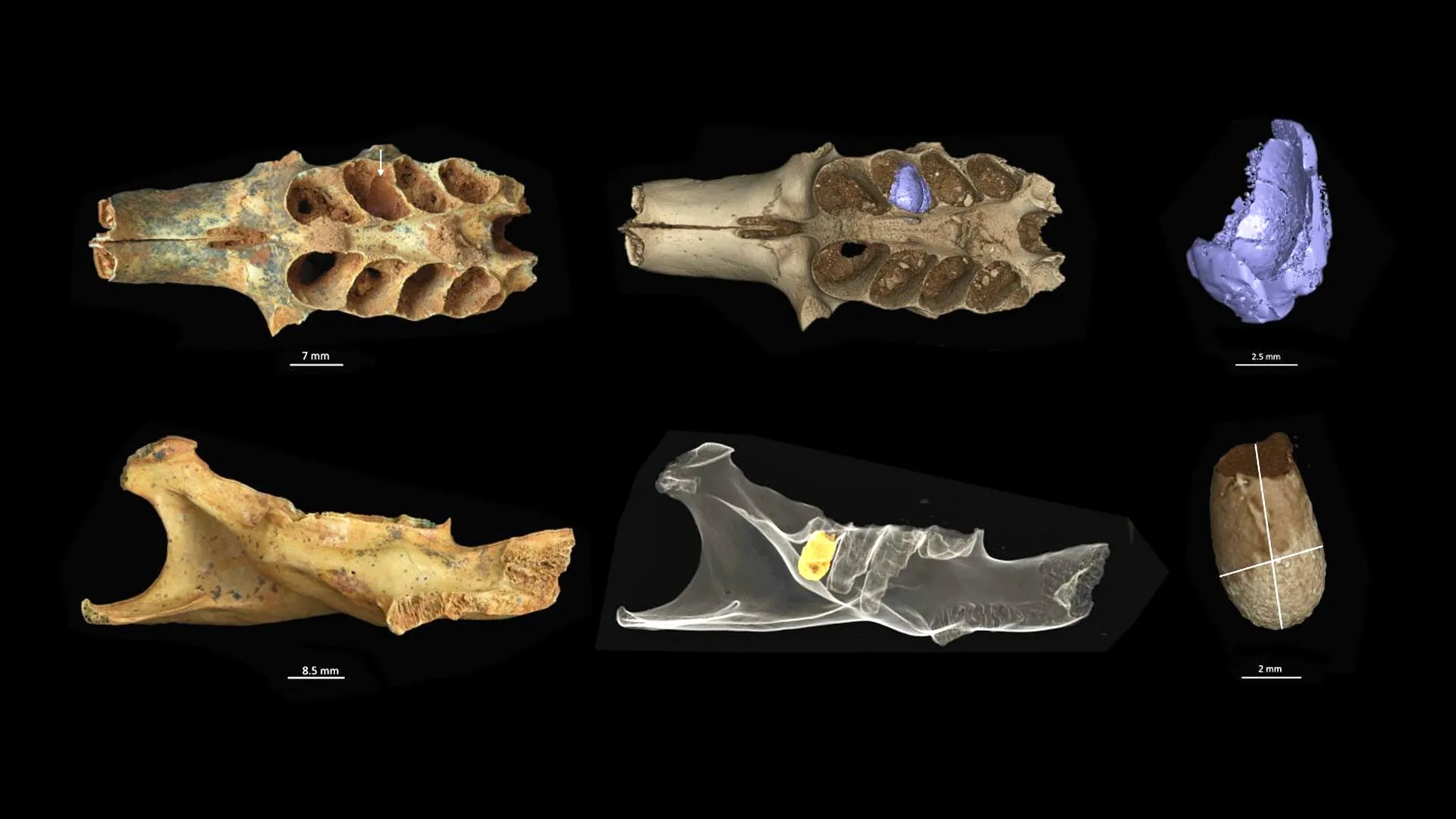
What initially seemed like an obstacle proved to be an extraordinary opportunity. The hutia’s jawbone, preserved by the cave’s stable environment, held a remarkable secret: the empty sockets, known as alveoli, where its teeth had once resided. These small, naturally formed cavities, though devoid of their original occupants, possessed dimensions that perfectly matched the bee’s requirements for a secure and protective nest. The smooth, consistent surfaces within these ancient bone structures offered an ideal micro-environment, a ready-made sanctuary for the bee’s developing brood.
This serendipitous discovery initiated a remarkable evolutionary shortcut. Over time, as more bees discovered these pre-existing cavities, a unique nesting behavior emerged. Instead of expending precious energy excavating entirely new tunnels in often challenging substrates, these bees began to utilize the hollow spaces within the fossilized bones as natural nurseries. This adaptation, refined over countless generations, created an intricate legacy: a record of ancient predation interwoven with the delicate architecture of insect life, preserved for the ages.
A Paleontological Surprise: Unearthing the Bee’s Ancient Habitats
The uncovering of this extraordinary phenomenon was not a matter of chance, but a testament to meticulous scientific observation and a willingness to question initial assumptions. Paleontologists, accustomed to meticulously cleaning excavated fossils to reveal their bony structures, often remove all extraneous material, including any sediment or organic matter lodged within cavities. However, in this instance, a doctoral student, Lazaro Viñola Lopez, working at the Florida Museum of Natural History, deviated from this standard practice.
Viñola Lopez was engaged in a significant excavation project at Cueva de Mono in the southern Dominican Republic, focusing on a species of hutia that was remarkably rare in other parts of Hispaniola. The sheer abundance of hutia fossils discovered at this site suggested that Cueva de Mono had served as a long-term, favored feeding ground for giant barn owls, a behavior known as a pellet roost. These owls, generation after generation, would have repeatedly brought their prey to this sheltered location, creating a rich archaeological deposit of skeletal remains.
Instead of immediately clearing the hutia jaws, Viñola Lopez, driven by an innate curiosity and a keen eye for detail, chose to inspect them closely. His attention was drawn to a particular cavity whose inner surface presented a stark contrast to the rough, porous texture of bone. This cavity was unusually smooth, a subtle anomaly that hinted at a story beyond simple skeletal preservation.
From Suspected Wasps to Confirmed Bees: A Case of Mistaken Identity
The smooth interior of the cavity immediately sparked a memory for Viñola Lopez. He recalled a similar observation made years earlier in Montana while excavating dinosaur fossils. At that time, he and his colleagues had discovered what appeared to be wasp cocoons embedded within the fossil material. His initial hypothesis was that the same explanation applied to the current discovery, and he entertained the idea of writing a brief report on the presence of wasp nests within the hutia mandibles.
He shared this preliminary theory with a fellow doctoral student, Mitchell Riegler. Riegler, initially occupied with other research, was somewhat dismissive, describing the idea as a "niche project." The concept lay dormant until Riegler accepted a challenge from a former advisor to complete a scientific paper within a week, a competitive exercise that encouraged rapid analysis and writing.
During this intensive week, Viñola Lopez and Riegler revisited the fossilized jawbones. Their initial assumption that they were documenting wasp nests began to falter as they delved deeper into research on ichnofossils – traces of past biological activity such as footprints, burrows, or nests. A crucial detail emerged: wasp nests are typically constructed from chewed plant material and saliva, resulting in rough, textured walls. In stark contrast, the structures they observed within the hutia alveoli possessed exceptionally smooth interiors. This characteristic is a hallmark of bee nests, which are often lined with a waxy secretion produced by the bees themselves. This secretion creates a waterproof, polished surface, providing an optimal environment for larval development. The realization was profound: they were not dealing with wasps, but with bees.
A Rare Behavior, Amplified by Opportunity and Preservation
The correction of their initial identification elevated the significance of their discovery exponentially. The use of pre-existing fossil structures by burrowing bees without any modification is an exceptionally rare behavior, with only one other documented instance of bees nesting within a cave. Furthermore, this specific behavior, where bees simply occupy natural cavities rather than excavating them, is unprecedented in the scientific literature. While a previous report mentioned bees drilling into human bones, this involved an active alteration of the material, a process distinct from the passive occupation observed in the hutia fossils.
Recognizing the profound implications of their findings, the researchers recalibrated their approach. They transitioned from a hasty preliminary report to a more comprehensive and in-depth study. This involved consulting with experts in modern bee behavior and conducting extensive reviews of existing scientific literature. Viñola Lopez even returned to Cueva de Mono to conduct further geological surveys, examining the cave’s stratigraphy to better understand the depositional history of the silt and the context of the fossil finds.
The Cueva de Mono site itself faced a significant threat during the research period. Plans were initiated to develop the surrounding land, which included a proposal to convert the cave into a septic tank. This impending development posed an immediate risk to the invaluable paleontological record contained within. Fortunately, the research team acted swiftly, launching a "rescue mission" to recover as many fossils as possible before any irreversible damage could be inflicted. This urgent endeavor proved successful, yielding a substantial collection of fossil material that further enriched their study.
Beyond the Jaws: Diverse Fossil Habitats for Ancient Bees
The final, comprehensive study revealed that the unusual nesting behavior of these ancient bees was not confined to the jawbones of the hutia. The researchers identified bee nests within a variety of fossilized remains, painting a broader picture of their opportunistic adaptation. In one striking instance, a nest was discovered nestled within the pulp cavity of a sloth tooth. These large, herbivorous mammals, once a prominent feature of the Caribbean fauna, had largely disappeared following human arrival on the islands. Another nest was found within a hutia vertebra, occupying the space that had once housed the animal’s spinal cord.
Advanced imaging techniques, such as CT scans, provided remarkable insights into the nesting patterns. These scans revealed that some cavities contained multiple layers of nests, indicating a remarkable degree of reuse. Rather than excavating new tunnels, certain bee species demonstrated a preference for occupying existing, empty cavities, stacking their nests one inside another, akin to the nested structure of Russian dolls. In one remarkable alveolus, six distinct bee nests were identified, one meticulously placed within the other. This behavior suggests a sophisticated understanding of resource availability and a highly efficient strategy for reproduction.
The Karst Landscape: A Driving Force Behind the Bee’s Migration
The researchers also proposed a compelling environmental explanation for this peculiar nesting behavior. The region where Cueva de Mono is situated is characterized by karst topography, a landscape formed from soluble rocks, primarily limestone, which is prone to erosion and the formation of sinkholes and caves. This type of terrain is often sharp and angular, lacking the stable, well-developed soils typically preferred by burrowing insects.
Mitchell Riegler elaborated on the challenges posed by this environment: "The area we were collecting in is karst, so it’s made of sharp, edgy limestone, and it’s lost all of its natural soils. I actually fell on it at one point, so I can tell you all about it." In such landscapes, any soil that does accumulate on the surface is easily eroded and washed into the underground cave systems. These accumulated pockets of silt within the caves, therefore, may have represented some of the only viable nesting substrates for burrowing bees in the region. The dark, protected environment of the cave, coupled with the presence of these relatively soft soil deposits, would have provided an attractive and secure alternative to the harsh conditions of the surface.
A Legacy in Stone: Unraveling the Cave’s Multifaceted History
The ongoing research at Cueva de Mono promises to yield further revelations. The team continues to analyze other fossils recovered from the cave, suggesting that this remarkable site holds many more stories waiting to be told. The study, published in the prestigious journal Proceedings of the Royal Society B, serves as a compelling testament to the intricate and often surprising ways in which life adapts and persists.
This discovery illuminates a profound ecological interaction that unfolded over millennia. The cave, once a site of ancient predation, transformed into an unlikely haven for a species vastly different from its original inhabitants. It underscores the interconnectedness of life, the resilience of natural processes, and the enduring power of scientific inquiry to reveal the hidden narratives embedded within the Earth’s geological record. The tale of the hutia, the owl, and the bees is a poignant reminder that even in death, life finds a way to flourish, leaving behind a legacy etched in stone for future generations to decipher.