The elusive nature of water, a substance fundamental to life as we know it, has long captivated scientists. While its common solid (ice), liquid, and gaseous (steam) states are familiar, the behavior of water under extreme conditions, particularly when cooled below its freezing point without solidifying, has revealed a deeper, more complex reality. Recent research has provided compelling evidence that supercooled water, existing in a liquid state below 0°C (32°F), can indeed manifest in two distinct liquid forms. These two phases, characterized by different molecular arrangements and densities, become indistinguishable at a specific thermodynamic point known as the liquid-liquid critical point. This groundbreaking discovery, achieved through sophisticated experimental techniques, sheds new light on the anomalous properties of water and has far-reaching implications for fields ranging from atmospheric science to biological processes.
Unveiling the Dual Nature of Supercooled Water
For decades, theoretical models and indirect experimental evidence have suggested the existence of two distinct liquid phases within supercooled water. These phases are hypothesized to differ in the arrangement of their water molecules. One phase, often referred to as the "low-density liquid" (LDL), features molecules that are more ordered and form a more open, tetrahedral network, similar to the structure of ice but still maintaining liquid mobility. The other phase, the "high-density liquid" (HDL), exhibits molecules that are more closely packed, with a less ordered arrangement, allowing for greater fluidity.
The challenge for experimentalists has been to directly observe and differentiate these two elusive liquid states. At ambient pressure, water typically freezes at 0°C. To achieve supercooling, water must be meticulously purified and protected from nucleation sites – impurities or imperfections that can trigger ice crystal formation. Even then, as water cools further, it becomes increasingly unstable, and at around -38°C (-36°F), it spontaneously freezes. This phenomenon, known as homogeneous nucleation, sets a limit on how far water can be supercooled under normal pressures.
The key to overcoming this limitation and probing the liquid-liquid critical point lies in manipulating both temperature and pressure. Scientists have employed high-pressure techniques and carefully controlled cooling rates to suppress ice formation and explore the thermodynamic phase diagram of water. The research in question leverages advanced laser-based spectroscopy to probe the molecular dynamics and structural characteristics of water under these extreme conditions. By analyzing how light interacts with the supercooled water molecules, researchers can infer information about their arrangement and vibrational modes, thereby distinguishing between the LDL and HDL phases.
The Critical Point: Where Two Become One
The concept of a critical point is fundamental in thermodynamics. For a pure substance, a critical point is the temperature and pressure at which the liquid and gas phases of the substance become indistinguishable. In the case of water, the liquid-liquid critical point represents a similar transition, but between two distinct liquid phases. At this specific temperature and pressure, the differences in molecular packing and density between the LDL and HDL phases vanish. The supercooled water exists as a single, homogeneous liquid phase, albeit one with unique properties.
The experimental determination of this critical point is a significant achievement. It confirms a long-standing hypothesis and provides a concrete target for understanding the underlying physics of water’s anomalous behavior. The location of this critical point is estimated to be around 64 MPa (approximately 630 atmospheres) and -70°C (-94°F), though precise values are subject to ongoing refinement. Reaching these conditions requires specialized equipment capable of generating and sustaining such high pressures while maintaining extremely low temperatures.
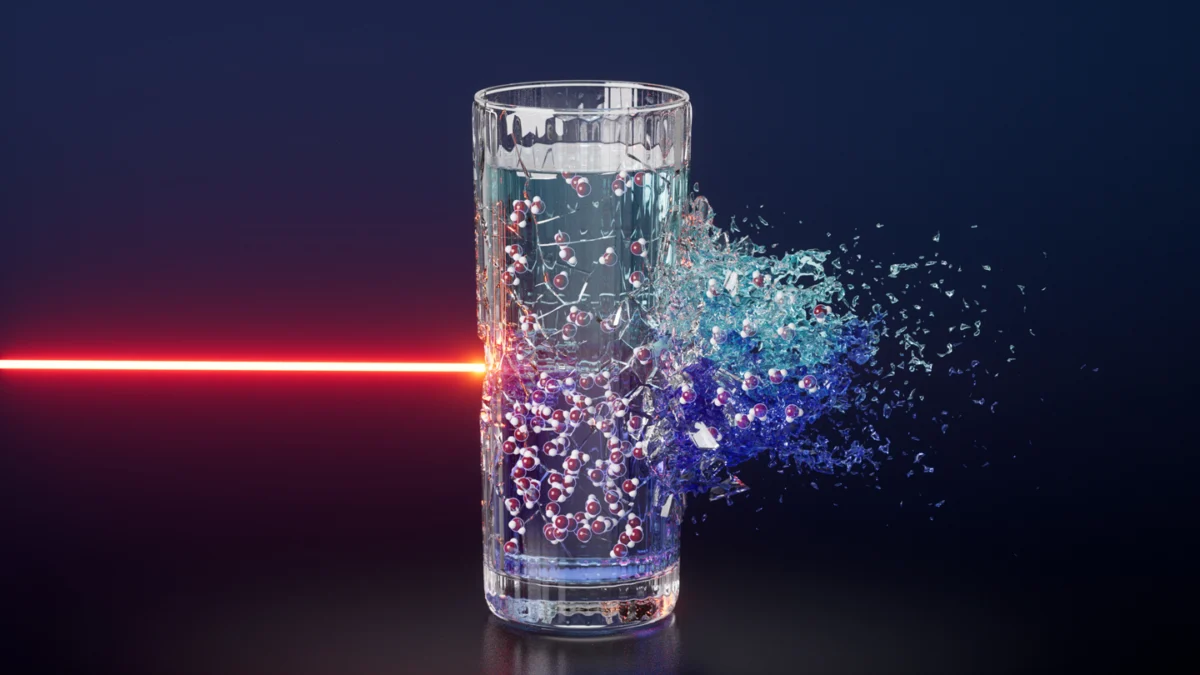
The illustration accompanying the research visually depicts this phenomenon. It shows a laser beam interacting with supercooled water. On one side, the water molecules are depicted as being more densely packed, representing the HDL phase. On the other side, the molecules are more spread out, illustrating the LDL phase. The implication is that under specific conditions, these two states can merge. The explosion of the glass in the illustration might be a metaphorical representation of the energetic interactions or phase transitions occurring under these extreme conditions, or it could relate to specific experimental setups involving rapid pressure changes.
Background and Chronology of Supercooled Water Research
The study of water’s anomalous properties dates back to the 19th century. However, the concept of two distinct liquid phases gained significant traction in the latter half of the 20th century with the advent of more sophisticated theoretical modeling and experimental techniques.
- Early Observations: Scientists noted that water could be cooled below its freezing point without solidifying, a phenomenon that defied classical nucleation theory.
- Theoretical Postulates: In the 1990s, theoretical physicists began proposing the existence of a liquid-liquid phase transition in supercooled water, suggesting a second critical point within the supercooled liquid region of water’s phase diagram.
- Indirect Experimental Evidence: Various experiments, including X-ray diffraction and neutron scattering, provided indirect support for the existence of LDL and HDL phases by observing changes in water’s structure and dynamics as temperature and pressure were varied. However, direct observation remained elusive.
- Advancements in Spectroscopy and Pressure Control: The development of techniques like Raman spectroscopy, infrared spectroscopy, and advanced diamond anvil cells (which can generate extreme pressures) allowed researchers to probe water at unprecedented conditions.
- Recent Breakthroughs: The current research builds upon decades of cumulative knowledge, utilizing these advanced tools to directly observe and differentiate the two liquid phases and, crucially, to identify the conditions under which they become indistinguishable – the liquid-liquid critical point.
Supporting Data and Experimental Methodology
While the provided snippet does not detail the specific experimental methods, typical approaches for probing supercooled water at high pressures involve:
- Diamond Anvil Cells (DACs): These devices use two opposing diamonds to compress a tiny sample of water to extremely high pressures, often hundreds of gigapascals.
- Cryostats: These are cooling systems capable of reaching temperatures far below freezing.
- Spectroscopic Techniques:
- Raman Spectroscopy: Measures the vibrational modes of molecules, which are sensitive to their local environment and structural arrangements. Differences in Raman spectra can indicate distinct molecular configurations.
- X-ray Diffraction: Provides information about the average distance between atoms and molecules, offering insights into the overall structure and density.
- Neutron Scattering: Similar to X-ray diffraction but more sensitive to hydrogen atoms, providing detailed information about hydrogen bonding in water.
The image caption indicates that lasers were used to probe the supercooled water. This could refer to spectroscopic techniques like Raman spectroscopy or potentially to methods involving light scattering to measure properties like density fluctuations, which become very large near a critical point. The illustration of the laser beam hitting the glass and causing it to explode might allude to the use of high-intensity lasers that can induce rapid heating or pressure changes, or it could be a visual representation of how probing these unstable states can lead to dramatic events.
Implications for Science and Technology
The confirmation of the liquid-liquid critical point and the existence of two distinct liquid phases in supercooled water has profound implications:
- Understanding Water’s Anomalies: Water exhibits numerous unusual properties, such as its maximum density occurring at 4°C (39°F), its high surface tension, and its ability to dissolve a wide range of substances. These anomalies are thought to be intimately linked to the complex network of hydrogen bonds between water molecules and the existence of different structural arrangements. The LDL/HDL hypothesis offers a framework for explaining these peculiarities.
- Atmospheric Science: Supercooled water is a crucial component of clouds at temperatures between 0°C and -40°C. Understanding its behavior under varying pressures and temperatures is vital for accurate weather modeling, precipitation forecasting, and understanding phenomena like hail formation and aircraft icing.
- Biological Systems: Water plays a central role in all biological processes. The unique properties of water, potentially influenced by its different liquid states, could have implications for the folding of proteins, the function of enzymes, and the transport of molecules within cells.
- Materials Science and Chemistry: The ability to control the properties of water by manipulating its liquid phase could lead to new applications in areas such as solvent design, cryopreservation, and the development of novel materials.
- Fundamental Physics: The liquid-liquid phase transition in water serves as a model system for studying critical phenomena and phase transitions in other complex fluids. It pushes the boundaries of our understanding of condensed matter physics.
Future Directions and Unanswered Questions
While this research represents a significant leap forward, several questions remain:
- Precise Location of the Critical Point: Further experiments are needed to refine the exact temperature and pressure values of the liquid-liquid critical point.
- Dynamics of Phase Transitions: The speed and mechanisms of transitions between the LDL and HDL phases, especially under different conditions, are still areas of active investigation.
- Role of Impurities: How do dissolved solutes and impurities affect the liquid-liquid phase transition and the location of the critical point? This is particularly relevant for biological and environmental contexts.
- Thermodynamic Stability: The exact thermodynamic stability of each liquid phase in different regions of the phase diagram is a subject of ongoing debate and experimental verification.
The continued exploration of supercooled water promises to unlock further secrets of this ubiquitous yet extraordinary substance, potentially leading to unforeseen technological advancements and a deeper appreciation of the fundamental principles governing our universe.